Showing posts with label suffering. Show all posts

Sunday, July 19, 2026

Words, and Hearts, and Saints

Part of my morning prayer routine is invoking the intercession of my prayer team of saints. I have a standard team that has been with me for I-forget-how-many-years, as well as my patron saint that changes every year at the beginning of Advent, and those I've added as I intercede for several specific individuals in my life.

My relationship with my standard team has been evolving, especialy over the last year to two. And by that, I mean that I'm aware of a change of need in what I think of as their "department." Essentially, I'm asking the Lord for different things.

My team consists of several pairs and a triad: St. Teresa of Jesus and St. John of the Cross; St. Teresa Benedicta of the Cross (Edith Stein) and St. Therese; Holy Father Elijah, St. John the Baptist, and St. Cecelia; and St. Joseph and our Lady of Mount Carmel. They are my constants.

I consider my triad my "words" department. And as I stop and ponder, the recent changes in my life where my "words department" is involved is somewhat overwhelming to take in. As my reality has changed, my prayer has adjusted to it.

For years I have prayed that my words would become a means through which God's power could be made known. I eventually adjusted that to specify the words that I speak, the words I write, and the words I sing, since that covered three major areas of my life. I changed that to include the words that I think, and the words I meditate on or ruminate on, because I realized the importance of what I let go through my mind. I've now added "the words that I battle with in my mind," because I had to admit that some of the words going through my mind are temptations. They come with an agenda to get me to doubt that I am loved and designed for intimate communion with The Word Himself. And my ultimate petition here is that my words in every category would arise from the place within me where I seek to live this union with God.

Words have always been important to me, but I've realized in the last year especially how trauma had impacted my "voice," making speaking up and speaking out -- in some moments and on some levels -- physically impossible. Big shout out to EMDR therapy for reaching into the depths to heal that. 

I feel like I'm exiting a season of healing and excavation, and entering a season of healing and activation. "Use your words" takes on a whole new meaning, here. "Out of the abundance of the heart, the mouth speaks" is true in many ways. I was in a setting recently where I was told I appeared very confident, facing the prospect of a task that would require meeting strangers at their worst, most vulnerable moments. Do I feel ready for that? Of course not! It's very unsettling. But I can indeed find words there if I have gotten comfortable with my own worst, most vulnerable moments. And frankly, the Lord has been walking me through just that. 

So our words (or lack thereof) show our hearts. Our hearts, in the Lord's hands, are safe, despite their breaking and aching, and all the scary traffic in and out of them. Our words reflect the truth of hearts back to ourselves in ways that can be incredibly hard to swallow. But our heart is exactly where the Lord wishes to meet us, exactly as we are.

Friday, June 05, 2026

Infilling of Love

Over the last year I have been actively grappling with the Scripture verse which was the Communion Antiphon of today's Mass. It's a verse I have tripped over interiorly for decades, and I've written about it before: "Whoever wishes to come after me, must deny himself, take up his cross, and follow me, says the Lord." (Matthew 16:24). 

It's that phrase "deny himself" that I have struggled with without being able to put words on the struggle until recently. 

I wrote my essay on St. John of the Cross in my third term of my Spiritual Direction Formation Program on what this verse does and does not mean. It does not mean self-abandonment, where one perpetuates the denial of one's own needs. John's context for climbing Mount Carmel and desiring "nada" is the overwhelming love of God.

This term, I am writing an essay on St. Therese and the Little Way, and again my theme is that it was God Himself in revealing Himself to her who caused her to understand that the embrace of her littleness, her vulnerability as they key to sanctity, not as something to be ashamed of or to try to overcome through effort. 

When I heard this verse recited this morning, my mind immediately translated it in a very new way for me: "If you want to follow me, you had better be convinced that I am God Almighty, full of love and compassion, even in the cross." In other words, if you want to follow Jesus but aren't sure He's Love, you are going to be very disappointed here, because the Christian life is designed to empty you. And you're only going to go for that if you believe God will fill you beyond what you lose in the emptying. 

It puts an entirely different light on the matter for me. God is not applauding when we make ourselves suffer by believing our basic needs don't matter. Suffering doesn't sanctify. Suffering is an evil. Making space for the infilling of Love is in a completely different category.

Friday, April 24, 2026

Just Look

A long time ago, when I lived in Japan, I had a dream that has stayed with me. In this dream, I was in my 6th grade classroom (the most difficult students of my six classes), and in the front of the classroom, Jesus hung on his cross. But my attention was drawn to the Blessed Virgin Mary. At first, I was observing her being present to Jesus on the cross. She was so deep in empathy with him, and so full of understanding of what His act there meant, and also so aware of the need of the people around her. Then she caught my gaze, watching her, and beckoned me to enter in to her experience and make it my own. I don't know that she spoke in the dream, but what was communicated to me strongly was the plea "Just look. Just look at Him." Somehow, looking at Jesus on the cross was key for me and for everyone else present. Mary seemed to keep this gaze perpetually in her heart, even when her attention was fixed on me or the others. What was most striking was the point in the dream where we both turned our attention to the other people in the room, which included some of my students and several other random people I either knew or didn't know. They were all chatting with each other or engaged in something and it was extremely difficult to get their attention. They were completely oblivious to Jesus, who hung immediately before them. I remember the type of anguish this caused Mary. She did not force anyone, but she was very sad and searched with an insistent heart for someone who would break free and look at Jesus.

It has been at least 30 years since I had this dream, and I have meditated on what it teaches me regularly. What it speaks to me these days harkens back to Moses and the bronze serpent and John 3:14-15, where this is directly compared to Jesus on the cross. In the account in Numbers, the Israelites' faith in God's goodness was not developed at all; they hardly had faith in Moses who had led them out of Egypt. They objected to their freedom from slavery if it meant dying of starvation, thirst, and discomfort. Can you blame them? Even the slavery we know can feel safer than the freedom we are on the way to, but aren't yet embracing. Then they had another crisis: people were being killed by venomous snakes, and they are jerked back into the present moment by their need for safety. They turn to Moses for help, and remember that he has this mysterious access to God who he says freed them from slavery. Ask God to take this crisis away, they say. God's answer to Moses is to make a bronze serpent and hang it on a pole, and if they look at it, they will be healed. 

The serpent was their crisis. It was what was harming them. It was their death. It was their reality. God has Moses tell them to look at it, for healing. 

And as Moses lifted up the serpent in the desert, so must the Son of Man be lifted up, so that everyone who believes in him may have eternal life. (John 3:14-15)

What does one see looking up at Jesus on the cross? On the literal level, we see a bloody, crushed, humiliated, agonizing man. A human being, just like us, who is immersed in a human experience of immense suffering. Spiritually, we see more than this. We see salvation, the Savior of the world entering into our human experience, not out of his crisis of sin, but out of an outpouring of love and the desire to be-with. 

And the response of the fully graced one, the response of the Church, is to say: Look! He entered your pain for you! Now, you, enter your pain for you! Meet Him there, and receive freedom and healing from it!!

The task of receiving our salvation is not to parrot some religious formula prayer to "make Christ our savior." We are called rather to recognize the crisis of our hearts, what is harming us, what is killing us. Look. Just look. At Him. It's all present there; He's gone before us to get there. God doesn't create a magic world where there is no suffering. When you look at humanity, you can realize that our freedom demands a capacity to choose badly. Jesus' choice was to enter it. The Father didn't have bloodlust in allowing His Son to die; the Son had the yearning of love to not leave us alone in our pain, but to meet us there to free us and to open up the path for His supernatural life to live in us, to return us not only to our true selves, but to divinize us.

And then, what is more, the fruit of the tree of life, the cross, is the Eucharist. Again, we don't just experience a ritual eating of a wafer; we feast on His act of handing over Himself as the very path for supernatural life to enter us, which it does through the faith that receives Him, daily if we want (in many places in the world). Daily, this supernatural transformation can be activated, and we look again, with today's burden, today's need, today's mission. We need this daily food; we are commanded to it at least weekly, in celebration of the resurrection, because Good Friday was not the end, it was the catalyst. Our suffering, our pain, our harm is not our end; let it be the catalyst which forms our purpose, our innermost self, our mission in this world, to turn and draw others to JUST LOOK

Just look, have faith, be healed. 

Wednesday, March 25, 2026

There's Abandonment, and then there's Abandonment

 Right now, I really need the consolation of coming home from Mass in the morning and sitting down to write. 

It's the feast of the Annunciation, and on this date in 1997 I left Japan and returned Stateside. I was leaving a very painful era of my life behind. It was a time of deep isolation which I tried to patch up with a bad relationship which I got swept up in against not only my better judgment, but in an embodiment of what I now know as self-abandonment. I understand self-abandonment to mean a set of learned behaviors that began in survival when a child felt unloved, unsafe, uncertain, insecure, and those learned behaviors reinforced the idea that the child's basic humanity was the problem in the equation. Where she felt unloved, she became hard and aloof. Where she felt unsafe, she locked herself up and away from threats. Where she felt uncertain, she may have become the mastermind that figured everything out. Where she felt insecure, she hid herself away. 

This trend did not start when I lived in Japan, but it intensified. And it unfortunately locked into place a lot of trauma that I have only recently addressed and dismissed. And I chose to leave it all behind on the feast of the Annunciation, symbolically saying Yes to a new lease on life. 

If only symbolic actions took care of everything. 

Today it is the Feast of the Annunciation again. Again I am saying Yes to the will of God as it plays out in my life. I have just experienced a very significant relationship in my life rupturing. I'm not going to write about the details here, but while I have been well primed for this Yes, having exercised my will in case this day was necessary, it also ruptured very quickly, and so I am left dealing with how stunned I am. 

Feelings and thoughts billow through my mind and my body, tumbling wildly, gently, tiredly, sadly. What I know is that I am not the victim of my self-abandonment any longer. I used my voice, I owned my needs, I stated my needs and pursued them being met, I accepted the rupture, and I moved away. I was not stuck in fear, in self-pity, or without an ability to voice my anger or my love. I did a damn good job with it.

I now know viscerally that being a human being is a good thing -- in fact it is a glorious thing. It is beautiful. It is not to be apologized for, disowned, flattened, or dismissed. Human love is typically so flawed; there are always hurty edges and messy bits. We go in directions that bring us healing and reveal our weakness at the same time. C. S. Lewis famously said in his work The Four Loves: 

To love at all is to be vulnerable. Love anything and your heart will be wrung and possibly broken. If you want to make sure of keeping it intact you must give it to no one, not even an animal. Wrap it carefully round with hobbies and little luxuries; avoid all entanglements. Lock it up safe in the casket or coffin of your selfishness. But in that casket, safe, dark, motionless, airless, it will change. It will not be broken; it will become unbreakable, impenetrable, irredeemable. To love is to be vulnerable.

There is so much potential for pain in love, and yet God is love. The pain in us is part of the transformation and the mystery and the gift we become when we choose union with God and choose love.

St. Therese in her Little Way writes about abandonment to God. This is really the polar opposite of the self-abandonment. When she was a little girl, she believed she saw the capital letter T in the sky, and she told her father that God had written her name in the heavens. She then asked him to lead her by the hand, because she didn't want to look at anything on earth, but throw her head back and get lost in the contemplation of the heavens as they walked. Abandonment to God is giving oneself totally up in the ecstacy of the interior embrace of the loving God, writ large in the world that reveals it. It moves one beyond feeling loved, safe, certain and secure -- it is an immersion into Love itself. It is also a transformation into a soul of mission of being love. 

Towards the end of another dark time of my life, when I was on pilgrimage in Poland, I heard the call clearly that I am called to love everyone. I was struggling with the loss of another friend, as well as an ongoing silence with another. I really struggled to love even one person when that call came through. I'm in a very different kind of place with my circumstances today. I've made a commitment to love which now takes on a cruciform -- so be it. My name doesn't start with T, but I see God showing me my call writ large in my world, and I too want to throw myself open to God's will, which is love and mercy itself. I am weirdly bouyed up in knowing I am loved by my partner in rupture. But what I need now more than ever is that immersion in God who is Love, and to walk by that trust into new paths. So I say Yes with Mary to the God who does all manner of amazing, impossible things.

Friday, March 06, 2026

Trauma-Informed Lent

I'm not trying to be trendy with this title; I'm trying to share my heart. 

For roughly the last nine months, I've been seeing a therapist who has a specialty in trauma work. Why, you say? Well, as I progressed through my Spiritual Direction Formation Program, I realized I had both childhood and adult trauma that I needed help addressing. Now I only wish I had started this process decades ago. It  has been incredibly freeing, like it would be freeing for someone to get rid of sciatica pain, but who had somehow spent so long with it they no longer recognized it wasn't the body's intended function. 

Both trauma and its resolution has impacted a lot in me, but for right now I want to look at how trauma had distorted Lent in my mind for a long time.

St. Paul reminds us that our thoughts are vital to our spiritual life. "Take every thought captive" and make it obedient to Christ (2 Cor. 10:5); "set your mind on things above," (Col. 3:2) and "whatever is true, noble, right, lovely... think upon these things" (Phil. 4:8) are examples written to three different cities' communities of believers. In other words, this was standard in his instruction of how to be a Christian. It does make a presumption, though. It presumes that people had already learned to seperate which thoughts were obedient to Christ, true, good, and from heaven -- from those that came from and led to disobedience, lies, bad, and from hell. 

Experience tells me that we life long Christians can make serious mistakes here. If I think it all the time, it must be true and good. Right? Right

Enter trauma to seriously mess with your mind. If the wheat your life long Christianity has mixed with the weeds of childhood trauma, you might just be clinging with all your religious might to things that definitely are not true and good. But they are so familiar, so worn in, so me that, certainly I must be understanding this correctly. After all, I'm a Christian

This is why we have the famous saying "anyone who takes himself for his own spiritual director is the disciple of a fool." We need to receive input from others to know ourselves.

I want to share a prayer we hear at daily Mass during Lent to illustrate how we can twist truth around our trauma, and believe we hear God confirming us in our dysfunction. From Preface II for Lent (italics mine):

...For you have given your children a sacred time
for the renewing and purifying of their hearts,
that, freed from disordered affections,
they may so deal with the things of this passing world
as to hold rather to the things that eternally endure.

Now, I have nearly a Master's degree in theology, but I'm telling you that my trauma did not care about that. I also have a BA in English, and I understand words well, but my trauma also did not care about that. My trauma latched on to emotional content, especially anything that struck fear of loss or demand for a certain kind of herculean  moral performance.

Disordered affections? This meant affection, attachment, and human feeling were ultimately bad news, and being a good Christian meant being willing to live without these, ready to rip them out, trample them underfoot. Yes, I know the prayer really means that a good, created thing like affection needs grace to raise it from the natural level (by that purification mentioned above it). But in the past as I prayed this, I baptized the voice of trauma and practiced steeling myself against my own humanity.

Dealing with the things of this passing world? Ok, what passes away. Voice of trauma says: the reliability of others. A sense of safety. A sense of others acknowledging I have intrinsic worth. What things eternally endure? I have to be the responsible one. The buck stops here. Maybe if I hold my breath long enough I will finally be able to escape.

Yeah, no. 

If you would have asked me for an analysis of these prayers in any recent year, I would have been able to theologically parse exactly what they really mean. But deep down, I would have found it hard to believe or connect the explanation to my experience. 

But today when I heard this at Mass, I heard it differently. I heard that the Lenten observance purifies my mind from clinging to lies and fears. I heard that the lost little one within who clung in fear to herself can in fact open more deeply to love and to life. God is love, love is eternal, and Jesus is right here with me all the time! His love fills me, and of course I'm going to love all the things He made; they're His! For me! And all the people He made -- they eternally endure, too. Some are harder to love, because they are curled up, clinging in fear to themselves, too. But just like trauma shapes us, love shapes us, too. It renews and purifies. We deal with the world by loving. So we already live in what eternally endures. Disordered affection means we don't love like Jesus. He puts things right so that we can. His love went to the cross, that place of ultimate shame and pain, taking our sin.

Freedom from disordered affection is when we allow Jesus to meet us right there: in our shame and our pain, and our sin. Jesus has been there the whole time. We are the ones who really can't bear to look up at Him, as long as we are curled up on ourselves. Sometimes tying ourselves down tighter with ropes made from religious words. 

God Himself will set me free from the hunter's snare.
   From those who would trap me with lying words  (Lenten responsory, Morning Prayer)


Tuesday, December 10, 2024

Seeking God, or Self-Harm?

This morning as I settled into my prayer time, I picked up Divine Intimacy and flipped to the entry for Tuesday of the Second Week of Advent. In a few pages, I realized I have found the key to something I wrestled with for years, and have struggled to put in to words, even after the struggle subsided.

The text asks, essentially, why is it hard to know God is present with me? The answer is that God hides. The method put forth to deal with that hiding is "to detach oneself, deprive oneself, renounce oneself, annihilate oneself, to die spiritually to oneself and to all things" (p. 32).

Leaving it at that is where I stumbled for years. As a teen, and even as an adult in some circumstances, I was pretty adept at things like going without food or water because I was too shy, hesitant, feeling-like-a-bother to ask for what I needed. Subtly I was firm in my opposition to my flourishing and even my existence. Is that the kind of detachment and self-deprivation that brings about revelation of God? Is that death to self? It never felt right to believe that was what Jesus was talking about, but my mind didn't know what else to do with that. 

The quote from St. John of the Cross there is actually this: 

It is to be observed that the Word, the Son of God, together with the Father and the Holy Spirit, is hidden, in essence and in presence, in the inmost being of the soul. Wherefore, the soul that would find Him must go forth from all things according to the affection and will, and enter within itself in deepest recollection, so that all things are to it as though they were not... God, then, is hidden within the soul and there the good contemplative must seek Him with love (Spiritual Canticle, 1, 6)

There's that huge, important missing piece: God is hidden in the inmost being of the soul. God is not hiding in a box or behind a garbage can somewhere. He hides within the soul, at least by His capacity to dwell there, if not through the indwelling presence given in baptism. 

The text goes on:

St. John of the Cross continues, "He that has to find some hidden thing must enter very secretly even into the same hidden place where it is, and when he finds it, he too is hidden like that which he has found. ... This is a new invitation to detachment -- to forget everything, to withdraw from everything -- in order to enter into the depths of your soul, the place where God hides Himself (p. 33)

I'm not meant to learn to deprive myself of food; I'm mean to deprive myself of what restrains me from eating. I'm not meant to go a day without water while staring for hours at a spare water bottle my friend has in the car (true story). I'm meant to forget the knots I tie myself into instead of caring for my need. The true physical, emotional, psychological needs I have are in fact needs because I am a spiritual being designed to seek and find God. They serve my ultimate end, which is union for God. They are meant to be met, and posthaste, but not for their own sake. 

Along with God being hidden in the inmost being of my soul, all the enemy territory is also there. All those lying beliefs about how it would be better if I didn't exist. All of those subtle motivations to pride and self-harm. This is why it can be such a battle to even go within in the first place. God hides among our mess.

But, the beautiful journey is to go within, and there to "forget all that is thine, withdraw thyself from all creatures, and hide in the interior closet of thy spirit" (Spiritual Canticle 1, 9). There it is that no one, and nothing else matters, but seeking the One alone, because He alone suffices. Finding Him, my spouse, my children, my friends, my achievements, my talents, my possessions, my health -- they all fade there. There I embrace the nada. There I flee what is superficial and external, and cling wholly and completely to what is God.

This actually sharpens our love for all persons and created goods, because we can see more clearly what they are all for, and their preciousness.

There God defeats our enemies and unfurls the flag of His love, now planted firm in territory fully ceded to Him. 

Monday, July 29, 2024

Hiking, Love, and Transformation


Eight years ago, I hiked in the Tatra mountains. Come to think of it, it was exactly this time of year I was there. The scenery was beautiful, but it was an emotionally wrenching time. Also, hiking sounds glamorous but it was grueling. At one point, my then-11 year daughter asked me why in the world we were doing this. I told her that at some point in her life, someone would use the metaphor of climbing a mountain, and this would teach her what that really means.

St. John of the Cross famously uses the metaphor of climbing Mount Carmel for growth in the spiritual life. Since he traveled all over Spain by foot, even though he was no soft modern, unaccostomed to physical effort, I'm sure he fully intended the implication that the human effort part of spiritual growth isn't easy.

One thing I remember doing often on the Tatra hike was stopping for rest and looking back down the path I had just come up, and then looking ahead to how much farther to our destination. I took some photos, fully thinking that when I got back home I would appreciate their beauty. At the time I was just trying to catch my breath, wipe some of the sweat off my face, give my aching feet and legs a momentary break, not think about whether I was going to need to pee in a nearby bush nor about the painful relationship issues that were clanging around in my heart, and will myself to move forward again. 

Today I had reason to pause interiorly and look down the mountain I've been climbing spiritually. I was challenged by the reading we studied in my Carmelite community formation yesterday, where St. Therese talks about how she learned what the Lord means by His command to love one another "as I have loved you." She talked growing in specific, active acts of charity for two particular Sisters that she could not stand. 

I've read Story of a Soul now countless times, and of course the Lord's command to love is not a new thing to me. But I was both convicted by this, and led to take this particular pause on the mountain and look back down and my lived reality, in order to start back up differently.

What I saw clearly in looking back is that in my early life I developed a thick, defensive shell against the people around me. I was a well of pain, and felt I personally was the cause of every broken relationship and every moral failing around me. The defensive shell kept me from feeling my own pain and perceived failures, and kept other people at a distance so they could do me no more harm. Both the well and the shell grew with me, never quite adequate for my need. I was constanly anxious to pull myself in.

God was at work by His grace, even as I was at work strictly regulating human contact. He had a much easier time reaching directly into my soul to bring me what consolation I would allow in. Increasingly, he would use the ministrations of people, and so by the time I was an adult I had let a couple of people into my circle of trust. Mostly, these were people I did not actually interact with except by an exchange of letters or a visit every couple of years. But they were like pilot lights to me that kept me alive. That was all I allowed. Mostly I learned to endure people, or to cope until I could escape their presence and actually relax and breathe. Hah, who am I kidding. Relax? I escaped their presence and crumpled into an anxiety I never even let myself feel. 

The process of grace transforming my heart made its steady progress, despite my lack of understanding (mostly) of the problem or the cure's path.

A key moment in this hike was clearly visible today. I remembered a crisis conversation I had with my pastor and a small group of people where I had managed to create a lot of hurt. My pastor simply pointed out that God called me to love everyone equally. I felt as if he was asking me to juggle boulders, because just then my felt choice was between hating everyone and allowing God to help me authentically love one human being in my faulty way. "Loving everyone," if I was honest about it, was nice Christian gibberish to me.

He had the right answer. But it was lightyears from my experience, because I was still operating in the mode of allowing, possibly, one person at a time into my trust. Except this time, it was a real person. It reminds me of a scene from some TV show I saw ages ago where a psychopath would steal female corpses and tie them to a table in a freezing room, pretending to have dinner with them, and then he finally kidnapped a living woman he admired and tried to do the same with her. He saw this as great personal growth. He was the only one with this perspective. 😏

When I was in Poland, same trip as my Tatra hiking experience, and a few years after that difficult moment of counsel from my pastor, I had an experience of being prayed with by some Polish-speaking women. One paused as she was praying, and said to me in English, "God calls you to love everyone." The Lord had said the same thing to me in prayer a few days before. This is how patiently God works our transformation. As soon as we are ready to open our hearts for more, He's there with what we need.

And as I climbed the Tatras, I struggled with a different real-life relationship, and felt the grueling process of handing over to the Lord the hard-fought trust in my friend that I had developed, and my fear that He would leave me, that His love wasn't real, wasn't enough, that my vision of the world that caused me to build shells and stare into wells in the first place were all there was to reality. I was trying to choose this loving everyone, or as the Carmelites call it, chastity. In reality it was a beautiful moment, but it was surrender at the point of exhaustion.

And then there's today. 

I am free, now. I came back from Poland with the unshakeable confidence and knowledge that God loves me. And a lot more has happened more recently than that. Today I know that the love God pours into me is eternal and infinite, and I do not need to bind my prey. We are all made with the same design, and we even all tend to malfunction in the same ways. I am called to love everyone with the Love God pours through me. And this is tested by those who are most disagreeable to me and where my natural bend towards self-protection activates. Like St. Therese, I can choose with my will to allow the Lord to love through me. And in fact, I am called to it

That's the thing, today. I'm free, and I get to choose what I do with my freedom. It's not just that loving everyone is possible or that it is a good idea. I am called, daily, to make decisions to do and to choose the loving thing. It's so easy for this to get bogged down and mired in psychology and just human evaluations of what is best and reasonable. But, going before the Lord and simply suiting up for growth in virtue and acts of charity is the key. My former pastor used to always say, "At least you can pray for them." I think I always heard that as a cop out. But to sincerely pray for a person you don't like to deal with is definitely an act of charity, not an act of dismissal. And I realize I need never be afraid, because I am never on my own doing this. It is not me who loves. I know, by looking down that mountain, that I just DO NOT HAVE a natural capacity for loving people. God had to reconstruct everything in me that is involved in loving. The fact that I do love is evidence to me that God has transformed my soul.

When I got to the top of our hike in the Tatras, we weren't, of course, at the top of the world. The mountain went on to the right and to the left. In fact, it was considered just a starting point for the more strenuous hikes. What I had climbed was labeled "Family Friendly hiking," meaning even children did it. I literally saw ladies in heels doing my path. I wonder what it would feel like to go do it again. By the time we got back to our cabin that evening, I could not walk because both of my knees were like water. 

This also teaches me something about the spiritual life. The small things we do (or avoid) every day impact greatly who we become. 

Let's start today and be diligent in allowing the Lord to love us, and to love through us.


Saturday, February 17, 2024

Joy Comes in the Morning


This morning as I enter into prayer, I find a strange gratitude welling up inside of me. Gratitude in general is unusual enough for me. But I review scenes of my past and find them a wellspring of gratitude that I wasn't expecting.

Let me be clear. I'm not grateful that these things happened. Bad things happen to everyone, and God is not some ogre who gets his jollies from this. 

When bad things happen, I at least (and I'm guessing this is rather true of everyone) become an expert wall builder. I don't want to feel the bad thing, so I wall it off. I snip the nerves that connect me to the experience. When you lay on your arm or leg and it goes numb, it feels heavy and useless, but it doesn't really hurt. It is after you free it that it starts to hurt. So a common and maybe subconscious reaction to emotional pain is to numb it, one way or the other. I have always done this with my mind. Some people do this with addictions. It's all the same mechanism, I think.

So part of the wonder is that all of this is now out of anesthesia. What was master is becoming servant.

I can trace through a whole list:
My father's mental illness and alcoholism, apparently in full swing already when I was born. His absence, in turn with my parents' fighting. My parents' divorce and my mother's stress and an utterly tumultuous relationship with my dad (for all of us). Feeling like a piece of furniture in a house rather than a member of a family. Gut-wrenching desperation and fear over chronic singleness, concurrent with toxic and sometimes abusive relationships with men who proverbially had red flags tattooed all over their faces. Anger and desperation over infertility. Spiritual confusion all along the way over what God's love actually is and layers upon layers of deception that I embraced. And the terror of trusting through actually being healed.

I am not grateful that a single bit of that happened. Except that last word, of course.

I am grateful to realize that God, by His Spirit, was closer to me than I to myself, through all of that. He never abandoned me. He never gave up on me. He never lost patience with me. 

Why didn't He stop it all? In answer to that, I'll invite you to watch Season 4 of The Chosen. In this world, things are unleashed. It's the way things are. Jesus did not come to stop the bad things; He came to go through them with us. He gave me the dose of grace I could handle, and infinitely more than I deserved as I consistently rejected and resisted His efforts to draw me closer sooner.

The end, the telos, of humankind is not a happy life on earth. We are made for something much more profound than that. We are made for union with God, forever in eternity, and with eternity starting now and entered into now. And as I see my past and see Jesus with me (which I absolutely, totally and completely, could never see in real time) I see the capacity I have within me now to receive the life of God into me. If I'm a thimble, God will fill me and I'll be a full thimble. If I'm a bowl, God will fill me and I'll be a full bowl. Swimming pool, crater, canyon. We don't have to make hollowing ourselves out a project; life does that. God will always, always, pour out Himself more abundantly than we can hold, because His love is always beyond our power to hold. Our work is to receive from Him and believe what He says.

And I know that whatever may come, this is the reality. I don't like pain and suffering. But I also don't have to fear it or dread it. Because God is faithful. 

Weeping may endure for a night, but joy comes in the morning. (Psalm 30:5)

Monday, June 19, 2023

Cleaning, Anxiety, and Magical Thinking

I feel things moving and changing in good ways. I've giving -- sometimes unintentionally -- developments a few days to marinate before I write about them. But I want to be sure to write, to grasp well the good things.

I had a revelation the other day about cleaning and housework. I know I'm not alone in having some odd emotional connections (or disconnections) where housekeeping is concerned. I've realized that as I am praying the Seven Sorrows rosary and handing over my anxieties and developing new practices, my emotional relationship with housekeeping is one of the moving pieces.

I have distinct childhood memories of cleaning out of anxiety. One memory is of knowing my mom was expecting some kind of business man coming for an appointment (insurance salesman, maybe a contractor, I don't remember) one certain late afternoon or early evening. Being the Gen-X kid that I was, I was home by myself after school on a regular basis for a couple of hours before my mom returned home from work in my elementary school years. So on this day, I knew that this appointment was coming, and I looked around the living room and saw it was a total wreck. I was anxious over the fact that the time was getting really close and my mom wasn't home yet. I couldn't let someone come into our house and see it be such a wreck, so I quickly got to work and cleaned everything. My mom came home at almost the same time that the man came for the appointment. When he left, she thanked me for cleaning up.

I also witnessed my mom stress-cleaning on occasion. I suppose the stress was induced by my dad's drinking and calling our house when he was drunk, because that was usually the thing. I know it left me in distress, too, but watching my mom stress-clean stressed me out all the more, and without knowing it I believe I drank in that the way to deal with emotional threats was to try to fix unrelated problems, such as our dirty sink. Magical thinking gets cemented this way, and carried over beyond the age of reason, I think, when there is no discussion or acknowledgment of the step that belongs between threat and response, i.e. coping strategy.

Ultimately, in my example, I was stressed because of my mom's absence and my sense that I, as a child, had to take on responsibility, rather than accept direction from my family's leadership team. Because there wasn't one. The way I understand it, my mom's stress led her to scour dirt, because it was something she had control over, unlike the relational mess of her former marriage. 

Fast forward to my adult life. Dirt is an objective reality of living in a house, regardless of what my emotional baggage contains. For many years I have noticed that whenever I go through a time where I feel emotionally strengthened, I clean and get rid of old junk with a good degree of joy. It's a feeling of liberation. But I've noticed as well periods of time where I avoid, avoid, avoid certain tasks. "I'm not a visual person," I say, and that is true. I don't get as easily bothered by clutter or grime as some people do. Plenty of times I have grumbled that other people could be helping me, even while feeling like asking someone to take on certain tasks wouldn't be quite right or good of me. I'm really the one who *should* do things, but if others spontaneously just knew and did, they would be higher quality human beings. So goes the endless ping pong game. Hiding inside, like cobwebs and giant dustbunnies, were a lot of unexamined and unresolved emotional issues that were fueling the endless back and forth between two losing options.

At holidays, I willingly welcomed the panicked stress-clean. We're having visitors, so, CLEAN! I treated this like a treasured childhood recipe, a necessary part of the celebration. Other times, I felt like the put-upon maid, the servant of my family, whose job it was to do everything because everyone else was lame (or a child). (Cue subsequent guilt and shame for these feelings.) There was also a good dose of, No, I'm not the maid, and I don't have to stress. And guess what? The house became a wreck. And I don't like that, either. So I plod along, just clean it, with mind turned off and tuned out.

So the revelation that has hit me is that there is another way to live with this. There is a way to find actual joy. I can approach housekeeping as caring -- in the first place, for my own self. I can tidy the kitchen because a tidy kitchen makes me happy. It frees me feel at home, to want to be there, and to do whatever I'm doing with a little note of the joy of being alive. (Ooh, the glory of God is man fully alive. There we go.) And then, if there is something else that really needs to take priority at the moment, I can peacefully realize that the task at hand just needs to wait; it doesn't become a threat. And I can say to the person next to me: "Could you do xyz?" I don't have to do everything. My family can learn to be a team, especially if I figure out how to lead the team that way.

I suppose I've gotten very close to working this way most of the time over the years, but having this as a conscious operating system is stunningly new. 

And you know what else? I can even engage in stress-cleaning effectively, if I acknowledge to myself that doing something physical would really feel good right about now, and it would help me release some of the pent-up anxiety or stress I have going on. 

I have found that emotional baggage is an enormous energy drain. The subconscious avoiding of messes because they represent my lack of being God, or at least not a magic fairy who makes all things bright, glittery, and happy -- yeah, it numbs a big swath of my heart, mind, soul, and strength. I need those for other purposes. Time for the anesthesia to come off. 

But everybody suffers. And the Seven Sorrows rosary is teaching me how to face my own pain and to live in virtue instead. Thanks be to God.


Real-time photo of my "office"


Thursday, June 15, 2023

Good Morning, and Welcome to my Anxiety

Writing has always been a key way for me to access and relieve the pressure built up in me by feelings and thoughts that develop as I journey through life. I am still meta-surprised to find I am human (surprised that I am still learning and encountering new chapters). And right now I am poking at my experience of anxiety, learning what is in it and listening for what the Holy Spirit is saying to me about it. 

And since it is a story, I'll back this up a bit and narrate from my last three blog posts as a starting point.

This little phrase that spoke to me on Good Friday has been growing into a strong, tall sapling: Everyone suffers. About a week after I began mulling on that, I was scrolling Facebook and found that a Carmelite friend of mine had posted about a conference he attended called (drumroll) "Everyone Suffers." I didn't need twenty nudges to check out the website, and saw that it was about praying the Seven Sorrows rosary or the daily prayer* which focuses on virtues and beatitudes. This linking of virtues and the Beatitudes sounded so much like what my OCDS formation group is working on right now that I immediately incorporated that prayer into my daily meditation. I also contacted a friend who makes rosaries and asked her to make me a Seven Sorrows rosary. 

My observation here is that I normally hesitate over moves like this. On a rare occasion, I listen to a speaker who is excited about something and I mesh with that excitement enough to go "rah rah" over whatever s/he is promoting, but those bursts of learning or practice are usually short-lived. This involved no one speaking, just seeing something concrete in front of me that had an undeniable connection to a word I heard God speak interiorly. I hesitate at the still, small voice sometimes because of a fear of getting burned. I know I have a capacity to get super excited over things, and it can make me feel unglued, scattered, and lost. I know that if I never follow any leads, I'll never end up feeling unglued, scattered, and lost. But there's a high price to pay interiorly for not following any leads.

So my friend finished my rosary, and it is beautiful. Oh, I have a picture:


One day, out for a walk, learning to pray this rosary, I had a foundational revelation about the grace I was being given. I'd say the Blessed Mother was teaching me that her sorrows, or the sorrows of Jesus, were not a place to camp. They passed through their sorrows on the way to glory. And I was to realize the same. My sorrows are not a place for me to camp or get stuck. And to the extent that I am stuck, what I need is the practice of virtues, according to the Beatitudes, which is basically Jesus' road map to the kingdom. One way that I repeatedly get stuck is that I measure my life by my own standard, and that standard is usually impossibly high, unrealistic, constantly shifting, or trying to be at peace with those who are not holy (including myself). It doesn't really matter which of these is the resulting mess -- the core problem is that I put myself in a wrestling lock against Jesus' Lordship. And it's usually because of my innate tendency to suspect incompetence everywhere, even in God. And because I'm a fool.

Basically the Blessed Mother has invited me to walk with her and learn to release my sorrows to the Lord.

And lo and behold, I find that my sorrows seem to be wrapped up in anxiety. More on that later.

When I started learning to pray the Seven Sorrows rosary, I remembered that somewhere in my vast collection of printed materials in my house, I had a booklet on how to pray it. I dug it out, and while I have not yet been able to really connect with those prayers (I tend to focus more on Carl Brown's prayer linked above), the booklet was by Immaculee Ilibagiza, whom I have known of by reputation and an occasional mention by my elderly Nigerian friend. I knew she was the woman who survived the Rwandan genocide by hiding in a bathroom, but I didn't know much more than that. 

Once again I did not squash an inspiration with excessive hesitancy, but went to Immaculee's website and ordered a copy of every book she's written. I have finished the first three, am in the middle of the fourth, and have three more that I have yet to start. 

Now, I had actually thought to write here earlier about this journey that began for me on Good Friday, but part of me wanted to wait to digest everything Immaculee wrote first. Clearly I've decided that it is ok to write while in process -- I mean, when am I not "in process." If there was ever a life which speaks to what the Blessed Mother is teaching me -- that sorrows are to lead us to glory -- then it is Immaculee's life and testimony. In brief, it seems that a big part of getting stuck is refusing to face or accept the suffering while still trusting in a Good God. Holding both. I can't summarize the intensity of her experience here, but if it intrigues you I certainly recommend you read her books. The scope of them is more than personal, because he also deals with the Marian apparitions of Kibeho which effectively predicted the genocide. It's huge, and more than I can even touch on right now. But it isn't strange to realize that any one of our little lives, in God, touches all of eternity. 

So, all of that is how I've gotten to the place today. For the last couple of months I have occasionally been experiencing unusual physical symptoms of anxiety, I mean, much more than is typical for me. As I look back on my life, I realize I have had chronic anxiety, even from childhood. But it was so normal for me that I didn't know there was another way to be. I recall a physical exam in my 30s where the doctor was trying to test reflexes in my elbow. He wanted me to raise my arm in an L-shape, letting my forearm dangle downward. I held my arm out like a concrete L. "Just relax," he said. "I am relaxed," I replied. I really could not tell the difference between tension and relaxation in my body.

I used to only notice anxiety when a new situation tested it, but that was pretty much all the time. Later, I started to only notice anxiety when I was able to feel rested inside; I began to notice a contrast. There's some strange looping going on there. In the last fifteen years or so the rest has greatly increased, and my ability to cope with new situations has increased. But down in between all of this, there is still more freedom that the Lord wishes for me.

Ah, another piece. A few days ago as I deep-cleaned my "cooktop," I listned to my favorite Carmelite, Fr. Iain Matthew, OCD give this talk: Making Life an Offering: Teresa's Experience of Life in the Trinity. In fact, I listened to it about four times in a row. The word that I needed to glean from it at the time was this notion of spaciousness in God. That St. Teresa's experience of God shaped how she related with people, and it was that there was space for her to be her. She could be playful. She could be a tad audacious. She could be free. She could be herself -- when she prayed and as she lived. The nature of God draws us to this. "Where the Spirit of the Lord is, there is freedom" (2 Cor. 3:17). 

This word reverberated around and around in me. Physically, anxiety makes me contract and pull in on myself, and it hurts my muscles and my back. This notion of space, spaciousness, of opening wide to God... it's all in the opposite direction of anxiety. No creature opens wide where there is no trust.

All of these things, physical, emotional, spiritual, mental... these are all where I'm at right now. It's good. It's in process. I see a lifetime yet of practicing these things ahead of me, though. Maybe this is wisdom of age starting to take root. 


*August 2023 Edit: Carl has taken down his old website, and the new one does not include that prayer. The text of it is below.

Seven Sorrows Prayer

Mary, by your example in hearing and accepting the prophecy of Simeon, may I learn the virtue of humility, and live the Beatitude: Blessed are the poor in spirit, the kingdom of God is theirs.

Through your example of selflessness in the flight into Egypt, may I learn the virtue of generosity, and live the Beatitude: Blessed are the sorrowful, they shall be consoled.

As you were single-hearted in searching for Jesus when you lost him for three days, may I learn the virtue of purity, and live the Beatitude: Blessed are the pure of heart, for they shall see God.

When things don’t go my way, may I practice the virtue of patience as you did, while watching Jesus carry his cross to Calvary, and live the Beatitude: Blessed are the peacemakers, for they shall be called sons of God.

When I’m tempted to escape difficulties through self-indulgence, may I be inspired to practice temperance as you did when you stood at the foot of the cross with your son, Jesus, and live the Beatitude: Blessed are those who hunger and thirst for holiness, they shall have their fill.

When others harm me or those I love, may I grow in the virtue of the kindness that you demonstrated in receiving the dead body of your Son into your arms, and live the Beatitude: Blessed are the merciful, for mercy shall be theirs.

When I’m tempted to despair or become despondent may I recall your diligence at the burial of Jesus, and live the Beatitude: Blessed are those persecuted for holiness, the kingdom of God is theirs.

Amen.

Tuesday, May 02, 2023

St. Joseph and the Desperation for Consolation

I was chatting with a priest friend recently about praying the Liturgy of the Hours, and I found that something poked at me like when a metal bra underwire cuts through the fabric and jabs you in the tender underside. So let's draw that out a bit and see what that was all about.

We were discussing the obligatory nature of praying the hours (for priests, same as for Secular Carmelites such as myself), and how he rarely or never finds priests remotely interested in or planning for praying the Office in common. Apparently he finds the norm to be priests always pray this privately, individually. He also mentioned how it takes time to pray this everyday, especially if one is to do so prayerfully, reflectively, with the freedom to pause and ponder, to take it in contemplatively, etc. I know he had mentioned in another conversation having been given the advice to prayerfully pray at least one section of the hours daily, and to be content with recitation of the other hours. The thought of praying all seven hours, for someone who is busy with apostolic life, is just nuts, basically.

Granted. Obviously the Church changed the structure of the Hours at the Council precisely because of the onerosity of an obligation to "make it through" huge chunks of Scripture daily, and how it became a burden to crank it out and plow through it all. Prayer, clearly, it not to be about merely cranking through.

What I found myself taking umbrage with, as one who daily drags myself out of bed to lead public chanting of Morning Prayer, at a consistent hour that I KNOW I would never keep up with, were I not committed to this small group who meets, is the notion that prayerful is consonant with comfortable. Something occurs to my mind, and I want to stop and nest on it, sucking the sweetness out, delighting in my mind, allowing it to speak to me. Vibe: suck it up, buttercup. Sometimes I am delighting in my rest, my thoughts, my privacy, and I don't want to discomfort myself by driving in the morning to meet people at church. Sometimes I'm physically not ready. Sometimes I don't want to sing. I switch it on so that other people can enter into prayer, and to help others with the discipline.

Sometimes a beautiful contemplative thought has struck me during the day, and then a child yells for homework help. Or the doorbell rings. Or there is no lovely thought, but there are whiny children who have required me to step out of the worship space during Mass and I have to set my will like a diamond stylus to engage in what is happening in the consecration -- and this happens more often than not for months or years. I learn prayer ain't all about me and my thoughts and feelings. Sometimes I can't access either of them. It is an act of my will, and it is joining to something larger than myself. Sometimes every step forward for years feels like a sheer act of will against tremendous pressure pushing me the other way.

The Liturgy of the Hours definitely is not mere private prayer. It is the public prayer of the Church. Yes, it can validly be prayed privately, but ultimately participating in it is giving voice to Christ present in His Church, for His Church, as a vehicle of salvation for the world. Ok, objective subject covered.

Ok, then screaming interior stuff. I'm tired. I'm tired of chronic responsibility, and I'm tired of feeling alone in it. I'm tired from a sense of trauma as a child, sensing the adults were falling apart, and I should step up to put them back together. I'm tired from having such a keen eye for every problem in the room and working out how I could solve it before other people are aware of it. I'm tired from being good at things and jumping into serving, and thereby training others to expect me to do things. I'm tired from taking a break and then finding the problems growing weightier and weightier when I step away from them. I'm tired from feeling like it is impossible for me to stop being responsible.

As a Carmelite, I'm called to pray for priests. I've got some anger stuck in there somewhere. I don't feel sorry for someone looking for a few seconds of mental or spiritual consolation. Maybe that's because I am desperate for a few seconds of mental or spiritual consolation. Maybe it is because I would really appreciate someone seeing my need, anticipating my need, and taking up my need as his own. 

I had this meditation the other day about St. Joseph, at the Presentation. The rite of purification was for the mother of the child. But the NAB mentions "when the days were completed for their purification," "they took him to Jerusalem." The law required it of Mary, but Joseph made it his. And it wasn't only because he was a wonderful husband and cared about Mary; he did, but more than that, he understood that this was God's will. It was an act of worship, an act of consecration to God. How he treated Mary was about how he obeyed God. Everything about St. Joseph is not just gratuitous fru-fru care, a nice but technically unnecesary extra, even though it strikes me like that. St. Joseph is absolutely necessary for Jesus' humanity, and for Mary's life, even though she is the sinless Virgin and the Queen of Heaven. God provided Mary and Jesus with Joseph. But Joseph had a human will of his own; he obeyed. He gave his own fiat. 

St. Teresa was of course an ardent devotee of St. Joseph, and taught her nuns to be rooted in, focused on, the humanity of Jesus. I'm seeing those two as inseparable. I don't think you can separate the humanity of Jesus from the person of St. Joseph. All I know right now is that is the antidote to the anger I've felt poking me. 

And maybe I want priests especially to see themselves like St. Joseph. 


Friday, April 14, 2023

Suffering, and Lenten Lessons Learned

 Here we are, a week after Good Friday. Time to take a break and reflect on what stood out to me at the end of Lent. Sometimes, without stopping to examine, I'm likely to lose or ignore the gifts I've received.

Right at the end of Lent, something was happening in my heart regarding suffering. I found grace reaching in to heal a blockage, with the simultaneous revealing to my conscious mind that it was even there. This blockage entailed a denial of suffering. Not a distaste for it, not a fear of it, but a refusal to accept that suffering happens, and is an unavoidable part of life. Oh, I'd heard and spoken words about this all my life, and on one level I knew what was true. But I discovered a part of me that insisted "This is not happening." A part that shuts down in the face of suffering. 

And now I'm remembering a meditation on the psychological suffering of Jesus in Gethsemane that I listened to on Wednesday of Holy Week. In it, Dr. Peter Malinoski looked at human responses to deep trauma, including this kind of total shutdown in the face of grief. (Remembering these pieces and how they fit together is exactly why I write this stuff out! Would lose it otherwise!) Jesus, bearing unimagineable pain from all the sins committed of all time, went through the same psychological processes we would, except without short-circuiting and beginning to malfunction. I, on the other hand, had been living with parts of me going into shut down mode. And it all seemed to revolve around a faulty sense of responsibility: It's my job to make sure no one suffers.

I had a weird sense of relief with the Veneration of the Cross on Good Friday. Everyone suffers. Scripture even says "Christ had to suffer..." (Luke 24:26). Mary suffered. This is of course one of those theological topics that one could spend a lifetime studying, but in the moment, the blockage removed from me was that somehow I and I alone bear guilt and responsibility for the suffering of the world. This realization frees me from weight and also frees to me receive the grace and power to then respond to suffering with compassion, with the LOVE that literally drew Christ into suffering in the first place. 

As Dr. Peter points out in that reflection, Jesus was crushed under the weight of sorrow, but then as he passed through all of that and Judas came with the crowd to arrest Him, He was in command of the situation and was actively acting in love, not being dragged along in their nets like a victim. I really need to go back and listen to that reflection again.

Wednesday, December 28, 2022

Disturbing Feast Day

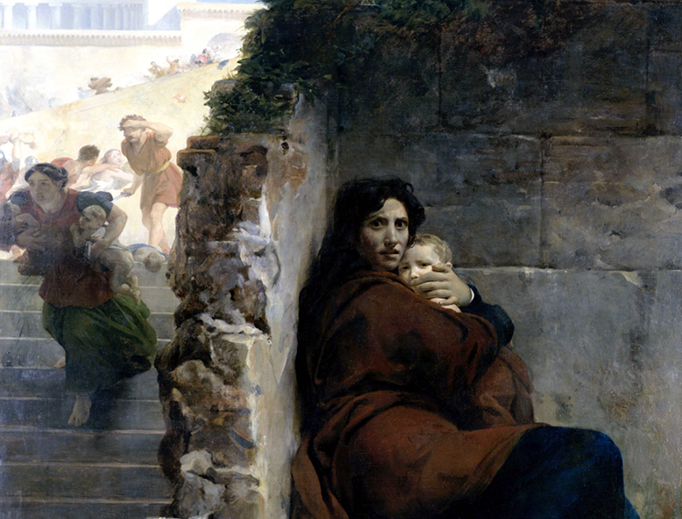
Léon Cogniet (1794-1880), “The Massacre of the Innocents” (photo: Public Domain)

I don't like the feast of the Holy Innocents. That was my main thought as I prayed Morning Prayer at church this morning and chose hymns to play for the morning Mass. In every Jesus movie where the slaughter of the innocents is depicted, I flinch and pull my blanket up a bit to hide. When my children were small I just flat skipped over it. It's a horrible thought and it's even more difficult to figure out how to enter into a liturgical celebration of a horrifying event. Babies saying "yeah! We were killed for Jesus who got away safely!"? What are we doing here, celebrating how great it is to be killed? What will we do next, celebrate child soldiers who join our bloody causes without any ability to comprehend the evils involved?

So I turned these things over in my heart this week. And I found my way clear of that disturbance, to a better and deeper one.

The liturgical calendar can be like the quiet cousin at the Christmas gathering who frequently gets upstaged by the more boisterous guests: feasting, gifting, more feasting, more gifting. But when we learn to celebrate Christmas with the calendar, we are brought right away to martyrdom with St. Stephen, to contemplate loving union with Jesus with St. John, and then to the gory effects of violence and fear in the world with the Holy Innocents. The Incarnation is so incredibly mind-blowing that a lifetime would not exhaust the depths of how God desires to impact us with it. But the liturgical calendar makes it quite clear that union with the incarnate Son of God preps us not only for eternal glory, but also for transformation into His image on earth. And He was "a man of sorrows, and acquainted with grief" (Is. 53:3). 

One of the deepest causes of grief is sin which causes innocent people to suffer. That could be simplified: Sin causes grief. 

Herod ordered the destruction of life because of his fear, his clutching at power, his arrogance. The thought of sharing the stage with someone, let alone bending his knee to reverence Another, was totally foreign to his soul. Those who carried out his orders were formed in a milieu that accepted force as a higher good rightly served. It's just a few children. 

This is the world Jesus came into, as one of the vulnerable. At this point, the Scripture text makes it clear he is totally dependent on Joseph's ability to receive a directive from God's messenger: Take the Child and His mother and flee. I wonder at the role that Israel's far history of pain and suffering, and  Joseph's, over Mary's pregnancy, prepared his heart at this moment to respond in complete detachment and obedience to just go. Pain and suffering are evils. Pain and suffering, united with the heart of God, become portals for God's glory to shine on earth. That is redemption. This can be pondered, but it is known most purely in the experience of it. Joseph in this moment obeyed God and this obedience preserved salvation for the whole universe.  

I take away two things from this. Union with Christ is a call to His vulnerability. We lay bare our hearts which are wounded and woundable to each other, to God, to our own gaze. I've been the worst at beating and castigating my own self for simply being, believing it to be a great fault. I have walked the path of learning to trust God and wearing Him down at every step, begging for certainty and protection instead of going by faith. I've done the chip on my shoulder, angrily raising walls against others, preemptorily blocking them out of my heart for fear of the harm they might bring. I've done stupid dependence on people who proved I could not ultimately depend on them as my gods. But God's vulnerability draws us into eternal peace. "Nothing will hurt or destroy on all my holy mountain" (Is 11:9). It's true.

Second thing: I must open my heart to the Lord, looking in His light for how I am like Herod. How do my attachments cause me to trample others underfoot? How do I exercise oppression to get what I want? How am I totally cut off from the hearts of others in their joys and sufferings? And how can I experience the same transformation Joseph did, that deep attachment to and freedom for the Lord? 

Jesus enters straight into the suffering of the innocent, and union with Him brings us there as well. May we repent of everything in us which is poised to cooperate with Herod. May we entrust ourselves like Joseph, in our own vulnerability, in the interdependence which is ours. May we walk by faith in God who does not exempt us from dark nights, but who is trustworthy.

Friday, April 15, 2022

Butterfly Release


Today is Good Friday. I'm not quite clear whether technically the Triduum is Lent, or if it is uber-Lent, but regardless, I am pausing to reflect on what I sense the Lord has been pointing to for me this Lent.

  • For probably the first time (hah, we are constantly only beginning) I feel that I have entered into fasting with some intensity, and without a worried layer of doubt that what God really wants is to watch my misery. As I wrote about early on, that has been hard for me to shake. And I cannot say how fasting works, but I find a resulting clarity and freedom that is striking in its power. When I fast, I feel anything but clear-minded and powerful. But subsequently I find myself with a level of freedom from old tethers that I did not anticipate, and clear resolution to questions on courses of action that had left me frustrated when I tried to just noodle them out.
  • Writing really is a form of prayer for me. I had lost motivation to do much of it here. But it helps me dig to the bottom of my heart, and access to that place is the best place from which to speak to God and make available to Him to receive from Him. But I can kill that process by thinking too much or writing as for publication (even though on a blog, technically, I am writing for publication).
Here's a big gong that went off for me yesterday. I happened to read a Facebook ad for a vagus nerve therapy. It started out (and I paraphrase): "An inability to speak is one of the most common yet unknown symptoms of unresolved trauma." BAM.

Very BAM.

My life started to flash before my eyes. First scene: the first time I was "slain in the Spirit," before I knew what that meant.  I had gone forward, asking for prayer, I was overwhelmed by the presence of the Holy Spirit, fell backwards onto the floor of the church, and lay there, continuing to be overwhelmed by the presence of the holy. What I became aware of was that my mouth felt like it was electrified, like the angel had taken the hot coal (ala Isaiah) and touched my lips. This lasted for several minutes, and I was left with a permanent knowing that God wants my mouth.

I thought of how, in my early 20s, I tried in a few occasions to tell people about painful things in my life, but all I could do was cry. 

I thought of how I used to panic for days whenever I had to make a phone call.

I thought of the hundreds of times I have keep silence instead of speaking forth what I wanted, needed, or thought. Probably thousands of times. 

I thought of how I found a refuge in narrow denominational or intellectual arguments, because they were words I felt sure of (because they weren't my own).

I thought of how I learned, starting at age 10 writing to my friend Gail, how to safely express myself in writing when I couldn't say things. Of how letters opened up a vein of exposure, healing, and then crisis.

An inability to speak is one of the most common yet unknown symptoms of unresolved trauma.

I believed as a child that the best thing I could do to bring peace to my divorcing parents and family trauma was to "shut up and go away." I got that wrong. And I clung so tightly to that wrong solution. 

When I was laying on the floor of that church, sensing that God wanted my mouth, I realize that I internalized a bit of a belief that God was displeased with my lack of courage to speak up. I thought he had expectations of me that I was not meeting. Sometimes I would feel urged, in a panic, to speak up about something, I wrestled with condemning thoughts that I lacked courage, or that I should not worry that something I was considering saying seemed wreckless or ill-advised; I had to choose courage or I would be failing God. Insidiously subtle temptations.

What I realize now is that when I went up for prayer that evening at church, God saw my trauma and wanted to initiate freeing me from it. The very first time I gave God an opening, He rushed in. He is able to bestow time-release graces that may take an entire lifetime to be absorbed. Blessed be God forever.

A long, long time ago I wrote a reflection after watching a butterfly that was trapped in a car repair shop. It was fluttering up and down the window, "seeing" the outside, but not able to access it through that window. A hand reaching in to bring it to freedom made it panic all the more, because hands like that are able to crush and destroy. I watched that poor butterfly sit on the wrong side of that window, seeing freedom but being unable to participate. I knew that butterfly was me.

Now I realize that God has slowly, slowly, worked with me to restore my voice to me, to give me the ability to speak, both literally and metaphorically. His wanting my mouth is not about "measuring up." It is about him redeeming me, reclaiming me, and setting me to live in his presence, as He wants for every single one of us. It is about His love. Lent is about His love. Purification is about His love. Jesus' death is about His love. His love frees, His love empowers, His love sets ablaze. 

The graces He gives us are personal, and they are intended for making us fully alive in Him, transforming us into a union with Him that is both unique to each created individual, and universal in availability. 

Tuesday, December 21, 2021

Inflating my Christmas Hope

I admit it; Christmas has been going flat for me. As a small child there was, I suppose, glitz that even I managed to be excited about, and as an older child, there was plenty to weigh down my soul with sadness, and later I brimmed with cynicism as we approached the celebration of the birth of Christ. No one could do it right enough for me.

But all of that changed for me on Christmas Eve of 1991 when I went to a Midnight Mass with a guy I was very interested in, though I managed to be even more interested in finally taking the step of personally experiencing something of Catholicism with as open a heart as I was able to muster. 

I was two years out of college. My grandmother had just died, I was emotionally paralyzed over remaining unpursued by any romantic interest, I constantly whined to God about how He didn't love me, my employment was purely survival-driven, and in many ways I was still waiting for my life to start. I plodded through life but dreamed, rather despairingly, of possibly having a future with meaning. 

It all seemed perfectly normal and relatively stable at the time, but when I look back, I realize I was in a rather dark place. 

This morning at Mass I began to recall the importance of keeping my personal journey fresh in my mind. I've written about that Mass many times in this blog; here's a link to the full story. Suffice it to say here that God stepped into my history as with a trumpet, announcing that He had come to save me -- me, not mankind. He showed up. He called to me: Here I am! This electrifying encounter shook my life for decades. 

Just like a little baby showing up in a poopy stable, He burst upon the scene and changed everything forever.

(Oh my goodness, I just realized I am coming up on this being 30 years ago! How did I suddenly get so old?)

It really was like being born again, in the sense that a brand new life started for me that night, and I also had much to grow into. When God again burst into my life within the last decade or so, which ended up with me entering the Secular Carmelites, I learned that a Christmas Eve conversion is something I had in common with St. Therese. I learned how Carmelite-y Advent is. I learned that my call is to be the intercessor that invites the same grace of conversion I have received to be present to souls who, like me, searched without hope of finding, whined after love with a cold, closed, cynical heart, and doubted the value of my own creation. And I realize how it makes me weep when I encounter souls like I was! Oh dear God, I can't stand to witness that pain! It makes me feel so helpless, so powerless, so... desperate! I could wish I had a magic wand to take away this pain, but in this moment I realize I have something that is real, and powerful: I have my own history of God's action in my life. Don't forget, Marie.

The proof of the power of the love of God is now in me. It is my life. It is in my reality. It is in my faith. 

For whoever is begotten by God conquers the world. And the victory that conquers our world is our faith. 1 John 5:4

Faith is the realization of things hoped for, the evidence of things not seen. Hebrews 11:1

Faith calls me, places me, into the community of believers. As a Carmelite, I know that my vocation is ecclesial; is of the Church and belongs to the Church. I also have long had the intuition that there were people of the Church praying for me -- I mean many more than the actually individuals who told me they were, or whom I experienced praying for me. Hidden people prayed for me. I know this.

And now I am one of the hidden people, and I pray for others. I have prayed for decades for the conversion of people's hearts. Some people "specialize" in praying for healing or praying long-term for those walking through difficult situations. My speciality has been to pray for the bottoms of people's hearts to open up to Love, and respond to Love's call to belong to Him. 

What I want most is to know that the people I love know and believe that God loves them, that they deeply respond to that love. This is my joy.

And I am going to keep on reminding myself that human pain is never the end of the story. Love is patient. The Lord Jesus Christ is powerful; He is present; He pursues our hearts and will never give up. Love is not desperate, nor whiny. Jesus is with us and is pursuing us for the long (or short) haul of our entire lives. His presence brings joy, life, peace, healing, truth, beauty. We have only to open to Him, and receive.


Thursday, October 07, 2021

While You are Dealing With Your Issues

This is an exercise in "I write, therefore I understand."

Recently I caught a clear view of something inside me in the process of being "triggered," to use the popular expression. By that, I mean I felt a strong, unpleasant emotional reaction to the behavior of another, which used to leave me feeling turned loose into a chaos-spiral. But this time, I was able to see more clearly the launch, the pre-launch, and the space where I could mentally re-position myself so as to not feel out of control.

Specifically, I had been watching a person in my life deal with a mental health struggle. When someone is far enough away from me, relationally, I have been fairly good at observing boundaries that kept their situation firmly in their court, with my well-wishes that it would go well for them. This time, though, that wasn't so fitting, nor so natural to do.

Soon there were these triggered feelings springing to life. I could not remember concrete situations, experiences, days when such and such happened which elicited these past feelings. But I could tell you well enough that as a child, I experienced both of my parents manifesting what I now recognize as depression, anxiety, or both. I myself lived in this territory for decades. It is well-traveled land.

But I found myself in a very different place in relation to these emotions. I have learned how to re-wire my thinking processes, as well as what my body needs in terms of nutrients and rest, to support a healthy functioning brain. I have not developed as many relational skills, other than boundaries which don't tend to draw in.... or... really it is probably true to say, that repel people who are habitually depressed. 

So suddenly I see I am faced with speaking and acting in the face of one of the biggest drains of my life: someone else's mental health challenge. When I was a child, I felt obligated, without realizing it, to bear my parents' troubles, to solve them by virtue of being me. I am called to love my parents, love heals, therefore I must heal my parents' troubles. This is something of the logic of a child. It is not only a bit faulty, it is all wrong. It buys into the idea that I myself am God, I am the Savior, I am the Almighty. And if I'm not, I'm guilty. Not good enough. A failure.

But while none of that is true, I also realize that I cannot resort to the kind of prayer that feels like, "If I just pray enough, the person will get healthy." While I believe in supernatural healing, I also believe that God is after our hearts. He wants us to entrust them to Him. And a big part of that is looking smack into the reality of our own pain, which we then realize is actually held in the crucified Jesus.

I had a dream about Mary doing that, and calling me to do it with her. 

Just turn, and look at Jesus on the cross. In my dream, she had a very, very difficult time trying to encourage people to do it. She was crying. She was in pain.

What else does that say?

How do I belong to people who are struggling with their issues? What I've learned is that embodying hope myself tells them that hope is possible and stability exists. I know that their issues give me something else to hand over to the Lord (Ps. 130: like a child at rest on his mother's knee, not setting my eyes on things beyond me). I think St. Paul testifies to feeling within himself the struggle of Christians being formed. So, I need to be open to feel what I feel, even while recognizing that life of said other person belongs to them. I can speak in faith about the good God holds out for them. I can throw out practical ideas. I can speak up when the frustration of another person comes out towards me in hurtful ways. I can entrust them to the Lord who knows all of what they need in every way.

Saturday, March 06, 2021

The Prodigal, The Fatherless, and St. Joseph

This morning's Mass has shaken loose quite a bit of useful thought fodder, so here I am to sort it all out.

The gospel reading was the parable of the Prodigal Son, famous of course for the son who squanders wealth, the father who compassionately welcomes him back after long expectation, and the brother who resents both of them. 

The homily I heard, though, was one of those ripping the needle off the record moments that backhandedly spoke into my personal situation and also has me pondering this year of St. Joseph.

Father mentioned, reminiscent of the writer to the Hebrews, that "we have all had that moment where we did something wrong, and we awaited that moment of how our fathers were going to deal with us about it." As Hebrews 12:9-10 puts it, "we have all had earthly fathers to discipline us and we respect them...they disciplined us for a short time at their pleasure, but [God] disciplines us for our good..."

The needle ripped off the record because, no, I don't have any childhood memories like that. In fact, the first thing I thought of was my experience of being corrected for singing harmonies out of turn when I joined our parish choir. I was ... 41 at the time. 

What felt so odd was to have this discussed as a universal human experience from which we all learned something about God. I went to that same category interiorly, and came up empty. That's not to say that God hasn't abundantly compensated that emptiness for me, because He has.

 My second thought went to the 23% of American households with children that are currently headed by single parents. And the divorce rate in the era of the childhoods of my generation (1970s and 1980s) that was at nearly 50%. And the trend, also prevalent within my generation of what Dr. Jonice Webb calls Childhood Emotional Neglect, where even physically present parents can be emotionally absent to their children. All of this is so much a given in my awareness of life around me that frankly Father's comments struck me like data from a different planet.

But my concern is not really with sociological trends, nor with Family Privilege, my personal experience or anyone else's per se. The direction these thoughts have taken me have been about human formation, and how that impacts spiritual formation.

I love what my Secular Carmelite Constitutions have to say about this: 

Both initial and ongoing formation in the teachings of Teresa and John of the Cross, help to develop in the Carmelite Secular a human, Christian and spiritual maturity for service to the Church. Human formation develops the ability for interpersonal dialogue, mutual respect and tolerance, the possibility of being corrected and correcting with serenity, and the capacity to persevere commitments. (OCDS Constitutions, No. 34)

Pope Francis has been insistent on reminding us that God meets us with His great spiritual riches on the peripheries of society and on the peripheries of our own hearts. The more clearly we see our poverty, our need, our lack, our misery, the more immediately God bestows His abundant grace. This is exactly why I say God has abundantly compensated me for the empty category I have felt in my human formation; though it did not always feel a blessing, I realize I have been tremendously blessed in being solidly in touch with my misery and crying out to God over it. It has taken me a few decades, but here I am!

I am now vigorously curious to learn how to help others in their human formation in this regard. Human formation happens when my human experience butts up against your human experience, and we both act with the graces God has given us. There is plentious room for correction and being corrected, for learning respect, to learn to tolerate persons and accept them as they are, not as we want them to be. The end result is to be that we both learn to persevere in our baptismal commitments, having been refined by the other. Multiply this by many people, many human experiences, much grace. This is an element that dare not be missing from spiritual formation (entailing learning Scriptural, doctrinal and spiritual truths). For dry bones to live we need both spirit and flesh to take part in resurrection.

And then my thoughts went to Our Lord Jesus. At the beginning of his life, he went straight for our vulnerable edges, in the persons of Mary and Joseph. Biblical scholars still debate over the nature of their legal and moral status at the time of Jesus' conception. They were betrothed but had not lived together as husband and wife; did this mean that Jesus' birth was legitimate or illegitimate? Regardless of how the eyes of the law looked upon them, or what people thought of Mary and Joseph, I can't imagine that Joseph avoided a dark night of faith. He knew that Jesus was not his child. Scripture clearly says he was of a mind to divorce Mary quietly. Some scholars say this was only because Joseph knew he was not worthy to be the father of the Son of God, and not that he doubted Mary or didn't know or believe that she was the mother of the Messiah until this was revealed by the angel (as if human Joseph having merely human thoughts somehow detracts from his holiness or vocation.) Mary also had to have needed to exercise dark faith in what the angel told her. I remember those early weeks of pregnancy where, in my case, I was sure I had lost my baby because I felt absolutely nothing. Mary had no advantage of seeing the blue line show up on her pregnancy test. In this very intimate, unprecidented and singular event of the pregnancy with the Son of God, both Mary and Joseph were pressed to the human limits of faith that God's word is to be believed above all else, including the entire natural order. I highly doubt that there were not intense conversations during that time that shaped and prepared them to live in their society in a radically, profoundly different way from anyone else. Their bond had to be a profound solitude that God transformed with every manner of compassion, wisdom, worship, and strength.

Jesus did not come to remove troubles by sanitizing humanity. He came to sanctify us by redeeming our broken humanity, and making sons of those whom sin had completely alienated. He entered into our human experience, sharing everything but sin, in order to drink the dregs and fill all with his healing and powerful presence, to make of us a people who witness to his presence in a broken world. As he raises us up to share in his divine nature, he fulfills through human beings what he promised in Psalm 10:18, "to vindicate the fatherless and the oppressed, that the men of the earth may strike terror no more."