Showing posts with label Emmauel. Show all posts

Sunday, July 19, 2026

Words, and Hearts, and Saints

Part of my morning prayer routine is invoking the intercession of my prayer team of saints. I have a standard team that has been with me for I-forget-how-many-years, as well as my patron saint that changes every year at the beginning of Advent, and those I've added as I intercede for several specific individuals in my life.

My relationship with my standard team has been evolving, especialy over the last year to two. And by that, I mean that I'm aware of a change of need in what I think of as their "department." Essentially, I'm asking the Lord for different things.

My team consists of several pairs and a triad: St. Teresa of Jesus and St. John of the Cross; St. Teresa Benedicta of the Cross (Edith Stein) and St. Therese; Holy Father Elijah, St. John the Baptist, and St. Cecelia; and St. Joseph and our Lady of Mount Carmel. They are my constants.

I consider my triad my "words" department. And as I stop and ponder, the recent changes in my life where my "words department" is involved is somewhat overwhelming to take in. As my reality has changed, my prayer has adjusted to it.

For years I have prayed that my words would become a means through which God's power could be made known. I eventually adjusted that to specify the words that I speak, the words I write, and the words I sing, since that covered three major areas of my life. I changed that to include the words that I think, and the words I meditate on or ruminate on, because I realized the importance of what I let go through my mind. I've now added "the words that I battle with in my mind," because I had to admit that some of the words going through my mind are temptations. They come with an agenda to get me to doubt that I am loved and designed for intimate communion with The Word Himself. And my ultimate petition here is that my words in every category would arise from the place within me where I seek to live this union with God.

Words have always been important to me, but I've realized in the last year especially how trauma had impacted my "voice," making speaking up and speaking out -- in some moments and on some levels -- physically impossible. Big shout out to EMDR therapy for reaching into the depths to heal that. 

I feel like I'm exiting a season of healing and excavation, and entering a season of healing and activation. "Use your words" takes on a whole new meaning, here. "Out of the abundance of the heart, the mouth speaks" is true in many ways. I was in a setting recently where I was told I appeared very confident, facing the prospect of a task that would require meeting strangers at their worst, most vulnerable moments. Do I feel ready for that? Of course not! It's very unsettling. But I can indeed find words there if I have gotten comfortable with my own worst, most vulnerable moments. And frankly, the Lord has been walking me through just that. 

So our words (or lack thereof) show our hearts. Our hearts, in the Lord's hands, are safe, despite their breaking and aching, and all the scary traffic in and out of them. Our words reflect the truth of hearts back to ourselves in ways that can be incredibly hard to swallow. But our heart is exactly where the Lord wishes to meet us, exactly as we are.

Thursday, July 02, 2026

Thoughts from Today's Gospel: Jesus Heals the Paralytic

Today's gospel reading is Matthew 9:1-8, the account of Jesus healing the paralytic. (If you are like me, when you hear this it is hard not to picture how The Chosen rendered this scene. That's helpful, because it is almost word-for-word, with imaginative context added.)

What strikes me in the text is, first, three points of action. It says, "Jesus saw their faith." Their faith was expressed in pressing in to make a way to get the man to Jesus. Matthew's gospel actually omits the detail that they let him down through the roof; Mark and Luke pick this up. Then, Jesus commands an action: "Rise, pick up your stretcher, and go home." His healing entails the man doing something, not just feeling it in his heart or embracing a new attitude. Jesus is more concrete than that. Then the last point of action was the crowd's response: "[T]hey were struck with awe and glorified God who had given such authority to men." They saw Jesus' action, and it landed like a seed of transformation in their souls. Some of them may have walked away from witnessing this without ever deciding to follow Jesus or believe in Him. But for others, it may have been a turning point that changed how they lived from then on. We readers, with them, are left with that grappling.

Another point. Jesus speaks boldly in a way that reveals His divinity to the crowd, but He isn't provoking the observing crowd or goading them on. He speaks that way because He is in an intimate exchange with the paralyzed man. Someone, recognizing his utter need, has come to Jesus. That's when Jesus acts in power. It's for the human need of the vulnerable. Jesus says to him, "Courage, child, your sins are forgiven." 

And what kind of response does this evoke from the scribes? (Luke throws in the Pharisees.) Accusations of blasphemy. Their thoughts were not on salvation. Their hearts did not quiver at the prospect of forgiveness and reconciliation with God. They were judging Jesus by comparing what He did to themselves, as if He were just a man. Self rules, for them. And the text says Jesus knows this and calls out their "evil thoughts." Why are your hearts not fixed on God? Why are they stuck on yourselves? That's the definition of evil, here.  

And so the work of healing that Jesus does has two different effects. It is a work of salvation for the paralytic, which evokes praise and awe from those who witness and accept Jesus' testimony that this miracle confirms His authority -- from God -- to forgive sins, even though theologically this is a big pill to swallow at the time. It is a work of consternation for those stuck on themselves. It calls to everyone to make a decision about which camp you are in. Do I brush off Jesus' power, not out of a desire to reject God, but maybe because I lack the faith to believe His power could do anything in my life? Brushing it off is brushing it off, regardless. Do I feel the awe and cultivate that awe, and start thinking about bringing all the stretchers and paralytics I know (and am) to the Lord in faith?

Friday, April 24, 2026

Just Look

A long time ago, when I lived in Japan, I had a dream that has stayed with me. In this dream, I was in my 6th grade classroom (the most difficult students of my six classes), and in the front of the classroom, Jesus hung on his cross. But my attention was drawn to the Blessed Virgin Mary. At first, I was observing her being present to Jesus on the cross. She was so deep in empathy with him, and so full of understanding of what His act there meant, and also so aware of the need of the people around her. Then she caught my gaze, watching her, and beckoned me to enter in to her experience and make it my own. I don't know that she spoke in the dream, but what was communicated to me strongly was the plea "Just look. Just look at Him." Somehow, looking at Jesus on the cross was key for me and for everyone else present. Mary seemed to keep this gaze perpetually in her heart, even when her attention was fixed on me or the others. What was most striking was the point in the dream where we both turned our attention to the other people in the room, which included some of my students and several other random people I either knew or didn't know. They were all chatting with each other or engaged in something and it was extremely difficult to get their attention. They were completely oblivious to Jesus, who hung immediately before them. I remember the type of anguish this caused Mary. She did not force anyone, but she was very sad and searched with an insistent heart for someone who would break free and look at Jesus.

It has been at least 30 years since I had this dream, and I have meditated on what it teaches me regularly. What it speaks to me these days harkens back to Moses and the bronze serpent and John 3:14-15, where this is directly compared to Jesus on the cross. In the account in Numbers, the Israelites' faith in God's goodness was not developed at all; they hardly had faith in Moses who had led them out of Egypt. They objected to their freedom from slavery if it meant dying of starvation, thirst, and discomfort. Can you blame them? Even the slavery we know can feel safer than the freedom we are on the way to, but aren't yet embracing. Then they had another crisis: people were being killed by venomous snakes, and they are jerked back into the present moment by their need for safety. They turn to Moses for help, and remember that he has this mysterious access to God who he says freed them from slavery. Ask God to take this crisis away, they say. God's answer to Moses is to make a bronze serpent and hang it on a pole, and if they look at it, they will be healed. 

The serpent was their crisis. It was what was harming them. It was their death. It was their reality. God has Moses tell them to look at it, for healing. 

And as Moses lifted up the serpent in the desert, so must the Son of Man be lifted up, so that everyone who believes in him may have eternal life. (John 3:14-15)

What does one see looking up at Jesus on the cross? On the literal level, we see a bloody, crushed, humiliated, agonizing man. A human being, just like us, who is immersed in a human experience of immense suffering. Spiritually, we see more than this. We see salvation, the Savior of the world entering into our human experience, not out of his crisis of sin, but out of an outpouring of love and the desire to be-with. 

And the response of the fully graced one, the response of the Church, is to say: Look! He entered your pain for you! Now, you, enter your pain for you! Meet Him there, and receive freedom and healing from it!!

The task of receiving our salvation is not to parrot some religious formula prayer to "make Christ our savior." We are called rather to recognize the crisis of our hearts, what is harming us, what is killing us. Look. Just look. At Him. It's all present there; He's gone before us to get there. God doesn't create a magic world where there is no suffering. When you look at humanity, you can realize that our freedom demands a capacity to choose badly. Jesus' choice was to enter it. The Father didn't have bloodlust in allowing His Son to die; the Son had the yearning of love to not leave us alone in our pain, but to meet us there to free us and to open up the path for His supernatural life to live in us, to return us not only to our true selves, but to divinize us.

And then, what is more, the fruit of the tree of life, the cross, is the Eucharist. Again, we don't just experience a ritual eating of a wafer; we feast on His act of handing over Himself as the very path for supernatural life to enter us, which it does through the faith that receives Him, daily if we want (in many places in the world). Daily, this supernatural transformation can be activated, and we look again, with today's burden, today's need, today's mission. We need this daily food; we are commanded to it at least weekly, in celebration of the resurrection, because Good Friday was not the end, it was the catalyst. Our suffering, our pain, our harm is not our end; let it be the catalyst which forms our purpose, our innermost self, our mission in this world, to turn and draw others to JUST LOOK

Just look, have faith, be healed. 

Tuesday, April 14, 2026

Fulcrum and Lever

Currently I have the luxury of quite a bit of time which I can give to reflective writing. So I am cashing in on it. I spent the morning meditating on several things that lept out at me during this morning's Mass: a prayer and several scriptures, which then, during that meditation, all fell within an analogy which St. Therese mentions in Story of a Soul. It was actually among the very last lines that she ever wrote -- in pencil because she could no longer wield a pen. The reference is this: 

A scholar has said: "Give me a lever and a fulcrum and I will lift the world." What Archimedes was not able to obtain...the saints have obtained in all its fullness. The Almighty as given them as fulcrum: HIMSELF ALONE; as lever: PRAYER which burns with a fire of love. And it is in this way that they have lifted the world; it is in this way that the saints still militant life it, and that, until the end of time, the saints to come will lift it.  (Story of a Soul, chapter XI, 36r-36v, italics and caps in original)

This is so important to me right now that I am going to edit what I have already written elsewhere and have another go-over of it all.

~~~~     ~~~~   ~~~~                                                           ~~~~   ~~~~   ~~~~

This morning I woke early with the sensible feeling of a certain kind of sweet weight to offer up to the Lord. In other words, I can receive the heaviness of late as a grace and a gift to turn into powerful prayer. It reminds me of what Therese wrote about God being the fulcrum and our prayer being the lever that can lift the world. I'm watching this video which states "without a fulcrum, a lever has nothing to support or balance it, so no work can be done." This deserves a moment of meditation. To allow God to be God is to allow Him to be that which supports my movement, my work, and our point of contact is the only thing that gives my freedom power. Otherwise, it isn't so much freedom that I have as total disconnection from reality. Within God I can rise up, within God I can bear down. Within God I have my full range of motion, my total potential, even though I might see potential beyond my potential -- if that makes sense. The oar can "see" up into the sky, where the rocket can launch, but if the oar is launched into the sky, it is not free, it is disconnected. To use a literally more human analogy, towards the end of the video there's a person lifting weights, and the question is, what part of the body is acting as the fulcrum. It seems the answer is the shoulders. And in this analogy, there is a different, less mechanical relationship between the fulcrum and the lever -- and I wonder now if this is connected to why St. Paul talks about the Body of Christ. Because as the arms rise up and the shoulder fulcrum strengthens, more potential is being created for both the arms and the shoulders. In this analogy, God's potential in us increases as we exercise that lever. He builds up strength within us. And this strength also builds grace, stamina, flexibility, beauty, potential for movement, dance, expression, inspiration, health -- everything. This really gives me an insight and a motivation for bodily movement, making it actual prayer. 

But now on to those Scriptures and phrases that popped out to me at Mass this morning. The first thing was from the collect: "Enable us, we pray, almighty God, to proclaim the power of the risen Lord, that we, who have received the pledge of his gift, may come to possess all he gives when it is fully revealed." The italicized part is what stood out to me in the moment. But as I look now at the opening phrase, I see it connected to the power to proclaim Jesus risen. It seems a bit like a wheel. We pray for the power to proclaim the power of the risen Lord so that we can move from having received a pledge to full possession of all he gives, when "it" is fully revealed. Again the fulcrum idea. The fulcrum being the center of a wheel, and the wheel turning around the fulcrum gives the movement. That's the power. We have received the power in our sacraments. That's the pledge (Eph. 1:13-14). Then comes the enabling to proclaim the risen Lord, which is the gospel preached by faith. As we speak forth in faith, we exercise our connection, we exercise our pledge, we turn that wheel around the fulcrum. And in doing that, God gives -- He gives abundantly. What He gives flows over, spilling everywhere. I have sensed this in the past. Gems and jewels way more than I am capable of carrying in my arms, dropping them left and right, but still having more than I can handle. We then pray for possessing all he gives. Not just stumbling with full arms, but making all of this mine. Taking it all in. Like Joseph in Egypt, managing, stewarding it all very well, not just so that I can be well taken care of, but so that many others will be safe and saved from famine. Then we have the full revelation. So this is an ongoing wheel turning. We travel farther and wider. The power of God will be fully revealed, and this is for the praise and glory of God. This is eternity, and this is the culmination and full purpose of our earthly lives. My earthly life. It is to be found in the praise and glory of God. This is the focus on union. It is going to look different for each person. For St. Elizabeth of the Trinity and St. Therese, this was manifested in death at an early age and terrible physical suffering, which then rocketed them into an eternity of sainthood, ministry, and intercession, personal glory of the sort that belongs to the canonized saint. This is not my path. But my path will be mine just as much as their paths were theirs. And I come to it the same way. I have received the sacraments, I proclaim faith in the risen Lord -- for me, it's what it means to believe and trust despite my human obstacles involving trauma. I receive what God pours out, and I steward it. The orientation of my life shifts away from the initial struggle to get the wheels to work together, and onto the terrain I traverse because of the movement God gives. This reminds me of the little girl I saw last night when I was out walking -- her father was helping her master riding her bike. I cheered her on every time we crossed paths. I have known certain people in my life to be my support, like training wheels are supports. We need this support from others, this witness, to get over the initial struggle of getting the wheels to work. And we need those who cheer us on when they do. And we need those who ride beside us, delighting in the mastery of movement together. Is there anything more beautiful than delighting in the unfolding of the glory of God with another person? This is the communion of saints for which we were created. 

Then from the Psalm: 93:1 "And he has made the world firm, not to be moved." Again with the fulcrum idea. This depiction of the world shows it in the image of God. God is the firm fulcrum. He does not move, but enables movement. Here the world does not move, but enables movement. Terra firma. In other words, God graces nature to reflect Himself, to be solid, trustworthy, predictable. That which enables us to have a solid foundation. We can rely on matter as it images God. In this way, reality is sacramental. He has done this. It is his gift, his reality. It is solid, stable. This is what makes sense out of things like Isaiah 54:10, that though the mountains be shaken -- this solid, trustworthy, God-imaging nature, God's covenant of love with me will never be shaken. With me, not just in general. "My love shall never fall away from you, nor my covenant of peace be shaken, says the Lord, who has mercy on you." Immovable stability is not something I have been able to presume upon psychologically. It is something I receive by faith and have come to trust in. 

Next verse was the communion antiphon, which combined Luke 24:46 and 24:26: "The Christ had to suffer and rise from the dead, and so enter into his glory, alleluia." I had been asking the Lord last night, or telling him that I was having a hard time believing that what is happening right now is for my good. This speaks into that. And it also fits with the reflection on the collect. If Christ had not died and been raised, we would still be in our tresspasses and sins (1 Cor. 15:16-17). If he had not died and risen again, we would have no faith in the risen Christ to preach. I would have nothing to say about trust and hope of moving through trauma because release from it would not be a thing. There would be no jewels and gems to gather up; it could only be imaginary effort, only psyching myself out. It is hard to wrap my brain around "the Messiah had to suffer these things." It was prophecied. It was God's plan. It was where the fulcrum located itself, and Jesus as fulcrum and lever moved the impossible thing. Maybe He could have done it differently, but He didn't, for whatever unfathomable reason, something having to do with the human design. Something having to do with Love, with the being-with in suffering that the Incarnation entails, as St. John of the Cross says in the Romances on the Incarnation. So the Christ had to do this to enter into His glory. That is the path. That was the path for Him, so that is the path for me. Or maybe it is because that is the path for me, that was the path for Him. He destroyed death by death. He opened up the path to life for us who lived in the shadow of death. He saw me in my trauma, and entered into trauma to destroy my trauma. To make that lever turn which would have been immovable otherwise. Thus the most holy thing we can do is to encourage someone to faith. To proclaim the wonderful deeds God has done and move someone else to faith so that they too pull the lever on the fulcrum presented before them, God-with-them-in-their-need.

 Two other verses came to mind as I received holy communion. First: 2 Peter 1:19 "Moreover, we possess the prophetic message that is altogether reliable. You will do well to be attentive to it, as to a lamp shining in a dark place, until day dawns and the morning star rises in your hearts" (morning star, an OT reference to the Messiah). This, I believe, was an encouragement to do exactly what I'm doing right now, to sit down and really meditate on these things that struck me. I realize that I have often let things like this slid, thinking "oh, that was nice. yep, I'm sure it's important" but not realizing how much this is exactly what I live on. What I need to survive, more than money, more than food, more than any tangible provision. More than oxytocin. I need to soak in and meditate on these truths, because this is what will give my life the solid foundation that I need and crave. And not just write about it here or think about it for an hour, but come back and review it, open it up and unpack it further. Continue to ask the Lord about it. Continue to reflect on it. And continue to even do the physical fulcrum/lever work to experience this somatically.


Second verse: 1 John 3:2, which I will expand to include verses 1 and 3: "See what love the Father has bestowed on us that we may be called the children of God. Yet so we are. The reason the world does not know us it that it did not know him. Beloved, we are God's children now; what we shall be has not yet been revealed. We do know that when it is revealed, we shall be like him, for we shall see him as he is. Everyone who has this hope based on him makes himself pure, as he is pure." The kernel that struck is me "what we shall be has not yet been revealed." In other words, God is in the midst of a work. He is the fulcrum, and that lever is in motion. My lever may have been both operating and screaming as of late. I can get funny ideas, like maybe the point of this is to shove my hand into the spot where the lever and fulcrum meet, because the goal is to crush myself to death. Maybe the spinning of the wheel is for me to stick my hand in there and get my fingers amputated. Maybe that's the goal here. (These would be lies, coming from one who loves to kill, steal, and destroy.) But no. What we will be, what this is all about, has not yet been revealed, and that verb tense implies that it will be. The revealing is not my work, it is something I will receive. And whatever it is, the work God is about is his fatherly love. His fatherly love is to make himself known, and as we see him and know him, we become like him. Again with the lever and fulcrum. We do our lever work, attached, properly attached to the fulcrum, and there is this strength of God Himself which is built up in us. As He gives to me, I give back to him with my movement of faith, and so He gives himself more, enabling me to give myself more. It is a beautiful progression of love, one that also recognizes and accepts both my limits and my aspirations. Love is eternal, and I can never outgive God. I am freed from the overgiving I am tempted to do when I see myself just an oar, a thing, disconnected from its mount, its fulcrum. I "give myself fully to the water" -- I drown. I "give myself fully to the wall" -- I'm never in the boat, in my potential. But when I am secure within that which holds me in existence, I am ready for developing that skill, that employment of grace and virtue that moves me along. The oar does not row itself. But the body can move itself, as it is given life from the head. 

Fulcrum and lever. It says everything I need to meditate on right now. 

Wednesday, July 09, 2025

You Can't Make God Happy

I regularly take BIG breaks from posting on this blog, generally because I am processing my thoughts in writing elsewhere. But like a cat out for a prowl, I always come back eventually.

I have indeed been processing some big life things, as I've been involved in formation to become a spiritual director. I've realized I owe it to the process to engage with all of my heart, mind, soul, and strength, and I've had significant help in that regard from the Lord who holds my life in His hand, and has brought some major shifts into this life of ours.

One of the results of that is that I have been going to counseling to address some things that I realized I've not addressed before, and that I can see have formed me, and not in healthy ways. 

One of the things that has come up is the concept of codependency. When the therapist mentioned that term, I instinctively knew by how I bristled at it that there was something there I needed to look at. When I was in college, I was involved in a local ACOA group (Adult Children of Alcoholics) with a few friends, and codependency was quite the buzzword. These friends were finding codependency in their every movement and breath, and the whole thing made me roll my eyes. Under the bristling I felt more recently I found an angry reaction -- one that insisted that codependency meant weakness, and weakness is hateful and no way buster am I that person. That sounded way too much like my angry teen self, the same way I was angry and hateful with the term alcoholic, which at that time was synonymous in my mind with my Dad. I was so angry with that term that I didn't learn to spell it correctly until I was nearly an adult. I wouldn't think about it long enough to do so. I realized I had been that way, in a buried sort of way, with the concept of codependency. 

So, I knew I needed to look there.

I am seeing how it has perhaps influenced my closer relationships to a degree. But the relationship that I am writing about here is my relationship with God. Is it possible I have inserted codependency into my relationship with God? That's today's question.

A priest once told me he used to approach prayer as if it were a daily dose of medicine that he had to administer to God, so that God would be okay. That struck me both in its ludicrousness and in its relatability. I should back up by saying that the definitions I have found for codependency settle in on the idea that the codependent lacks a firm sense of identity within herself. She doesn't know who she is without the responses and affirmation of other people. What she does in relationship to others, she does to learn who she is, not to express who she is. She is always motivated to make other people happy, because then she knows she is ok. If other people are not happy with her, then her identity tanks.

So I'm thinking about this: is it possible to go around "trying to make God happy?" How do I know when I've succeeded? What if I never can? What if God is so demanding that I'll just stay in constant stress, because He tolerates me, but constantly points me to the need of the world and to saints who converted thousands. I'm accepted (begrudgingly) but I have so far to go until He's actually delighted. Maybe even in heaven I'll just squeak in to some lowly place because I'll simply never measure up. 

Newsflash: God is perfect beatitude. I can't "make Him happy." Maybe, just maybe, that striving comes from a) poor formation in theology, Christian anthropology, and worship, and b) a codependent attitude. What if I am actually called to find my identity in Christ, to grow up into Him who is the head (Eph. 4:15) and from that place, express what God has put in me (namely, my created nature, deified in Him; the life of the Holy Spirit) into the world. What if building my entire moral life on some other foundation, even the most exacting religious standard, is going to fall apart, because it isn't built on the rock of Jesus Christ himself? 

Well, wouldn't that just blow your mind?

What if my sense of jangled nervousness comes from a lack of faith that God delights in me, that I am His child, that He has covenanted with me in my baptism, giving me new life, and that He is never going to let me go or require me to earn His favor? What if He eagerly awaits the slightest invitation from us to fill us to our current capacity with every good grace He has. What if these are new every morning, and we can constantly be filled with His goodness when we call upon Him? "How much more" will our heavenly Father give to those who ask? 

What if the thing that destroys my peace is believing that I need to give God just the right formula to get Him to be ok with me, so that I can be ok. What if that's just not the way any of this works?

Honestly, I think we could change the world overnight if this lie could be wiped clean from the depths of our hearts. 

Sunday, January 12, 2025

Confessions of a Closet Gnostic

As soon as I type "closet gnostic" I am anticipating one of my more intellectual readers taking me to task for theological imprecision, so right off the bat I am going to invite those feelings of Precision Demand to go outside and attend to their own domain, like monitoring the Earth's orbit around the sun, or whatever it is they are for. I'm here to speak a bit more poetically.

The gnostic I'm talking about is the one who says knowledge is the savior, and secret knowledge is for the superior elite (understood as themselves), and this invisible realm is where all Good resides. The body, matter, and that thereto connected is deeply suspect. An apparent necessary evil, to be escaped or avoided. Slapped on to a Christian package, this encourages practices such as spiritualizing: when one avoids dealing with matters that originate in the material world by framing them as having exclusively spiritual origins and solutions. 

I'd say the opposite of this gnosticism is the Incarnation of Christ, and all of its ramifications. 

And I think I am still a recovering gnostic. 

It isn't so much that I started out being an enemy of my body or anyone elses, or the material world. But very early on I became an enemy of my emotions. I suddenly I feel like I've been dropped into a movie a little bit like The Kid where I am being invited to meet Small Child Me, or even Young Adult Me, and renegotiate a few things. 

One of the things I need to renegotiate is the reality that emotions give information, and emotions are experienced in the body -- and stored there unhealthfully if they don't make it all the way through to expression. 

I've been doing some somatic exercises lately, and I've just recently started a new set of practices designed to address traumatic experiences. This latter thing was designed by a Catholic woman for Catholic women, and now that I am finally actually open to something like this, I'm finding it very powerful. I have always kind of shifted uncomfortably in my chair when people would suggest, for example, beginning your prayer with taking deep breaths or being aware of your body in the space, etc. It just seemed too "woo-woo" to me. Intellectual things are my comfort zone, and all this body talk just seemed, I dunno, suspicious. 

But what is the case is that as a child, I spent a lot of time in extremely tense environments. Parents arguing, parents divorcing, my father being so sad and miserable, my mom being so stressed, hiding at the neighbors house with my mom when they split up, Then there was my dad drinking, and when he would get drunk, he would call our house, and that telephone became terror activation. Mostly my Mom would yell at him and slam the phone down, or sometimes he would ask to talk to me, and I'd be stuck on the phone listening to him drunk rant. I don't know how many times that happened, but in my memory it feels like a lot. Of course, we'd never know when he'd start drinking, so sometimes the phone ringing was just the phone ringing, and sometimes it wasn't. Sometimes he'd talk to me when he was sober, but those conversations were usually apologies, and they were short. I remember one time, in the midst of my dad's phone calls, one of my sister's college friends happened to call, and my mom yelled something about "operator, trace this call" and hung up. When we learned later who actually had been on the other end, the whole thing became something to laugh about. That was so weird and confusing. 

I remember this happening at least through to my teenage years. I suppose it became part of the normal warp and woof of my life. And it had a lot to do with why I shut down my emotions and ignored how this made me feel. It transferred over to basically numbing myself around other people entirely.

I have a memory from about age 19 that tells me how far I got with this. I had a friend at the time who was in her 30s, and she had two small kids, around ages 3 and 5. I started appearing at this friend's house somewhat frequently, as we were becoming Bible study buddies. One day when I arrived, her daughter, the younger child, greeted me at the door with an exuberant hug of my legs. I stood there, stiff as a board, and looked at her rather expressionlessly. I remember her face melting from a bright smile to something akin to utter fright, as she backed away from me. I had absolutely no idea how to respond to her, and she felt how abnormal that was, even though I couldn't. 

Now, things have changed for me a lot. But I am finding there are some areas I still need to renegotiate and allowing myself to listen to my body and the emotions that do commerce there is not, after all, poppycock. I even have to retrain my intellect (aka learn!) to accept this as important information, and to make some shifts. 

I've tried to erase my humanity, thinking that this is more spiritual. I'm pretty sure my prayer journals from past decades are filled with ridiculous and elaborate spiritual theories about why such and so was happening to me, when it really boiled down to: I'm not managing my emotions here. I'm denying my humanity over here. I'm avoiding addressing this conflict over here. I don't have all of the facts straight over there. It's not all about God testing me and it's definitely not all spiritual warfare and attacks of the devil, or elaborate communications from the Holy Spirit. Nor is it about my need to just try harder or beat myself up over stuff, or any other elaborate heap of chaff I've been able to create. So much froth, so little Incarnational Lord. 

He is, however, incredibly patient with me. 

This morning, I read the first Psalm from the Office of Readings (for the Baptism of the Lord). I found it striking.

O give the Lord, you sons of God,
give the Lord glory and power;
give the Lord the glory of his name.
Adore the Lord in his holy court.

The Lord's voice resounding on the waters,
the Lord on the immensity of waters;
the voice of the Lord, full of power,
the voice of the Lord, full of splendor.

The Lord's voice shattering the cedars,
The Lord shatters the cedars of Lebanon;
he makes Lebanon leap like a calf
and Sirion like a young wild-ox

The Lord's voice flashes flames of fire.

The Lord's voice shaking the wilderness,
The Lord shakes the wilderness of Kadesh;
the Lord's voice rending the oak tree
and stripping the forest bare.

The God of glory thunders.
In his temple they all cry: "Glory!"
The Lord sat enthroned over the flood;
The Lord sits as king forever.

The Lord will give strength to his people,
The Lord will bless his people with peace.

If this isn't physical imagery, I don't know what is. My embedded emotional paralysis can feel as immovable as a cedar of Lebanon, or like the very land itself, but the voice of the Lord currently speaking over me, I know, has the power to break that spell of death, and replace it with strength and peace. 


Wednesday, December 04, 2024

Better than a Hallelujah

 Recently I was reminded again of the song Better than a Hallelujah, which Amy Grant recorded in 2010. From the first that I heard it, it's been a tear-jerker for me, but now it strikes me on even a deeper level than before. 


When I first latched on to the song, I was drew encouragement and consolation from it, because I was in a time of pouring out my miseries. I needed to hear that my mess was indeed beautiful, and that pouring it out to God really was better than a choir singing out... The hallelujah, well, that spoke to me of trying really hard to have faith and to stand firm, when all I felt capable of was crumbling. 

We pour out our miseries
God just hears a melody
Beautiful the mess we are
The honest cries of breaking hearts
Are better than a hallelujah

Now it's some ten-odd years later. Now I'm in a formation program to become a spiritual director. Now this makes me weep for the sheer beautiful truth of it. 

God just hears a melody

It's in fact the Song of the Resurrection, which He has written and He pours into us even as we are pouring out our miseries to God. "Give, and it will be given to you. A good measure, pressed down, shaken together, running over, will be poured into your lap" (Luke 6:38). It is precisely in those moments where we feel the most pitiful, when we cry out, that God is instantly reciprocating and pouring Himself out in return. It might take years to consciously receive, but "everyone who calls on the name of the Lord will be saved" (Rom. 10:13). 

I think if there is one task of the contemplative spiritual companion, it is to bear witness to God's presence, who He is and what He does. In a way, it is what Amy Grant did for me (or rather Sarah Hart and Chapin Hartford, songwriters, did). The song affirmed to me, yes, it really is better to pour out your misery than it is to carry out mere religious action, even if that action is objectively good (and especially if it is just conformity for the sake of saving face or pleasing someone else). There is a messy point in life where honesty, for a moment, flies in the face of what is right, decent, and true. But the truth is, God hears through it. Hearing another human being affirm that pouring out one's heart to God is beautiful is enough to support faith until it becomes one's own interior knowledge.

Heaven knows there's no shortage of provocation to our cries of misery. It's a grace, actually. The misery itself? No. But the act of faith that knows there is God to whom I can turn meaningfully with it, that's such a tremendous gift. 

In reality, most of the time these exchanges happen in excruciatingly slow motion. I don't just feel miserable for an hour, cry out to God, and then skip along merrily through my life, blessed beyond measure. These things require patience, stamina, and determination. I think it is like planting a fruit tree, and it is why it is ten years later than I can look back and hold the fruit in my hand that grew from a dead pit. This is the spiritual life. There is no quick fix, but there is real transformation. It's true!


As a bonus, here's the official video, telling its own story: 


Tuesday, October 01, 2024

The Urgency and Simplicity of Love

It seems that the Lord enjoys inviting me to go spelunking with Him. I am one of those people who, if an invitation seems too good, like too much fun, I panic and turn it down, thinking surely if I enjoy it, there must be something wrong with it. I'm silly, I know. 

This morning as I was reading, something caught my attention, and it feels like a spelunking invitation, so I'm here for it.

I was reading Temptation and Discernment by Segundo Galilea, and the section that caught my attention was from Part III, The Demons of Prayer, under the heading "Not Being Sufficiently Motivated." The author says that this distraction is all about being primarily motivated by felt need, whether emotional  psychological. Then, the part that caught my attention: "Above all... the ultimate, persisten motivation for prayer and its solid foundation is the conviction that God loves us and offers us the gift of liberating friendship. If this truth of faith does not genuinely persuade us, our motives will remain shallow... (p. 48, bold in the original).

When I read this, I immediately saw myself as an intense 20-something, sitting in my apartment in Milwaukee, interiorly clawing myself something fierce. I desired God. I had the example of my charismatic fellowship which taught me to throw myself whole hog into studying the Bible and pouring out my soul, keen to confront every painful, broken thing in me. I had a collection of books dealing with "healing the inner man" which focused a lot of forgiving those who had done us wrong and exposing these hurts to God to fix them. I was in the habit of going to church and crying buckets of tears in those days, because I was aware of lots of pains, past and present. My family felt very broken, and I was verging on desperation for God to "bring me a husband," because I felt certain that having a husband was to experience being loved and having proof that I was worthy of love. 

Ah, what would I say to young Marie if I were to meet her today...

I had some close relationships in those days, and honestly almost all of them netted more pain than good for me. One clear exception was my friend Ann (may she rest in peace) who was my prayer partner. We heard and supported one another, and she was even more interiorly quiet than myself. The others were men, and all of these were fraught with problems. My contribution to these problems I can trace back to one theme that I turned over and over in my mind in those days: I felt that I turned to God for fellowship and hanging out, and I turned to people to find my meaning and stability. In other words, I used God for what people are for, and I used people for what God is for. I did a lot of using, and not a lot of relating. 

I was doing Christianity as hard and as well as I knew how. But I really missed the basics. We had a discipleship class that I took in order to get dunked in the pool at the YMCA (which I later repudiated as a "re-baptism"). I heard it constantly, but I was unable to take it in that the foundation of life is prayer, and the foundation of prayer is that God loves us. And that prayer is receiving the liberating gift of God's friendship. To the best of my ability, I was wanting to give myself to God, but in reality I was terribly bound up in myself. I constantly betrayed and beat myself up verbally and emotionally. 

So, when this book Temptation and Discernment talks about the trap of going to God because of felt needs, I can testify that the danger is real. The enemy knew that my weak point was the desire for the love of a man (a natural good), and that I was not averse to putting a condition on God: if He would "bring me a husband" I would believe He loved me. Until then, I was going to agonize constantly and find reason to doubt whether what He says in Scripture is true.

And you know what? The enemy will use other misguided Christians. There came a point where my pastor at that time, who knew a small drama I was facing with one of the only single young men in the church, delivered what he said was "a word from the Lord" for me about God having a husband for me, and I in my deeply wounded credulity took it as gospel truth and affixed it to literally the first person who sat down next to me, who also happened to be the only other single young man in the church at that time. What ensued was several months, stretching into years, of me learning the very, very hard way the difference between standing on the Word of God and standing on foolishness. It's a long story.

But where sin abounds (and people's pastors mislead out of misguided compassion), grace abounds all the more. In the end, this became part of the grace that brought me into the Catholic Church, and back to the basics of the Incarnation of Christ -- the mindblowing reality that God came to live among us because of love. Because He loves us and wanted to live a human life so that we could share His life. 

When we come to discover and grow in our relationship to God it is so vitally important to be rooted correctly. And correctly, here, means in the conviction of the truth that God is love. The He loves me. That he offers the gift of liberating friendship. Some of us get so entangled with so many other things, and they all seem so dire or so important or so pressing or so distressing. The wounds yell. But when they are silent, and God gets a silent Word in edgewise, it always will be, "I love you."

Friday, July 19, 2024

Ponderings from Dear Master, Part Two

Fortunately I marked for myself the second piece that struck me as I was reading Ponderings from Dear Master, which I had intended to write about. I'm forgetful that way. In fact, one of my primary purposes for writing is to be sure that I return to things that I know I have more to glean from, like marking an unmined vein of gold. 


Here is the line, from page 15 of Susa Muto's book:

My faults were at war with God's faith in me, but God was the victor on this battlefield. His perfect virtues gained the upper hand over my imperfections.

This quote captures something simple but central to my experience. 

In January, I tried to write about the moment I had a revelation about this phrase: "[m]y faults were at war with God's faith in me." With God's faith in me.  Here's what I wrote then: 

You know that plastic thing that holds a turkey's legs together? (I had to Google it; apparently it is called a hock lock.) I feel like I had one of those taken off me. But instead of locking poultry legs, this thing held something in me to a way I -- or it -- wanted God to be, that He just isn't. A way I unconsciously was tempted to believe God is, and which subsequently kicked up a fight within me. What I could not see was it was the Holy Spirit fighting to get me out of the lock, and so I put up immense resistence. I was partnering with the wrong side of the struggle. 
My faults were at war with God's faith in me. 

Galatians chapter 3 says this:

Now before faith came, we were confined under the law, kept under restraint until faith should be revealed. So that the law was our custodian until Christ came, that we might be justified by faith. But now that faith has come, we are no longer under a custodian; for in Christ Jesus you are all sons of God, through faith. (Gal. 3:23-26, RSV-SCE)

 What Paul was saying about the point in salvation history when the Jesus entered it seems also to have application to the path of spiritual development. Maybe a better way of putting that is that we go through stages of purification of our interiority after baptism; it doesn't all happen at once. That's actually the whole basis of purgatory and of "growth" in the spiritual life. God has a schedule, and our job in partnering with Him is to continue to say yes, intelligently, to His designs for our transformation. And the "intelligently" part requires that we have accurate information about who God is and what He wants. His goal is that we become partakers in the divine nature (2 Peter 1:4). He is our loving Father (Mt. 6:9). We can need decades of meditation on these truths before they break through into our experience of them with God Himself. Or, He can communicate them to us in an instant, or by any combination of means. 

"Faith" in an incorrect understanding of God clearly is never going to be born of and fueled by the Holy Spirit. I will always be "trying to believe." Say for example that underneath my formal training in catechism, I hold a rather primal belief that God is secretly disappointed that I'm a human woman with physical senses, intellect, and desires. Say further that my religious training left me linking that which is intrinsically human with that which is intrinsically evil. What I'm left with, as an adult, then is that at best, God tolerates me, even though I'm bombarded with homilies about God's love for me. I will be "trying to behave" according to standards of a God who finds my humanity rather disgusting, all the while I'm "trying to believe" that He actually loves me. Or, maybe I will completely buy that God does hate transgressors and they deserve fierce condemnation. They'll just always be someone who's not me, because if I can prop myself up to look better than some vile sinner, that will help me "try to believe" in my faith.

The Holy Spirit will always and only lead us to embrace the truth. The more deeply we are able to tell Him, "I don't care what the truth is or what it costs; I want You" then the easier time He will have in leading us. 

False beliefs, lies about the image of God or His will for us, can in fact twine themselves so closely around good things that we cannot see them. We simply cannot save ourselves. We will have blind spots. Such a blind spot I encountered in January.

And I found that I was fighting against God's faith in me. Wow. That almost sounds audacious. I was trying to believe that needed me to be restrained, like by law, like a criminal in handcuffs, like a woman in a burqa, like the toughest Bill Gothard devotee. This was all humming at a level far below my conscious thought. But when I had the experience of going to confession, and then coming across that one line in the Catechism as directed by my penace, I encountered the living power of God. BAM! "God does not want to impose the good, but wants free beings."

In other words, faith has come. You are a son [daughter] of God by faith in Christ Jesus. To the core. Or at least to the deeper core than yesterday. 

The battle was what I was trying to do because I believed it was my Christian duty, my Christian battle even, vs what the Holy Spirit wanted for me. 

And as I intuited then, that exchange has brought tremendous peace, happiness, stability, certainty, and freedom to my heart. And has stripped away so much overgrowth of "should," or self-imposed obligation, that I didn't even realize I had. 

I remember writing to a friend in the 80s that my life on the outside always looks about the same, but inside, my life is like a three ring circus. I've realized that is because God calls me to be a contemplative, and He's been wrecking and building and renovating and designing in me for years. It is actually an exciting, adventurous life. 

Saturday, February 17, 2024

Joy Comes in the Morning


This morning as I enter into prayer, I find a strange gratitude welling up inside of me. Gratitude in general is unusual enough for me. But I review scenes of my past and find them a wellspring of gratitude that I wasn't expecting.

Let me be clear. I'm not grateful that these things happened. Bad things happen to everyone, and God is not some ogre who gets his jollies from this. 

When bad things happen, I at least (and I'm guessing this is rather true of everyone) become an expert wall builder. I don't want to feel the bad thing, so I wall it off. I snip the nerves that connect me to the experience. When you lay on your arm or leg and it goes numb, it feels heavy and useless, but it doesn't really hurt. It is after you free it that it starts to hurt. So a common and maybe subconscious reaction to emotional pain is to numb it, one way or the other. I have always done this with my mind. Some people do this with addictions. It's all the same mechanism, I think.

So part of the wonder is that all of this is now out of anesthesia. What was master is becoming servant.

I can trace through a whole list:
My father's mental illness and alcoholism, apparently in full swing already when I was born. His absence, in turn with my parents' fighting. My parents' divorce and my mother's stress and an utterly tumultuous relationship with my dad (for all of us). Feeling like a piece of furniture in a house rather than a member of a family. Gut-wrenching desperation and fear over chronic singleness, concurrent with toxic and sometimes abusive relationships with men who proverbially had red flags tattooed all over their faces. Anger and desperation over infertility. Spiritual confusion all along the way over what God's love actually is and layers upon layers of deception that I embraced. And the terror of trusting through actually being healed.

I am not grateful that a single bit of that happened. Except that last word, of course.

I am grateful to realize that God, by His Spirit, was closer to me than I to myself, through all of that. He never abandoned me. He never gave up on me. He never lost patience with me. 

Why didn't He stop it all? In answer to that, I'll invite you to watch Season 4 of The Chosen. In this world, things are unleashed. It's the way things are. Jesus did not come to stop the bad things; He came to go through them with us. He gave me the dose of grace I could handle, and infinitely more than I deserved as I consistently rejected and resisted His efforts to draw me closer sooner.

The end, the telos, of humankind is not a happy life on earth. We are made for something much more profound than that. We are made for union with God, forever in eternity, and with eternity starting now and entered into now. And as I see my past and see Jesus with me (which I absolutely, totally and completely, could never see in real time) I see the capacity I have within me now to receive the life of God into me. If I'm a thimble, God will fill me and I'll be a full thimble. If I'm a bowl, God will fill me and I'll be a full bowl. Swimming pool, crater, canyon. We don't have to make hollowing ourselves out a project; life does that. God will always, always, pour out Himself more abundantly than we can hold, because His love is always beyond our power to hold. Our work is to receive from Him and believe what He says.

And I know that whatever may come, this is the reality. I don't like pain and suffering. But I also don't have to fear it or dread it. Because God is faithful. 

Weeping may endure for a night, but joy comes in the morning. (Psalm 30:5)

Sunday, December 10, 2023

Sorrow is Not Lord

If I am to take in the lessons of the Seven Sorrows that I have been learning lately, here's the main thing: I need to hold both the reality of the sorrow and the goodness of God. Hold both, together. I picture this like holding one reality in each hand.

Interiorly, though I think I've done this, I have given sorrow the first place, keeping it the most visible, as if the goodness of God as a reality has to be covered over or buried a bit. But sorrow is not Lord. I think this is the crux of Christian life. Sorrow is not Lord. 

I can't drum up -- in any kind of healthy way -- chipperness that allows me to bear (or ignore) sorrows. Something in my soul will give way, break, die, become deformed, become false when I do that. And I can't stuff the void sorrow creates with religious platitudes or mere observance. No, the antidote is not with me drumming up, putting forth effort, trying hard enough, to make sorrow dissipate, either in my own heart or in the world at large. Isn't this why people get either so angry or frustrated or overwhelmed or resort to escapism or addiction in the face of so much pain in the world? How do you cope with it all?

Christians say the answer is Emmanuel. Jesus Christ has shown His face on earth.

But how does that historical fact turn into access to something that makes a change in me? I'm baptized, I receive sacraments, I'm part of the community of the Church.... But I can still be this person who is proclaiming that Sorrow is Lord, and religious practices can feel empty. How do I move forward?

Here's the good news: The Lord knows my heart so much better than I do. The key is to go into that secret place (my heart), because the Lord is there, waiting for me. Our own hearts can be intimidating: deep, interior, cavernous places. What fears, hopes, desires -- sorrows -- are there? Does it make any sense that the path to regime change (Sorrow is Lord to Jesus is Lord) happens by way of stepping back into sorrow's territory again? Won't I just get sucked in to be its slave again?

Ah, but right there is the lie. The truth is, child of God, that the King of Love resides there. He waits for you there, eagerly. Sorrow as Lord has been trying to starve you off of the love and glory that is yours by right of your rebirth. 

Jesus is a man of sorrows, aquainted with bitterest grief. He knows this territory. He's lived it. He's not afraid of it. He's faced it, felt it, endured it, was killed by it, and then conquered it by getting up again, as it simply not possible by nature alone. And what it means to be baptized is that He has united you to Himself in that supernatural resurrection power. This absolutely does not mean that we will escape suffering. No. It is the human condition: Everyone Suffers. It means that when we suffer, not if, we have access to the same "juice" flowing through us. Grace: the very life of God. This is precisely how we share in His glory. We stand in the very real sorrows, we allow them to touch us (that is, we don't bolt and run, but neither do we chain ourselves to every sorrow that presents itself) and we turn to Jesus with our wills, with our interior selves. Where His love is. We pour out the sorrow to His loving heart, and we draw into ourselves the life He pours out to us in return. This exchange forms a bond of love, and as many times as we do this, with as many sorrows as we remember from the past or live through in the present, His love opens up a highway to flow through us. As St. Elizabeth of the Trinity says, we become His "supplemental humanity" through which He lives His life here, on earth. His love that conquers death flows through us into the world. This is prayer.

And in the process, yes, we continue to know sorrow, but we learn not to camp there. The hope of glory -- this marvelous exchange of our sorrow for His power -- enables us to keep moving forward, and to daily dethrone Sorrow as Lord, and to pledge our allegiance to the Good God.

Saturday, December 09, 2023

Let Advent In


Tomorrow I'm singing in a community choir Christmas concert, and today was our dress rehearsal. Somewhere along the line this morning I finally became present to the words we were singing. I mean, this is perhaps an unusual community choir, where, for Christmas at least, we are singing almost all sacred music, or traditional carols, so almost every single song is actually about Jesus Christ. I confess I really haven't been tuned into that fact at all.

I confess I've gotten fairly comfortable with distracting myself pretty heavily from my interior life. Did you know that an easy way to do that is to get really busy with church stuff? At least six days out of the week I am leading music in one way or another. I found myself this week getting really bothered and ever so slightly confrontational with the sacristans about small things I noticed that went awry at Mass. Standing around the coffee pot after Mass I suddenly realized there were cobwebs in a corner of the ceiling right there. I confessed aloud to my daughter and a friend who was with us that I thought occasionally I should go to a different parish for Mass so I wouldn't be so distracted with being such a Church Lady.

And we won't even discuss hours passing through my fingers like water as I watch mindless reels on Facebook. Geez. Every day seems to go so fast, and I keep thinking about how I'm never going to get any of these days back. And yet, if I stop to ponder, even sometimes if I think I need to pull out that blog and write so I can actually dig down into it, I reprimand myself with Other Stuff I could be doing. Something supposedly more important. 

Distraction. Everything and anything except...

Reality. 

It's Advent.

Once upon a time, on a Christmas Eve night, a shockwave of grace went off in my soul that reverberated for, oh, something like 20 years. This shockwave taught me that becoming a human being was good enough for the Eternal Son of God. It isn't that I didn't know the doctrinal tenet of the Incarnation. But it wasn't so real to me until then. I can't explain the revelation except to say that Jesus embraced my humanity and said, "It is good. I made this." It was that night that, in my heart, I became a Catholic (followed be being received into the Church about 16 months later), and my Christian identity shifted from Luther's "poor, miserable sinner" who would never change, to a daughter who is redeemed, restored, and healed by the love of Jesus and the power of the Holy Spirit. 

But there was another shockwave that followed some 20 years later, and it was the Epiphany. Just search the blog for the word, and you'll see. 

And yeah, so here I am, in 2023, singing Christmas songs and just barely allowing the words to touch my heart. How did I get so controlling? What's the threat, here? 

There's a scary word in those Ephiphay posts: risk. I can't even write more about that right now, other than to say I need to bring my risk PTDS to the Lord. What I know to the marrow of my being is that God is good and there is nothing He cannot fill with His glory. The more cracked and broken it is, the bettter to showcase His glory. Honestly, I am eligible to be a massive, mighty showcase.

You know what? I don't want to be anxious and controlling. I know, better than I know my own name, that there is absolutely nothing for me to fear in God. I've spent my life feeling a fool to myself, so if there's new territory for me to scout there, hey, who doesn't love an adventure. I can set a daily intention to feel what is happening inside, and if I need to stop and smile, or stop and cry, or stop and write a blog post -- all are fine. All are just different verses I sing to the Lord, calling out, "Where have you hidden?" I can learn and I can change. I've been doing it for years. Any worthwhile endeavor takes some work, and I love work, as long as I also have hope and companionship.

This is the path of contemplation. How silently, how silently the wondrous gift is giv'n...

St. Ivo, pray for me.


Wednesday, November 22, 2023

Become Who You Are


One of the reasons I write is to document the unfolding of life within me. Since childhood I have found that wrestling thoughts and feelings into words helps me understand where I am (hence, the name of this blog, Naru Hodo -- now I get it.)

And this happened with my last post. It frequently happens that when I write something that feels raw at the moment, I soon find that the raw spot becomes a well, and I find Living Water welling up there. At times, it has driven to me create rawness where it was not naturally occurring, out of desire (really, desperation) for God. But no, God is not drawn to a state I get myself worked up into, like emotional coin dropped into a divine vending machine. It's rather that moment of need that I bring, presenting in nakedness. For me, there is a good measure of the feeling that I am not sure what is right or wrong in the moment. In other words, I don't know which of my interior movements are tricking me (trying to maintain self in control) and which are seeing reality, open to God, open to life and growth. Not knowing, I respect them all and bring them before God, as I mentioned the other day.

By the way, though I am not fluent in this school of thought, it reminds me of Internal Family Systems Theory, which Dr. Peter Malinowski speaks about often in his podcasts. It has really helped me stop fighting with myself and has made it easier to hand myself over to the Lord in prayer.

So what I really wanted to get to in this post was the joy I encountered after bringing all of these disparate parts to the Lord after this last little anxiety flair I mentioned the other day. The process goes like this: Something happens, I feel panicked, I feel interiorly compelled to react according to the part that feels moral responsibility. The old script kicks in that I have to take care of everything; I have to be in control or all hell is going to break loose, and when it does it will be all my fault, and I'll be reeling in pain. The witness of my friends kick in (even though they know zero about what I'm wrestling with interiorly). I go to God with all the broken-feeling bits and lay it all out. Then, later, in prayer, God comes and says, "Let me remind you who you are." And He scoops up my soul, reminds me of conversations that have been going on for years, uncovers my heart again, and reminds me of my dignity, the crown He has set on my head, His vision. Strength fills me. Tears flow, washing away the confusion.

That's what happened to me yesterday as I read Carmelite Spirituality in the Teresian Tradition by Paul-Marie of the Cross, OCD. In the brief paragraphs I read, he simply described the spirit of Carmel. I could go back and quote what I read, but it wasn't the words that were powerful but the experience of God that happened with them. This is the way all the time. This has happened to me with people. Something simple happens, but God inhabits it, and my experience of that person becomes, in that moment, and experience of God. It is contemplative. It is mystical in a sense. 

I'll quote one paragraph:

The spirit of Carmel is none other than this power and life that spring from the divine word and seek to enter the soul; none other than this divine presence that is waiting to be received and communicated in a reciprocal gift. Today, no more than in the first days, can this word wait for tomorrows in which it will be accomplished. (p. 21)

God is ardent, and in his presence is purity. He brings this purity to the soul to the extend we can withstand it. This is my place of safety, and this is how anxiety (inward-bending paralysis) is replaced with love (gift-of-self, available and at the ready).


Wednesday, December 28, 2022

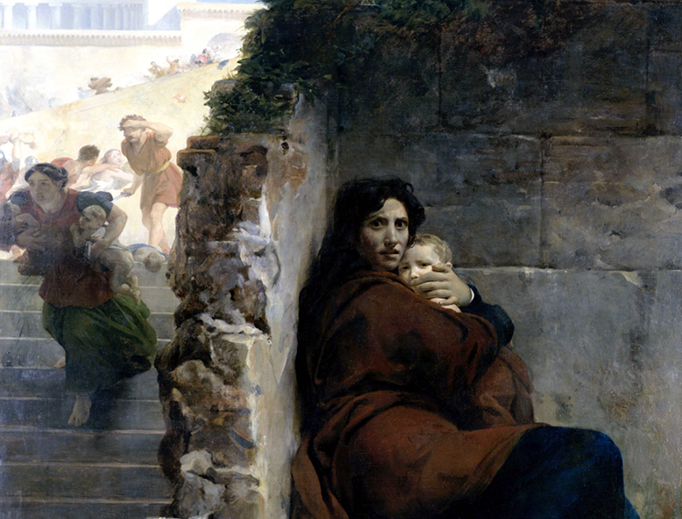
Disturbing Feast Day

Léon Cogniet (1794-1880), “The Massacre of the Innocents” (photo: Public Domain)

I don't like the feast of the Holy Innocents. That was my main thought as I prayed Morning Prayer at church this morning and chose hymns to play for the morning Mass. In every Jesus movie where the slaughter of the innocents is depicted, I flinch and pull my blanket up a bit to hide. When my children were small I just flat skipped over it. It's a horrible thought and it's even more difficult to figure out how to enter into a liturgical celebration of a horrifying event. Babies saying "yeah! We were killed for Jesus who got away safely!"? What are we doing here, celebrating how great it is to be killed? What will we do next, celebrate child soldiers who join our bloody causes without any ability to comprehend the evils involved?

So I turned these things over in my heart this week. And I found my way clear of that disturbance, to a better and deeper one.

The liturgical calendar can be like the quiet cousin at the Christmas gathering who frequently gets upstaged by the more boisterous guests: feasting, gifting, more feasting, more gifting. But when we learn to celebrate Christmas with the calendar, we are brought right away to martyrdom with St. Stephen, to contemplate loving union with Jesus with St. John, and then to the gory effects of violence and fear in the world with the Holy Innocents. The Incarnation is so incredibly mind-blowing that a lifetime would not exhaust the depths of how God desires to impact us with it. But the liturgical calendar makes it quite clear that union with the incarnate Son of God preps us not only for eternal glory, but also for transformation into His image on earth. And He was "a man of sorrows, and acquainted with grief" (Is. 53:3). 

One of the deepest causes of grief is sin which causes innocent people to suffer. That could be simplified: Sin causes grief. 

Herod ordered the destruction of life because of his fear, his clutching at power, his arrogance. The thought of sharing the stage with someone, let alone bending his knee to reverence Another, was totally foreign to his soul. Those who carried out his orders were formed in a milieu that accepted force as a higher good rightly served. It's just a few children. 

This is the world Jesus came into, as one of the vulnerable. At this point, the Scripture text makes it clear he is totally dependent on Joseph's ability to receive a directive from God's messenger: Take the Child and His mother and flee. I wonder at the role that Israel's far history of pain and suffering, and  Joseph's, over Mary's pregnancy, prepared his heart at this moment to respond in complete detachment and obedience to just go. Pain and suffering are evils. Pain and suffering, united with the heart of God, become portals for God's glory to shine on earth. That is redemption. This can be pondered, but it is known most purely in the experience of it. Joseph in this moment obeyed God and this obedience preserved salvation for the whole universe.  

I take away two things from this. Union with Christ is a call to His vulnerability. We lay bare our hearts which are wounded and woundable to each other, to God, to our own gaze. I've been the worst at beating and castigating my own self for simply being, believing it to be a great fault. I have walked the path of learning to trust God and wearing Him down at every step, begging for certainty and protection instead of going by faith. I've done the chip on my shoulder, angrily raising walls against others, preemptorily blocking them out of my heart for fear of the harm they might bring. I've done stupid dependence on people who proved I could not ultimately depend on them as my gods. But God's vulnerability draws us into eternal peace. "Nothing will hurt or destroy on all my holy mountain" (Is 11:9). It's true.

Second thing: I must open my heart to the Lord, looking in His light for how I am like Herod. How do my attachments cause me to trample others underfoot? How do I exercise oppression to get what I want? How am I totally cut off from the hearts of others in their joys and sufferings? And how can I experience the same transformation Joseph did, that deep attachment to and freedom for the Lord? 

Jesus enters straight into the suffering of the innocent, and union with Him brings us there as well. May we repent of everything in us which is poised to cooperate with Herod. May we entrust ourselves like Joseph, in our own vulnerability, in the interdependence which is ours. May we walk by faith in God who does not exempt us from dark nights, but who is trustworthy.

Tuesday, August 09, 2022

A Gift of Grace

Six years ago today, something profound happened. In fact, it was so profound that six years later I know I'm only beginning to take it in and live by its truth. 

At the time, I wrote about it here, surrounding the main event in lots of context. By the sheer grace of God, I had the rare presence of mind to take a short video while this striking thing was happening. You won't see what happened, because it was interior, (you won't see much of anything due to camera and videographer quality) but you will hear something lovely:


This was captured on my last full day in Poland, after a month-long pilgrimage during World Youth Day in the Year of Mercy. Personally, it came at the end of a stormy period of several years where God was teaching me my vocation to love and purifying my heart in some really painful and humbling ways. It was during this juncture that I started formation as a Secular Carmelite.

I wrote a lot about the whole trip in a blog called A Pilgrim in Poland, which is pretty good. As I have begun re-reading, I've learned some things. I recommend it. 𝨾 

I think the most profound things are not "new truths," but the grace to believe truth.
Looking back, here are the graces I have received:
I know that God is Love.
I know that God loves me.
I know that His love is immense, powerful, personal, intimate, insistent, edifying, knowledgable, big, deep, wide, unconditionally available to every living being, fiery, awesome, desireable, healing. 
I know that His love is pain-inducing to the degree that we resist being love-shaped, to the degree we grip our fists, try to possess out of fear of loss, try to feed our addictions and our brokenness. 
I know that He is bigger than our wounds, and that we all have wounds. 
I know all human beings are made not only to belong to God, but to belong to each other.
I know we need not only God to be holy, we need each other. God made it that way. He makes us secondary causes of holiness for each other.
I know He has called me to Carmel to learn to be Love in the heart of the Church. To live in God, and God in me, on this earth, immersing everyone into the ocean of God's mercy and love (which is His heart, the Holy Eucharist, the Blessed Sacrament).

And while there were years leading up to being able to receive this, and while I am still working it out (and it will remain my life's task until I die), I know that on this day, six years ago, there was a significant grace deposit made, where in a prolonged instant, God gave me this.

Here's a secret. One of the songs the quartet played was Blue Moon. It was actually a pinacle moment of personally receiving this. It is why, on the rare occasion when I go to a restaurant and order beer, I order a Blue Moon. It is also one of the many graced musical moments in my life that make me a devoted non-stickler when it comes to the question of what kind of music God can use to minister life.

The only possible fitting thanks I can think of is to give my entire life to Him, trusting the Lord totally to take care of everything. Amen.

Sunday, December 13, 2015

An Advent Examination of Conscience

An examination of conscience is very important, but the term is not one I use much. I once thought it required me to mentally castigate and punish myself for everything I did wrong, and since as a child I had learned that I was incapable of doing good, I had a hard time getting past the need to accuse myself of the sin of existing. Bad theology really messes with the mind.

So instead I find it helpful to review my day and look for where I experienced God most profoundly, and how it changed my day, and how it needs to still change my day.

Today, that was fairly easy. The first whaabang was in praying the Office of Readings this morning, especially in the reading from St. Augustine. The readings about St. John the Baptist almost always strike me very profoundly, because God gave me a personal gift of a St. John in my life. This line especially: "We should take our lesson from St. John the Baptist. He is thought to be the Christ; he declares he is not what they think. He does not take advantage of their mistake to further his own glory." I could never really put into words how that made me weep, but consider how not only easy but common it is for one person to take advantage of another, but what an act of love and honor of God it is to choose to humble oneself rather than hurt another person. And how rare that is. For a person to put the honor of God even above how they wish to be received by another or what advantage they want for themselves -- that is a big deal. And when I could have truly been used, I instead encountered this witness of honoring God. Today I wept in gratitude for that. And I know that those tears washed yet clearer the true image of what I was spiritually perceiving.

The other moment was at Mass, while singing the communion hymn. I thought of how grateful, how content, how peaceful I am, not because everything is perfect, but because I was there with the Lord who has given me so much, has set so much at rights, has surrounded me, provided me with everything I need to be happy. I have no blind eye turned to what could be better, but that is so much my natural inclination -- seeing the problems, seeing the lacks -- that it is so beautiful to me to just say "I am here, and it is good." It is God's love that fills me and enables me to be grateful, satisfied, peaceful. And love bubbles from me and seeks others. That is not natural to me, and I know it full well.

I did other things throughout the day, I got tired, I began to take on other people's emotions. I had an interesting extended experience of thinking about who I was 20 years ago as I finished watching a video I took when I lived in Japan. Listening to myself talk (so sarcastic, so pain-sopped, so disconnected from other people) was deeply cringeworthy, as my son put it. I faced other aspects of my life that are problematic.

But then I thought, examination of conscience: go back to where I experienced God, not my own misery. With God, He teaches me to have mercy on my old self, understanding the pain that motivated me, while honoring the courage. It is a recipe for every day, and not only for myself. Have understanding for the pain that is behind others' actions, too, honor the courage with which they act nonetheless.

But mostly, nothing trumps being with Jesus. He gives the best gifts. Sometimes it takes us years to fully appreciate them. Every pain we pass through in pursuit of Him is worth it. He promises us the difficulties, but he also promises the hundred fold. I have been so silly, but He keeps being more and more generous to me. All I can offer Him is all of me, anything and everything that He wants. Just want He wants of me. I am convinced that no matter what it is, it will always be the best possible thing.

Saturday, January 03, 2015

And This is Why I Love Epiphany

God frequently seems to use the liturgy and liturgical feasts to teach me personal things. Sometimes the nature of how this works is that something significant will happen in conjunction with a liturgical celebration of a feast day, but the significance of it will only dawn on me several years down the road. My initial conversion to Catholicism at a Christmas Eve midnight Mass is the most obvious example.

And another such thing is connected to the Epiphany.

The liturgy of the hours for Epiphany preserves the tradition that it has, in the past, encompassed the Visit of the Magi, the Baptism of Jesus, and the Wedding at Cana: the Illuminatio, Manifestatio, and Declaratio. The message is clear: Jesus is on the scene with power and He's changing things.

It took me quite a long time to realize how that applied to this thing that happened to me six years ago tomorrow, on Epiphany Sunday.

That would have been one of those moments that if I had been able to see into the future, I probably would have turned and run away as fast as I could.

I'm glad I didn't. I think.

No, no: I'm sure. And I have the scars to prove it. 

It had been a quiet life for Jesus, Mary and Joseph (as long has he lasted) until the time of Jesus' public manifestation and His first miracle. I can only imagine Mary's heart at the moment when she knew it was time for Him to move on. We make a lot of her request that moved Him to His first public miracle. I'm convinced it was not a giddy moment for her, but one of surrender to the Father. Her statement "Do whatever He tells you," besides the other volumes it speaks, I believe was her fiat to the Messiah's mission which any student of the prophecies must have known would lead to His death.


The rest of us see these glory moments and think Cool! Dude, I want in on this! She realizes that the glory of God comes at the price of suffering and death. Which hearkens back to celebrating martyrs right smack after Christmas Day. Did the Church make some awful blunder in scheduling St. Stephen and the Holy Innocents? Of course not. We make the blunder in forgetting that Christmas flows into Epiphany which flows into Lent which flows into Holy Week, Easter, Ascension and Pentecost. Jesus' birth is the beginning of the pascal mystery.


Christmas is often presented as a sugar-coated fairy tale. But God is born into a world where there is also a great deal of suffering and misery. -- Pope Francis 

And God came to live that suffering and misery with us, as one of us.

And, you know, in my book, when there's suffering and misery and God shows up, that suffering and misery suddenly get changed. Where God is, there is delight. Even when the glory points to a cross, which points to glory.


Funny. Seems like I wandered far away from the purpose I started writing with, which was to remember that Epiphany six years ago when God used the liturgy to show me something I didn't understand yet.

But this is how it works. And that's all I've been talking about.

Saturday, December 20, 2014

Loneliness and Christian Emptiness


Earlier this week, I came across this quote which speaks volumes to me:

God looked over the world for an empty heart -- but not a lonely heart -- a heart that was empty like a flute on which He might pipe a tune -- not lonely like an empty abyss, which is filled by death. And the emptiest heart He could find was the heart of a Lady. Since there was no self there, He filled it with His very Self.
~ Fulton Sheen, The World's First Love: Mary Mother of God
In a manner of speaking, one of God's goals for us is for us to become empty. This emptiness, of course, has to be understood, as Sheen's sense has it, in the Carmelite way. Empty means ready. Empty implies availability, and it implies purpose and community. One is available for something, or rather for Someone.

It speaks, of course, to the scene of Joseph and Mary journeying to Bethlehem, looking for available space where Jesus might be born. Is my house, am I, available? Not much is made of this in Scripture, but much has been made of it in meditations such as the custom of Las Posadas

The enemy of this kind of emptiness is loneliness. When I read this, the naru hodo alarm rang within me as my personal history instantly shot up multiple instances of proof of this. Oh my goodness how my nature has recoiled from self-emptying for fear of loneliness, of that sense of being left out of the life-stream that certainly everyone else was deeply enjoying. The voices that speak contrary to truth: the world, the flesh and the devil, scream that I must have things, people, experiences that fill me, things I can possess, things I must hold on to to stay afloat. For certainly life revolves around something I don't have but need, or something I don't have enough of, or something I might lose, or something someone else controls and I have to posture myself in order to receive. Certainly without having, I am nothing.

Right?

Um, no.

In the midst of frantic craving I lose sight of reality. Reality is that the God of the universe, the Blessed Trinity, created me for a purpose. My purpose is to love and worship God in a holy communion of persons. I worship God as I lay down my life, as I empty myself and empty from myself all lesser pursuits.

I do this not because I am a masochist and don't believe in or want good things for myself. It is not Christian to understand "empty" in the sense of "denude." I do this out of great faith in the One who reciprocates my emptiness with Himself. The availability we offer to God is always for communion. God's ultimate goal for us is union with Him, not for us to become simply a great void. As I relinquish my obsessive self-factor I see that God loves, gives, and is deeply merciful in response to enter into human misery and to be, literally, God-with-us.

To break it down and make it real simple: faith in Jesus calls me to abandon everything to Him in love. I long to be empty, I agree to be emptied, I move towards emptiness because I know, love, and trust in the One who fills. And that infilling is what every smidgeon of my being longs for.

Oh yeah, there might be long, painful gaps where there are no blissful feelings. Stuff of earth feels useless and the bliss of heaven is nowhere. You experience loss, dependencies will be broken, and temporal security will be shaken.

But I believe and trust in the promise -- no, in the One who made the promise. He is faithful. He is true. I love Him; He calls me. To wait for such a One in emptiness is not the death-filled abyss of loneliness. It is the strengthening and deepening of love. It is worth giving your life for. In fact, it is the only thing worth giving your life for.

Monday, December 15, 2014

Hope, Heaven, "Epiphanic Pointers"

I value words highly. I especially value words that are able to convey something that is deeply meaningful to me. Sometimes I'm not able to pull it off myself, but I find someone else who has. That's when I post quotes.

"Hope is the virtue that prevents us from setting our hearts on this world as the final aim of living. Knowing how much more awaits us in the life to come, we shed all clothing that would kill or erode this hope. Thus we learn the greatest lesson of Christian commitment: how to live in this world in service to God while at the same time rising above the things of the world (cf. John 15:19). I mean things insofar as they are seen as merely worldly rather than as epiphanic pointers to the Most High. We thus comprehend what it means from experience what it means to care for the persons, situations, and things entrusted to us by God without tarnishing our green veneer of hope for the home He has prepared for us from the beginning."

Susan Muto, St. John of the Cross for Today: The Dark Night, p. 277, emphasis mine.
 I have waited years to come upon this phrase: epiphanic pointers. Yes. 

Tuesday, March 18, 2014

Remembering My First Love

I went to Mass for about 18 months before I received Confirmation and entered the Church. All that time I already knew I would become a Catholic. All that time I had a lot going on inside of me. I really had no human being to accompany me; those who had been instrumental in my conversion lived far away from me and I saw them very infrequently. Letters were our contact. God gave me a lot of graces in those days that I realize now were a little unusual. I also had heaps of pride and prejudice to work through, and no, there's no oblique Jane Austen reference there.

After I decided to become a Catholic, God really had only one directive for me: "Be going to Mass." I understood the Lord meant I should go to daily Mass, and I did, though it took me several months before I moved beyond Sundays only.

But even when it was just Sundays, I began to discover my first love. Liturgy.

There's that first kiss or first touch or embrace from someone you love that makes every nerve involved stand on end for a couple days. The physical memory seems indelible. I had those moments with the liturgy in those, my early Mass-going days. I remember how profoundly struck I was by the prophetic power present in the liturgical dialogue between priest and people. I was struck by how immanent heaven and all its treasures felt, and that I was being drawn up into it. I was amazed at how much work God could do in my soul in such a quick, efficient way, day after day. I realized that I had found my home and my family for the first time ever. I would come in sight of the tabernacle after my day at work and feel God's peace wrapping me up and drawing my weariness out of me.

But much of this mystical sensation was lifted from me quickly. The memory stayed, but my more regular experience was of my frustration over my own dullness and the lifeless way that seemed demanded of me, by general consensus, as this new Catholic family of mine celebrated liturgy. I had very serious struggles accepting the flesh and blood people next to me in the pews, and it seemed just as important to God that I learn to love them as Him. He always knows what He is doing as He leads His children.

I have come to a completely different place in my life now. I really have learned to love people. I have had some mighty lessons in that department.

And now the Lord calls me to remember my first love in the way He first introduced me. Maturity makes love make more sense, and there is always so much more room to grow both in understanding and in the actual action of loving.

I love the fact that no matter how long I have walked with Jesus, He is always doing something new with me, and I always feel I am just beginning to know Him.