Today is the feast of Our Lady of Sorrows, and I've been wanting to sit down and map some thoughts out for myself that connect here. It's been a hairy day, so I'm not coming to this from some great place of recollection. I'm going to dive in and swim through it.
Yesterday I wrote about the Triumph of the Cross and all those anniversarial thoughts. Today's feast has an obvious connection to yesterday's. Mary is the model of the Church -- whatever we see in her is what God intends, generally, for the Church. Of course her personal role is unique, because no one else carried the Son of God in her womb. But we are all called to bring Christ into the world. And we do it through participation in grace, just as she did, although in the way specific to us, and general to the Church.
And Mary at the foot of the cross is of course unique. And yet she means something for all of us there.
She means something for me there.
The homily I heard this morning made me aware that not everyone pulls out exact the thing from this feast that I cannot help but pull out. I feel like, for whatever reason, the Lord has formed me in a certain way where this is concerned. The homily focused on how Mary is with us to comfort us in our sorrow. In a way I guess she was there to comfort Jesus -- I mean, where else would she have been right then?
But that's not what stays with me here. Somewhere in this blog I have probably written about a dream I had when I lived in Japan that stayed with me in a way only a few dreams have in my life. It stayed in a deeply instructive way that I've returned to again and again. Ah yes, here it is. It was just this April when I wrote about this. It didn't completely register with me that this dream is specifically about Our Lady of Sorrows. There has definitely been an invitation for me in this for decades: this call that she seemed to extend to me was to enter into this mysterious work, specifically of Our Lady of Sorrows. And it is about calling people to the deeper conversion of life specifically through no longer ignoring the reality of their own pain (shades of yesterday's post). The vice we tend to go for when we want to ignore the reality of our own pain in something akin to intemperance: gluttony, lust, excess. Addictions come in to play here, and numbing. All the various ways we voluntarily or involuntarily reach for the off switch for our pain.
Now, about a year before I began even thinking about the spiritual direction formation program I have just finished, I had an encounter with Our Lady of Sorrows and the seven sorrows rosary. I wrote about that here, which links to several other pieces of the story as well. The kicker there was that as I started praying the seven sorrows rosary, I got the distinct impression that the Blessed Mother was teaching me that the sorrows of life are not a place to camp out; they are a place to move through, towards the glory, Granted, life is full of sorrows. We are never free from sorrow while we are on this earth. That's a true, general principle. But the particular principle, the personal lesson, seemed to be a nudge from her that I had set my camp -- my mind -- in sorrow, and that it was time for an identity shift.
Now the absolute kicker of all kickers dawned on me the other day. Two years ago this evening, I was winding up the last piece of my very first in person Intensive of the SDFP. I encountered a line in a meditation that knocked me on my butt so hard that it also became a benchmark moment for me. And I just realized that, although it was Sunday and not observed that year, it was the feast of Our Lady of Sorrows when this happened. I suppose I wrote about it several times, but this is the first time the story appears. On this blog, at least. And I realized then that Jesus was calling to me to follow Him. That if I had thought I knew before what it was to follow Him, I was about to have quite a different experience.
And I was to get extricated from an identity rooted in sorrow.
And I was to learn authenticity in following Christ. Christ is Aslan, not a lapdog. He is Lord and King, not my accessory.
And I hear and feel the searing heat coming through those words.
There has been a work going on. I've had to just look at a lot of very painful realities in my history. Some of these I tried to look away from for years. Some had to tear through feelings older than words in me, and it felt like my psyche itself was rending apart. And just look has also turned into just act, and I'm still working on that. So much reality to contend with.
So I came here to look at how Our Lady of Sorrows weaves through this. One of the things that was impressed on me that day that I was praying the seven sorrows rosary and walking through the park was that now, Mary lives in glory. Yes, she accompanies us in our sorrow, but she herself lives in glory. I can go way, way back to my days when I was on my way into the Catholic Church and recall another day that I was walking and praying and struggling with the issues of conversion. The Lord gave me a lot of graced helps in those days. I didn't actually have any human beings present in my life at the time who were helping me on my conversion road (only friends I wrote to -- back in the days before computers!). So the Lord came to help me very generously. And that day as I walked, He impressed on me these words: I want the glorious to become commonplace in your life. I don't know that I'm there yet, or that I've ever been close. Oh, wait of course it is true. It simply rarely feels like it in the moment. But that's a poor measure of reality. For one, I've been going to daily Mass (with a few chunks of exception) since 1992. That's glorious. But when I think of that, I think of my interior experience. I would love to feel glorious. Maybe that's not how this works. But I know that camping out in sorrow (and the anxiety and etc that goes with it) does not help matters. Again, it's the personal call. I've been experiencing God re-rooting my identity to align with Him, to align with reality.
I don't know exactly where we go next, but it is fascinating to put all these things together and ponder them.
The cross of Christ is the most horrible and horrifying, absurd event in human history. It is also the catalyst that changes everything, conquers death, unleashes divine mercy, and ushers human kind into eternal life. That's some awesome, glorious thing to be standing near.
Tuesday, September 15, 2026
Our Lady of Sorrows


Friday, September 11, 2026
Not Pridefully Nor Begrudgingly
I went to Mass today at the hospital where I am now employed. It's a very small congregation that shows up for that, and at the beginning of his homily, the priest decided to ask everyone what their job is, or was. He is one of the Nigerian Franciscan University students, so he didn't personally know anyone there. He was applying this information to the reading from 1 Corinthians, so it really didn't come completely from left field.
But it sent me for a loop. I was the third person in order of answering as his eyes went around the room, and the question left me mentally scrambling. I believe I actually said I don't know out loud before I answered: A Mom.
There's some irony in my fumbling, because in part it brought me back two years to the day, to the beginning of my Spiritual Direction program. There, as I shared meals with my new associates, the topic often gravitated towards "What do you do?". I wrote a few blog posts or reflections on this very experience of suddenly needing to pull my identity into a neat descriptor.
Today, though, I could have said I'm a chaplain, because I am. But my mind fumbled through how I'm on-call though, so maybe my job is waiting for the phone to ring. But I also sell books. I also drive for Wingz. I'm also a spiritual director. Do I pick the one that earns me the most money? Which one has my identity?
Perhaps because the people in front of me were retired, my mind raced towards what I used to do full time. So it came out, I'm a Mom.
I could have said, "This question is too complicated," because that's what I felt.
But I listened to his homily unfold. He spoke of a job as an obligation God gives us, to be carried out willingly and not pridefully. Able to listen to others. Able to receive correction or suggestions from others. Not wishing you could just check out and go home.
And at the same time, what was unfolding in my head is how I have defined my sense of "job" since I started looking for one in my early 20s: Being Me.
It's not about being paid a lot for this task (I never have). It is really about my deepest desire, and something I am really only beginning to own.
And then what was forming in my head met his homily, and my eyes got a bit watery.
[Being Me] is an obligation God gives me. I am not to carry this out pridefully (and I've done that -- pride is really about masking pain). And I am not to carry this out begrudingly, or unwillingly as St. Paul puts it.
You know, I'd been asking the Lord to help me get ready for a good confession, and I think this spears it right in the heart.
There have been times I've thought about how I would be willing to give a kidney to a person I know who actively hates me. Absolutely, I'd be first in line to be tested. But to willingly and ungrudgingly embrace all that is entailed with being me? To refuse to muffle, silence, oppress, reject, deny the creation of God that is me.... ooh. Wow. An obligation God gives me, huh? That's pretty intense.
Yeah, I'm gonna have to think about that one some more.
Sunday, July 19, 2026
Words, and Hearts, and Saints
Part of my morning prayer routine is invoking the intercession of my prayer team of saints. I have a standard team that has been with me for I-forget-how-many-years, as well as my patron saint that changes every year at the beginning of Advent, and those I've added as I intercede for several specific individuals in my life.
My relationship with my standard team has been evolving, especialy over the last year to two. And by that, I mean that I'm aware of a change of need in what I think of as their "department." Essentially, I'm asking the Lord for different things.
My team consists of several pairs and a triad: St. Teresa of Jesus and St. John of the Cross; St. Teresa Benedicta of the Cross (Edith Stein) and St. Therese; Holy Father Elijah, St. John the Baptist, and St. Cecelia; and St. Joseph and our Lady of Mount Carmel. They are my constants.
I consider my triad my "words" department. And as I stop and ponder, the recent changes in my life where my "words department" is involved is somewhat overwhelming to take in. As my reality has changed, my prayer has adjusted to it.
For years I have prayed that my words would become a means through which God's power could be made known. I eventually adjusted that to specify the words that I speak, the words I write, and the words I sing, since that covered three major areas of my life. I changed that to include the words that I think, and the words I meditate on or ruminate on, because I realized the importance of what I let go through my mind. I've now added "the words that I battle with in my mind," because I had to admit that some of the words going through my mind are temptations. They come with an agenda to get me to doubt that I am loved and designed for intimate communion with The Word Himself. And my ultimate petition here is that my words in every category would arise from the place within me where I seek to live this union with God.
Words have always been important to me, but I've realized in the last year especially how trauma had impacted my "voice," making speaking up and speaking out -- in some moments and on some levels -- physically impossible. Big shout out to EMDR therapy for reaching into the depths to heal that.
I feel like I'm exiting a season of healing and excavation, and entering a season of healing and activation. "Use your words" takes on a whole new meaning, here. "Out of the abundance of the heart, the mouth speaks" is true in many ways. I was in a setting recently where I was told I appeared very confident, facing the prospect of a task that would require meeting strangers at their worst, most vulnerable moments. Do I feel ready for that? Of course not! It's very unsettling. But I can indeed find words there if I have gotten comfortable with my own worst, most vulnerable moments. And frankly, the Lord has been walking me through just that.
So our words (or lack thereof) show our hearts. Our hearts, in the Lord's hands, are safe, despite their breaking and aching, and all the scary traffic in and out of them. Our words reflect the truth of hearts back to ourselves in ways that can be incredibly hard to swallow. But our heart is exactly where the Lord wishes to meet us, exactly as we are.
Thursday, May 28, 2026
Renovation
I just want to give the Lord a shout-out and acknowledge how incredibly efficient, all-knowing, all-wise, all-loving, and how downright sneaky He can be at times with me. There have been many, many times that I have honestly said Lord, I don't understand what you are doing, but never once has it turned out that it hasn't been for my good. Not one single, solitary time.
And I'm all... Uh, Lord? Wait a second. Do you see how completely compromised my load bearing walls actually are?
And He's all... Yes. I've known that a long time. And now you do, too. What do you think we've been working on all this time? That work is actually done now.
It's a bit like waking up from exploratory surgery and getting the report of the dire situation the surgeon discovered and repaired while you were under anesthesia and time ceased to exist to you. Maybe make that analogy one better by entering into it from an accident where you blacked out as it happened, so you wake up never aware surgery was even coming. And then you get the revelation of the problem -- which shocks you and worries you -- until you realize it actually is now a crisis that has been averted and an injury that has been repaired. And you are left with soreness that indicates not something that needs solving, but evidence of the solution being past tense. This is what I mean by God being sneaky.
I actually came to a point where I felt so healed that I figured I was completely done. (Oh wait. The work was done? Really?) And then the Lord ripped out my structural support. Foul language rose to my lips. A lot of it. Because only then could I see how much devastation the Lord had actually replaced. And like someone getting the surgery report in post-op, my timeline got terribly confused and I relived every last bit of the devastation as if it were still happening in real time. That's what trauma does to you. And so while the Lord was trying to talk with me about future developments, all I could do is look at the wreckage and say that is my life.
No, child, that was your life. For a long time, that was your life. Truth is, I've installed an entirely new support system, and now, living stone, you will have a secure dwelling.
I really came here to write about the second reading from the Office of Readings from today. It's from St. Gregory the Great, who wrote without a modern understanding of psychology, but with perhaps a less tainted understanding of the human person, and how love of God and love of neighbor is by necessity predicated on proper love of self. He says of the man ruled by the love of God, "The prizes he covets lie within; outward blessings do not elate him. His conduct is blameless, for he cannot do wrong in devoting himself entirely to love of God and his neighbor. He is not ambitious. The welfare of his own soul is what he cares about. Apart from that he seeks nothing. He is not selfish...." (italics mine).
And now the Lord says, believe what I say, and receive it. Live in love, and begin with yourself by allowing Me to fill every last nook and cranny like I want to.
Thursday, May 14, 2026
Of Love and Needs and Clashing
This morning as I sat down to pray, I had one of those instantaneous downloads that crystalized for me exactly where I'm at in my interior journey. And that was this: I have had a severe, life-long disconnect between the notion of "I love you," and "I will meet your needs."
I felt a blaze of wrath of the Holy Spirit, not against me but on my behalf, against this disconnect. And I finally saw, on a human level, how being made in the image and likeness of God naturally makes us expect a connection between love and needs being met.
And I realized I have never once presumed my needs being met to be something I was within my rights to expect, or even really to conceptualize. It's not like I've debated it in my head you should be meeting my needs, and you're failing. It's that it had never occurred to me concretely that it would apply to me, or really that it applies to anyone. To be honest, it has been hard for me to even articulate that I have needs. I have stories I've told in spiritual direction several times, once as a teen, once as an adult, where I was terribly hungry or thirsty, but denied it as a reflex, even though I was physically suffering and the remedy was literally in front of me.
And this makes sense out of so much of my life right now.
I believe that because of the dependent nature of babies, we are born taking in the care we are given as the definition of "I love you," regardless of what that is. For me, somehow my sense of what it means to be in a cared-for relationship taught me that if I take in "I love you," it means I have just become the caretaker. Someone telling me "I love you" really translated into "I am dependent on you, and I'm weak, and I really can't do much for you at all." What a confusing message for a helpless child to take in. Because of course, care was given. Basic needs were met. Survival happened. And it all taught my brain that exactly food in the mouth and breath in the lungs was all life was truly about. Everything else was too much to ask. That which makes for human dignity is rightly kicked to the curb, locked out to whimper at the back door until it slinks away under the house in depression and neglect. And maybe, come to think of it, food in the mouth and breath in the lungs, under duress, really should end up in the "too much to ask" category. Because if my dignity can be booted, maybe survival deserves the same treatment. Probably so. And yes, I spent my later teenage years struggling hard with suicidal ideation. Under great duress, it still pops back up.
I chose to be a Christian already as a child. And my first responsive prayer to the Lord's call to me was, "I will go and be a missionary." That is, I know you are dependent on me to do for you what you need, and I will do it. Because I hear that you love me. And this is how I say "I love you" in response.
We all start our inner journey where we are. And so this starting point for me is not surprising. But to be transformed in Christ is to grow out of where I was, into truth. And He is so patient with me, and knows how to grow virtue in the graced soil of my soul that still has rocks and weeds to be removed. He knows exactly how to lead me. Even when it scares the bejeebers out of me.
Jesus tells us we are to love our neighbor as we love ourselves, and that we are to love one another as He has loved us. I think there's some geometric proof here that would say we therefore must learn to love ourselves as God loves us. Because here's the thing. As I have lived both in grace and in the fallout of this total disconnect between "I love you" and "I will meet your needs," I have learned that I should ignore my own needs at the expense of (genuinely) coming to the support of other people. And I have learned that God (genuinely) wants me to serve other people, but expecting him to act on my account is selfish. That love, i.e. living in the image of God, means to be the caretaker of the world, while my human dignity is locked outside, whimpering for attention until it slinks under the porch in depression and neglect.
And God says no. The way I love you entails meeting your needs. Look around you. You've made it a little difficult at times because of the ways you have reflexively chosen things, but look at how I have taken care of your needs, even when I had to slide things in sideways and keep secrets from you so I wouldn't scare you away. Now imagine what could be if you trust me more. Imagine what could be if you worked with me in this instead of against me. Imagine what could be if we were both pulling in the same direction, and you learned to honor your needs, own your needs, even insist on your needs the way I do. Your dignity is non-negotiable -- remember when I told you that? This is what I was driving at. You are making great progress, but it is time for you to really throw out the old and throw yourself into the new.
This is where I am at. Part of the flourishing of human (and Christian) community happens precisely when the needs of those in close proximity to each other clash. I learned to silence my clash instead of raise it. It's time to choose otherwise.
Wednesday, March 25, 2026
There's Abandonment, and then there's Abandonment
Right now, I really need the consolation of coming home from Mass in the morning and sitting down to write.
It's the feast of the Annunciation, and on this date in 1997 I left Japan and returned Stateside. I was leaving a very painful era of my life behind. It was a time of deep isolation which I tried to patch up with a bad relationship which I got swept up in against not only my better judgment, but in an embodiment of what I now know as self-abandonment. I understand self-abandonment to mean a set of learned behaviors that began in survival when a child felt unloved, unsafe, uncertain, insecure, and those learned behaviors reinforced the idea that the child's basic humanity was the problem in the equation. Where she felt unloved, she became hard and aloof. Where she felt unsafe, she locked herself up and away from threats. Where she felt uncertain, she may have become the mastermind that figured everything out. Where she felt insecure, she hid herself away.
This trend did not start when I lived in Japan, but it intensified. And it unfortunately locked into place a lot of trauma that I have only recently addressed and dismissed. And I chose to leave it all behind on the feast of the Annunciation, symbolically saying Yes to a new lease on life.
If only symbolic actions took care of everything.
Today it is the Feast of the Annunciation again. Again I am saying Yes to the will of God as it plays out in my life. I have just experienced a very significant relationship in my life rupturing. I'm not going to write about the details here, but while I have been well primed for this Yes, having exercised my will in case this day was necessary, it also ruptured very quickly, and so I am left dealing with how stunned I am.
Feelings and thoughts billow through my mind and my body, tumbling wildly, gently, tiredly, sadly. What I know is that I am not the victim of my self-abandonment any longer. I used my voice, I owned my needs, I stated my needs and pursued them being met, I accepted the rupture, and I moved away. I was not stuck in fear, in self-pity, or without an ability to voice my anger or my love. I did a damn good job with it.
I now know viscerally that being a human being is a good thing -- in fact it is a glorious thing. It is beautiful. It is not to be apologized for, disowned, flattened, or dismissed. Human love is typically so flawed; there are always hurty edges and messy bits. We go in directions that bring us healing and reveal our weakness at the same time. C. S. Lewis famously said in his work The Four Loves:
To love at all is to be vulnerable. Love anything and your heart will be wrung and possibly broken. If you want to make sure of keeping it intact you must give it to no one, not even an animal. Wrap it carefully round with hobbies and little luxuries; avoid all entanglements. Lock it up safe in the casket or coffin of your selfishness. But in that casket, safe, dark, motionless, airless, it will change. It will not be broken; it will become unbreakable, impenetrable, irredeemable. To love is to be vulnerable.
There is so much potential for pain in love, and yet God is love. The pain in us is part of the transformation and the mystery and the gift we become when we choose union with God and choose love.
St. Therese in her Little Way writes about abandonment to God. This is really the polar opposite of the self-abandonment. When she was a little girl, she believed she saw the capital letter T in the sky, and she told her father that God had written her name in the heavens. She then asked him to lead her by the hand, because she didn't want to look at anything on earth, but throw her head back and get lost in the contemplation of the heavens as they walked. Abandonment to God is giving oneself totally up in the ecstacy of the interior embrace of the loving God, writ large in the world that reveals it. It moves one beyond feeling loved, safe, certain and secure -- it is an immersion into Love itself. It is also a transformation into a soul of mission of being love.
Towards the end of another dark time of my life, when I was on pilgrimage in Poland, I heard the call clearly that I am called to love everyone. I was struggling with the loss of another friend, as well as an ongoing silence with another. I really struggled to love even one person when that call came through. I'm in a very different kind of place with my circumstances today. I've made a commitment to love which now takes on a cruciform -- so be it. My name doesn't start with T, but I see God showing me my call writ large in my world, and I too want to throw myself open to God's will, which is love and mercy itself. I am weirdly bouyed up in knowing I am loved by my partner in rupture. But what I need now more than ever is that immersion in God who is Love, and to walk by that trust into new paths. So I say Yes with Mary to the God who does all manner of amazing, impossible things.
Sunday, January 12, 2025
Confessions of a Closet Gnostic
As soon as I type "closet gnostic" I am anticipating one of my more intellectual readers taking me to task for theological imprecision, so right off the bat I am going to invite those feelings of Precision Demand to go outside and attend to their own domain, like monitoring the Earth's orbit around the sun, or whatever it is they are for. I'm here to speak a bit more poetically.
The gnostic I'm talking about is the one who says knowledge is the savior, and secret knowledge is for the superior elite (understood as themselves), and this invisible realm is where all Good resides. The body, matter, and that thereto connected is deeply suspect. An apparent necessary evil, to be escaped or avoided. Slapped on to a Christian package, this encourages practices such as spiritualizing: when one avoids dealing with matters that originate in the material world by framing them as having exclusively spiritual origins and solutions.
I'd say the opposite of this gnosticism is the Incarnation of Christ, and all of its ramifications.
And I think I am still a recovering gnostic.
It isn't so much that I started out being an enemy of my body or anyone elses, or the material world. But very early on I became an enemy of my emotions. I suddenly I feel like I've been dropped into a movie a little bit like The Kid where I am being invited to meet Small Child Me, or even Young Adult Me, and renegotiate a few things.
One of the things I need to renegotiate is the reality that emotions give information, and emotions are experienced in the body -- and stored there unhealthfully if they don't make it all the way through to expression.
I've been doing some somatic exercises lately, and I've just recently started a new set of practices designed to address traumatic experiences. This latter thing was designed by a Catholic woman for Catholic women, and now that I am finally actually open to something like this, I'm finding it very powerful. I have always kind of shifted uncomfortably in my chair when people would suggest, for example, beginning your prayer with taking deep breaths or being aware of your body in the space, etc. It just seemed too "woo-woo" to me. Intellectual things are my comfort zone, and all this body talk just seemed, I dunno, suspicious.
But what is the case is that as a child, I spent a lot of time in extremely tense environments. Parents arguing, parents divorcing, my father being so sad and miserable, my mom being so stressed, hiding at the neighbors house with my mom when they split up, Then there was my dad drinking, and when he would get drunk, he would call our house, and that telephone became terror activation. Mostly my Mom would yell at him and slam the phone down, or sometimes he would ask to talk to me, and I'd be stuck on the phone listening to him drunk rant. I don't know how many times that happened, but in my memory it feels like a lot. Of course, we'd never know when he'd start drinking, so sometimes the phone ringing was just the phone ringing, and sometimes it wasn't. Sometimes he'd talk to me when he was sober, but those conversations were usually apologies, and they were short. I remember one time, in the midst of my dad's phone calls, one of my sister's college friends happened to call, and my mom yelled something about "operator, trace this call" and hung up. When we learned later who actually had been on the other end, the whole thing became something to laugh about. That was so weird and confusing.
I remember this happening at least through to my teenage years. I suppose it became part of the normal warp and woof of my life. And it had a lot to do with why I shut down my emotions and ignored how this made me feel. It transferred over to basically numbing myself around other people entirely.
I have a memory from about age 19 that tells me how far I got with this. I had a friend at the time who was in her 30s, and she had two small kids, around ages 3 and 5. I started appearing at this friend's house somewhat frequently, as we were becoming Bible study buddies. One day when I arrived, her daughter, the younger child, greeted me at the door with an exuberant hug of my legs. I stood there, stiff as a board, and looked at her rather expressionlessly. I remember her face melting from a bright smile to something akin to utter fright, as she backed away from me. I had absolutely no idea how to respond to her, and she felt how abnormal that was, even though I couldn't.
Now, things have changed for me a lot. But I am finding there are some areas I still need to renegotiate and allowing myself to listen to my body and the emotions that do commerce there is not, after all, poppycock. I even have to retrain my intellect (aka learn!) to accept this as important information, and to make some shifts.
I've tried to erase my humanity, thinking that this is more spiritual. I'm pretty sure my prayer journals from past decades are filled with ridiculous and elaborate spiritual theories about why such and so was happening to me, when it really boiled down to: I'm not managing my emotions here. I'm denying my humanity over here. I'm avoiding addressing this conflict over here. I don't have all of the facts straight over there. It's not all about God testing me and it's definitely not all spiritual warfare and attacks of the devil, or elaborate communications from the Holy Spirit. Nor is it about my need to just try harder or beat myself up over stuff, or any other elaborate heap of chaff I've been able to create. So much froth, so little Incarnational Lord.
He is, however, incredibly patient with me.
This morning, I read the first Psalm from the Office of Readings (for the Baptism of the Lord). I found it striking.
O give the Lord, you sons of God,
give the Lord glory and power;
give the Lord the glory of his name.
Adore the Lord in his holy court.
The Lord's voice resounding on the waters,
the Lord on the immensity of waters;
the voice of the Lord, full of power,
the voice of the Lord, full of splendor.
The Lord's voice shattering the cedars,
The Lord shatters the cedars of Lebanon;
he makes Lebanon leap like a calf
and Sirion like a young wild-ox
The Lord's voice flashes flames of fire.
The Lord's voice shaking the wilderness,
The Lord shakes the wilderness of Kadesh;
the Lord's voice rending the oak tree
and stripping the forest bare.
The God of glory thunders.
In his temple they all cry: "Glory!"
The Lord sat enthroned over the flood;
The Lord sits as king forever.
The Lord will give strength to his people,
The Lord will bless his people with peace.
If this isn't physical imagery, I don't know what is. My embedded emotional paralysis can feel as immovable as a cedar of Lebanon, or like the very land itself, but the voice of the Lord currently speaking over me, I know, has the power to break that spell of death, and replace it with strength and peace.
Wednesday, December 04, 2024
Better than a Hallelujah
Recently I was reminded again of the song Better than a Hallelujah, which Amy Grant recorded in 2010. From the first that I heard it, it's been a tear-jerker for me, but now it strikes me on even a deeper level than before.
When I first latched on to the song, I was drew encouragement and consolation from it, because I was in a time of pouring out my miseries. I needed to hear that my mess was indeed beautiful, and that pouring it out to God really was better than a choir singing out... The hallelujah, well, that spoke to me of trying really hard to have faith and to stand firm, when all I felt capable of was crumbling.
We pour out our miseries
God just hears a melody
Beautiful the mess we are
The honest cries of breaking hearts
Are better than a hallelujah
Now it's some ten-odd years later. Now I'm in a formation program to become a spiritual director. Now this makes me weep for the sheer beautiful truth of it.
God just hears a melody
It's in fact the Song of the Resurrection, which He has written and He pours into us even as we are pouring out our miseries to God. "Give, and it will be given to you. A good measure, pressed down, shaken together, running over, will be poured into your lap" (Luke 6:38). It is precisely in those moments where we feel the most pitiful, when we cry out, that God is instantly reciprocating and pouring Himself out in return. It might take years to consciously receive, but "everyone who calls on the name of the Lord will be saved" (Rom. 10:13).
I think if there is one task of the contemplative spiritual companion, it is to bear witness to God's presence, who He is and what He does. In a way, it is what Amy Grant did for me (or rather Sarah Hart and Chapin Hartford, songwriters, did). The song affirmed to me, yes, it really is better to pour out your misery than it is to carry out mere religious action, even if that action is objectively good (and especially if it is just conformity for the sake of saving face or pleasing someone else). There is a messy point in life where honesty, for a moment, flies in the face of what is right, decent, and true. But the truth is, God hears through it. Hearing another human being affirm that pouring out one's heart to God is beautiful is enough to support faith until it becomes one's own interior knowledge.
Heaven knows there's no shortage of provocation to our cries of misery. It's a grace, actually. The misery itself? No. But the act of faith that knows there is God to whom I can turn meaningfully with it, that's such a tremendous gift.
In reality, most of the time these exchanges happen in excruciatingly slow motion. I don't just feel miserable for an hour, cry out to God, and then skip along merrily through my life, blessed beyond measure. These things require patience, stamina, and determination. I think it is like planting a fruit tree, and it is why it is ten years later than I can look back and hold the fruit in my hand that grew from a dead pit. This is the spiritual life. There is no quick fix, but there is real transformation. It's true!
As a bonus, here's the official video, telling its own story:
Tuesday, October 01, 2024
The Urgency and Simplicity of Love
It seems that the Lord enjoys inviting me to go spelunking with Him. I am one of those people who, if an invitation seems too good, like too much fun, I panic and turn it down, thinking surely if I enjoy it, there must be something wrong with it. I'm silly, I know.
This morning as I was reading, something caught my attention, and it feels like a spelunking invitation, so I'm here for it.
I was reading Temptation and Discernment by Segundo Galilea, and the section that caught my attention was from Part III, The Demons of Prayer, under the heading "Not Being Sufficiently Motivated." The author says that this distraction is all about being primarily motivated by felt need, whether emotional psychological. Then, the part that caught my attention: "Above all... the ultimate, persisten motivation for prayer and its solid foundation is the conviction that God loves us and offers us the gift of liberating friendship. If this truth of faith does not genuinely persuade us, our motives will remain shallow... (p. 48, bold in the original).
When I read this, I immediately saw myself as an intense 20-something, sitting in my apartment in Milwaukee, interiorly clawing myself something fierce. I desired God. I had the example of my charismatic fellowship which taught me to throw myself whole hog into studying the Bible and pouring out my soul, keen to confront every painful, broken thing in me. I had a collection of books dealing with "healing the inner man" which focused a lot of forgiving those who had done us wrong and exposing these hurts to God to fix them. I was in the habit of going to church and crying buckets of tears in those days, because I was aware of lots of pains, past and present. My family felt very broken, and I was verging on desperation for God to "bring me a husband," because I felt certain that having a husband was to experience being loved and having proof that I was worthy of love.
Ah, what would I say to young Marie if I were to meet her today...
I had some close relationships in those days, and honestly almost all of them netted more pain than good for me. One clear exception was my friend Ann (may she rest in peace) who was my prayer partner. We heard and supported one another, and she was even more interiorly quiet than myself. The others were men, and all of these were fraught with problems. My contribution to these problems I can trace back to one theme that I turned over and over in my mind in those days: I felt that I turned to God for fellowship and hanging out, and I turned to people to find my meaning and stability. In other words, I used God for what people are for, and I used people for what God is for. I did a lot of using, and not a lot of relating.
I was doing Christianity as hard and as well as I knew how. But I really missed the basics. We had a discipleship class that I took in order to get dunked in the pool at the YMCA (which I later repudiated as a "re-baptism"). I heard it constantly, but I was unable to take it in that the foundation of life is prayer, and the foundation of prayer is that God loves us. And that prayer is receiving the liberating gift of God's friendship. To the best of my ability, I was wanting to give myself to God, but in reality I was terribly bound up in myself. I constantly betrayed and beat myself up verbally and emotionally.
So, when this book Temptation and Discernment talks about the trap of going to God because of felt needs, I can testify that the danger is real. The enemy knew that my weak point was the desire for the love of a man (a natural good), and that I was not averse to putting a condition on God: if He would "bring me a husband" I would believe He loved me. Until then, I was going to agonize constantly and find reason to doubt whether what He says in Scripture is true.
And you know what? The enemy will use other misguided Christians. There came a point where my pastor at that time, who knew a small drama I was facing with one of the only single young men in the church, delivered what he said was "a word from the Lord" for me about God having a husband for me, and I in my deeply wounded credulity took it as gospel truth and affixed it to literally the first person who sat down next to me, who also happened to be the only other single young man in the church at that time. What ensued was several months, stretching into years, of me learning the very, very hard way the difference between standing on the Word of God and standing on foolishness. It's a long story.
But where sin abounds (and people's pastors mislead out of misguided compassion), grace abounds all the more. In the end, this became part of the grace that brought me into the Catholic Church, and back to the basics of the Incarnation of Christ -- the mindblowing reality that God came to live among us because of love. Because He loves us and wanted to live a human life so that we could share His life.
When we come to discover and grow in our relationship to God it is so vitally important to be rooted correctly. And correctly, here, means in the conviction of the truth that God is love. The He loves me. That he offers the gift of liberating friendship. Some of us get so entangled with so many other things, and they all seem so dire or so important or so pressing or so distressing. The wounds yell. But when they are silent, and God gets a silent Word in edgewise, it always will be, "I love you."
Monday, July 29, 2024
Hiking, Love, and Transformation

Eight years ago, I hiked in the Tatra mountains. Come to think of it, it was exactly this time of year I was there. The scenery was beautiful, but it was an emotionally wrenching time. Also, hiking sounds glamorous but it was grueling. At one point, my then-11 year daughter asked me why in the world we were doing this. I told her that at some point in her life, someone would use the metaphor of climbing a mountain, and this would teach her what that really means.
St. John of the Cross famously uses the metaphor of climbing Mount Carmel for growth in the spiritual life. Since he traveled all over Spain by foot, even though he was no soft modern, unaccostomed to physical effort, I'm sure he fully intended the implication that the human effort part of spiritual growth isn't easy.
One thing I remember doing often on the Tatra hike was stopping for rest and looking back down the path I had just come up, and then looking ahead to how much farther to our destination. I took some photos, fully thinking that when I got back home I would appreciate their beauty. At the time I was just trying to catch my breath, wipe some of the sweat off my face, give my aching feet and legs a momentary break, not think about whether I was going to need to pee in a nearby bush nor about the painful relationship issues that were clanging around in my heart, and will myself to move forward again.
Today I had reason to pause interiorly and look down the mountain I've been climbing spiritually. I was challenged by the reading we studied in my Carmelite community formation yesterday, where St. Therese talks about how she learned what the Lord means by His command to love one another "as I have loved you." She talked growing in specific, active acts of charity for two particular Sisters that she could not stand.
I've read Story of a Soul now countless times, and of course the Lord's command to love is not a new thing to me. But I was both convicted by this, and led to take this particular pause on the mountain and look back down and my lived reality, in order to start back up differently.
What I saw clearly in looking back is that in my early life I developed a thick, defensive shell against the people around me. I was a well of pain, and felt I personally was the cause of every broken relationship and every moral failing around me. The defensive shell kept me from feeling my own pain and perceived failures, and kept other people at a distance so they could do me no more harm. Both the well and the shell grew with me, never quite adequate for my need. I was constanly anxious to pull myself in.
God was at work by His grace, even as I was at work strictly regulating human contact. He had a much easier time reaching directly into my soul to bring me what consolation I would allow in. Increasingly, he would use the ministrations of people, and so by the time I was an adult I had let a couple of people into my circle of trust. Mostly, these were people I did not actually interact with except by an exchange of letters or a visit every couple of years. But they were like pilot lights to me that kept me alive. That was all I allowed. Mostly I learned to endure people, or to cope until I could escape their presence and actually relax and breathe. Hah, who am I kidding. Relax? I escaped their presence and crumpled into an anxiety I never even let myself feel.
The process of grace transforming my heart made its steady progress, despite my lack of understanding (mostly) of the problem or the cure's path.
A key moment in this hike was clearly visible today. I remembered a crisis conversation I had with my pastor and a small group of people where I had managed to create a lot of hurt. My pastor simply pointed out that God called me to love everyone equally. I felt as if he was asking me to juggle boulders, because just then my felt choice was between hating everyone and allowing God to help me authentically love one human being in my faulty way. "Loving everyone," if I was honest about it, was nice Christian gibberish to me.
He had the right answer. But it was lightyears from my experience, because I was still operating in the mode of allowing, possibly, one person at a time into my trust. Except this time, it was a real person. It reminds me of a scene from some TV show I saw ages ago where a psychopath would steal female corpses and tie them to a table in a freezing room, pretending to have dinner with them, and then he finally kidnapped a living woman he admired and tried to do the same with her. He saw this as great personal growth. He was the only one with this perspective. 😏
When I was in Poland, same trip as my Tatra hiking experience, and a few years after that difficult moment of counsel from my pastor, I had an experience of being prayed with by some Polish-speaking women. One paused as she was praying, and said to me in English, "God calls you to love everyone." The Lord had said the same thing to me in prayer a few days before. This is how patiently God works our transformation. As soon as we are ready to open our hearts for more, He's there with what we need.
And as I climbed the Tatras, I struggled with a different real-life relationship, and felt the grueling process of handing over to the Lord the hard-fought trust in my friend that I had developed, and my fear that He would leave me, that His love wasn't real, wasn't enough, that my vision of the world that caused me to build shells and stare into wells in the first place were all there was to reality. I was trying to choose this loving everyone, or as the Carmelites call it, chastity. In reality it was a beautiful moment, but it was surrender at the point of exhaustion.
And then there's today.
I am free, now. I came back from Poland with the unshakeable confidence and knowledge that God loves me. And a lot more has happened more recently than that. Today I know that the love God pours into me is eternal and infinite, and I do not need to bind my prey. We are all made with the same design, and we even all tend to malfunction in the same ways. I am called to love everyone with the Love God pours through me. And this is tested by those who are most disagreeable to me and where my natural bend towards self-protection activates. Like St. Therese, I can choose with my will to allow the Lord to love through me. And in fact, I am called to it.
That's the thing, today. I'm free, and I get to choose what I do with my freedom. It's not just that loving everyone is possible or that it is a good idea. I am called, daily, to make decisions to do and to choose the loving thing. It's so easy for this to get bogged down and mired in psychology and just human evaluations of what is best and reasonable. But, going before the Lord and simply suiting up for growth in virtue and acts of charity is the key. My former pastor used to always say, "At least you can pray for them." I think I always heard that as a cop out. But to sincerely pray for a person you don't like to deal with is definitely an act of charity, not an act of dismissal. And I realize I need never be afraid, because I am never on my own doing this. It is not me who loves. I know, by looking down that mountain, that I just DO NOT HAVE a natural capacity for loving people. God had to reconstruct everything in me that is involved in loving. The fact that I do love is evidence to me that God has transformed my soul.
When I got to the top of our hike in the Tatras, we weren't, of course, at the top of the world. The mountain went on to the right and to the left. In fact, it was considered just a starting point for the more strenuous hikes. What I had climbed was labeled "Family Friendly hiking," meaning even children did it. I literally saw ladies in heels doing my path. I wonder what it would feel like to go do it again. By the time we got back to our cabin that evening, I could not walk because both of my knees were like water.
This also teaches me something about the spiritual life. The small things we do (or avoid) every day impact greatly who we become.
Let's start today and be diligent in allowing the Lord to love us, and to love through us.


Saturday, February 17, 2024
Joy Comes in the Morning

This morning as I enter into prayer, I find a strange gratitude welling up inside of me. Gratitude in general is unusual enough for me. But I review scenes of my past and find them a wellspring of gratitude that I wasn't expecting.
Let me be clear. I'm not grateful that these things happened. Bad things happen to everyone, and God is not some ogre who gets his jollies from this.
When bad things happen, I at least (and I'm guessing this is rather true of everyone) become an expert wall builder. I don't want to feel the bad thing, so I wall it off. I snip the nerves that connect me to the experience. When you lay on your arm or leg and it goes numb, it feels heavy and useless, but it doesn't really hurt. It is after you free it that it starts to hurt. So a common and maybe subconscious reaction to emotional pain is to numb it, one way or the other. I have always done this with my mind. Some people do this with addictions. It's all the same mechanism, I think.
So part of the wonder is that all of this is now out of anesthesia. What was master is becoming servant.
I can trace through a whole list:
My father's mental illness and alcoholism, apparently in full swing already when I was born. His absence, in turn with my parents' fighting. My parents' divorce and my mother's stress and an utterly tumultuous relationship with my dad (for all of us). Feeling like a piece of furniture in a house rather than a member of a family. Gut-wrenching desperation and fear over chronic singleness, concurrent with toxic and sometimes abusive relationships with men who proverbially had red flags tattooed all over their faces. Anger and desperation over infertility. Spiritual confusion all along the way over what God's love actually is and layers upon layers of deception that I embraced. And the terror of trusting through actually being healed.
I am not grateful that a single bit of that happened. Except that last word, of course.
I am grateful to realize that God, by His Spirit, was closer to me than I to myself, through all of that. He never abandoned me. He never gave up on me. He never lost patience with me.
Why didn't He stop it all? In answer to that, I'll invite you to watch Season 4 of The Chosen. In this world, things are unleashed. It's the way things are. Jesus did not come to stop the bad things; He came to go through them with us. He gave me the dose of grace I could handle, and infinitely more than I deserved as I consistently rejected and resisted His efforts to draw me closer sooner.
The end, the telos, of humankind is not a happy life on earth. We are made for something much more profound than that. We are made for union with God, forever in eternity, and with eternity starting now and entered into now. And as I see my past and see Jesus with me (which I absolutely, totally and completely, could never see in real time) I see the capacity I have within me now to receive the life of God into me. If I'm a thimble, God will fill me and I'll be a full thimble. If I'm a bowl, God will fill me and I'll be a full bowl. Swimming pool, crater, canyon. We don't have to make hollowing ourselves out a project; life does that. God will always, always, pour out Himself more abundantly than we can hold, because His love is always beyond our power to hold. Our work is to receive from Him and believe what He says.
And I know that whatever may come, this is the reality. I don't like pain and suffering. But I also don't have to fear it or dread it. Because God is faithful.
Weeping may endure for a night, but joy comes in the morning. (Psalm 30:5)
Saturday, January 06, 2024
A New (Leg of the) Journey
New years and new things may suggest each other, but I'm not one to choose some big newness project on January 1. Gosh, even writing that feels exhausting. Life is exhausting enough normally; I don't need to resolve myself any further.
This new leg is more something I am sensing I need and agreeing to.
I think it just follows on what the Holy Spirit nudged me with last Good Friday with this line "everybody suffers." The second biggest take-away I had after I started praying the Seven Sorrows Rosary was that the suffering we experience is not meant to be a place to camp in, but a place to pass through, on our way to the glory of God. This little revelation came to me as I was out for a walk one Spring day, and I think these little revelations are like slow-blooming flowers, and they are meant to hold my attention for a long time, because they are gonna need awhile to really sink in.
I slipped into a blog post here and there last year that I've been dealing with anxiety more frequently than ... well, more frequently than I'd like to be the case, and more frequently than I'd like to admit. And more intensely than what has been normal for me. In fact, one Spring day I had a full blown panic attack, which hasn't happened for years, and really only happened to me one other time in my life, to my recollection. In the same time period I also had two episodes of anxiety hives, which was completely new. This got my attention and both by plan and sort of by happenstance I made some health changes, including ditching my exercise plan which was itself stressful and taking up one that fit me so much better, and was more demanding in good ways. I also completely gave up drinking coffee. I can't tell you how much good that did me. Between the two of these, my cortisol belly has all but disappeared, and my clothes fit me happily again. I'm also not completely freezing and interiorly curling up into a ball all of the time, despite the fact that our furnace has been functioning questionably for a solid month.
So all these are good things. But I know they aren't all that I need to address. I don't know -- yet, completely -- what I don't know, but I recognize certain sticking points in my life that don't just come out of nowhere.
One tell-tale thing happened New Year's Eve. I read a friend's Facebook post that was a list of "23 ways I have seen Jesus' love in 2023," with the challenge to follow suit and post your own. I tried it. I started, but I couldn't finish it. I found myself focused on, Oh, that thing -- it wasn't nearly as bad as it could have been and I was worried about this, but it turned out ok and This really sad thing we survived ... It was all so heavy. And I thought of a few uplifting things but found myself afraid to share them publicly. Now, that's kind of a new one for me. I didn't like how this whole thing felt.
Normally I pray about stuff like this, but I've really got nothing, there. No gush of words tumbling from the heart faucet. But I've been going back to St. Ivo and thinking of the Holy Spirit as the Advocate. So, I've prayed the Veni, Sancte Spiritus. Come, Holy Spirit.
My favorite Carmelite, Fr. Iain Matthew, OCD, mentioned in one of his talks that, when it comes to allowing God to love us, one of our biggest difficulties is that 90% of us is in the deep freeze. It's there, we have it, but we can't really access this part of ourselves. This image and phrase has been tumbling around a bit, in this process. I want to love God with more of me. I want access to more of me to love God with. He deserves it.
So, I'm praying this way, and as I'm working through my used book inventory, getting stuff listed, I come across the book More Than Words: the Freedom to Thrive after Trauma by Margaret Vasquez (who just happens to be a regular at my parish). I set it aside to read, because it look valuable -- for someone else I know and what they are going through. (heh)
So, I read it.
We pause here for the classic peanut butter and chocolate collision meme, signifying the creation of a new wonderful reality.
So I've ordered her second book, Fearless: Abundant Life through Infinite Love, and I've begun listening to her podcast about the integration of spirituality and human formation. This is a theme that Dr. Peter Malinowski also speaks and writes on at Souls and Hearts.com that I've been loosely following for a couple of years. But I know there is something for me to address, and I'm going to guess I'm going to discover it as I kind of make this my winter's work.
One line that struck me from one of her videos was to the effect that God has more love for me than I need to heal my trauma symptoms.
I think new avenues of growth await me. These often involve a good deal of falling apart, but I figure I'm gonna do that, regardless; or if I don't fall apart I'll just get stony and unfeeling, and I really don't want that. I really don't.
So, here's to the journey.
Friday, December 30, 2022
Both Sides Now
When I was younger, I prided myself on everything.
Other people seemed so lazy. They would tell me of the one thing they had planned for that afternoon, and I thought how I could do that in five minutes and thirty other things as well. Other people seemed so stupid. They struggled with things that had such obvious answers to me, as if they didn't even know how to think. They were always complaining of their struggles. I forced myself through things and pushed all the pain away. When I had breakdowns and couldn't cope, other people were uncaring and went on about their business around me in the most callous way. It was clear to me that I was superior in practically every category, and that if people would just listen to me, they would learn a lot.
When I was younger, I was really lonely.
I was filled with anxiety and didn't even realize it. I was afraid at every turn that I would be literally abandoned by those who were supposed to care for me, or that my house would burn down or that I would be killed. I had no reassurance that any other human being had my back in any way that I could rely on tangibly. The good in my world had to come from me, and therefore had to come from the few things I could do well. Working hard to be independent was survival and mandatory. I was always disppointed that I seemed to struggle far harder than I was rewarded for; the crisis was always too small for my effort.
I thought people were hell. God had to teach me that heaven was people. Community. Communion. Outside myself, or rather, people allowed in. All the people, all the way. God's own way.
Jesus Christ gave me His body and blood, soul and divinity. He said, it's for you, and for all. When I came to Him for peace, He told me He's a package deal. "Unless you love the brother you have seen, you cannot love God whom you have not seen."
"I will take from you your heart of stone, and give you a heart of flesh." (Ez, 36:26).
God's design was never for me to be a prideful machine or to be lonely. Humility enables intimacy to be, thrive and grow. Jesus Christ wants us to learn meekness and humility from Him so that we can actually experience joy and life, beginning here and now. Purification from our sin hurts like hell. But living in our sin hurts like hell. It all depends whether we face going deeper into anesthesia or farther out into freedom.
I choose the pain of life, freedom, and love.
Wednesday, December 28, 2022
Disturbing Feast Day
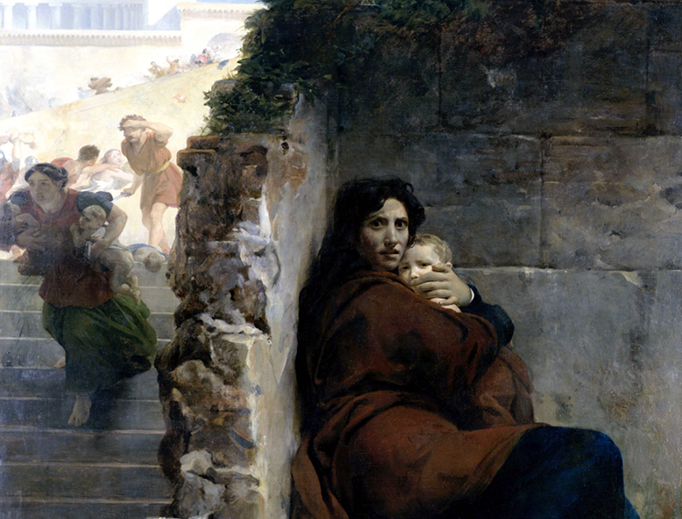
I don't like the feast of the Holy Innocents. That was my main thought as I prayed Morning Prayer at church this morning and chose hymns to play for the morning Mass. In every Jesus movie where the slaughter of the innocents is depicted, I flinch and pull my blanket up a bit to hide. When my children were small I just flat skipped over it. It's a horrible thought and it's even more difficult to figure out how to enter into a liturgical celebration of a horrifying event. Babies saying "yeah! We were killed for Jesus who got away safely!"? What are we doing here, celebrating how great it is to be killed? What will we do next, celebrate child soldiers who join our bloody causes without any ability to comprehend the evils involved?
So I turned these things over in my heart this week. And I found my way clear of that disturbance, to a better and deeper one.
The liturgical calendar can be like the quiet cousin at the Christmas gathering who frequently gets upstaged by the more boisterous guests: feasting, gifting, more feasting, more gifting. But when we learn to celebrate Christmas with the calendar, we are brought right away to martyrdom with St. Stephen, to contemplate loving union with Jesus with St. John, and then to the gory effects of violence and fear in the world with the Holy Innocents. The Incarnation is so incredibly mind-blowing that a lifetime would not exhaust the depths of how God desires to impact us with it. But the liturgical calendar makes it quite clear that union with the incarnate Son of God preps us not only for eternal glory, but also for transformation into His image on earth. And He was "a man of sorrows, and acquainted with grief" (Is. 53:3).
One of the deepest causes of grief is sin which causes innocent people to suffer. That could be simplified: Sin causes grief.
Herod ordered the destruction of life because of his fear, his clutching at power, his arrogance. The thought of sharing the stage with someone, let alone bending his knee to reverence Another, was totally foreign to his soul. Those who carried out his orders were formed in a milieu that accepted force as a higher good rightly served. It's just a few children.
This is the world Jesus came into, as one of the vulnerable. At this point, the Scripture text makes it clear he is totally dependent on Joseph's ability to receive a directive from God's messenger: Take the Child and His mother and flee. I wonder at the role that Israel's far history of pain and suffering, and Joseph's, over Mary's pregnancy, prepared his heart at this moment to respond in complete detachment and obedience to just go. Pain and suffering are evils. Pain and suffering, united with the heart of God, become portals for God's glory to shine on earth. That is redemption. This can be pondered, but it is known most purely in the experience of it. Joseph in this moment obeyed God and this obedience preserved salvation for the whole universe.
I take away two things from this. Union with Christ is a call to His vulnerability. We lay bare our hearts which are wounded and woundable to each other, to God, to our own gaze. I've been the worst at beating and castigating my own self for simply being, believing it to be a great fault. I have walked the path of learning to trust God and wearing Him down at every step, begging for certainty and protection instead of going by faith. I've done the chip on my shoulder, angrily raising walls against others, preemptorily blocking them out of my heart for fear of the harm they might bring. I've done stupid dependence on people who proved I could not ultimately depend on them as my gods. But God's vulnerability draws us into eternal peace. "Nothing will hurt or destroy on all my holy mountain" (Is 11:9). It's true.
Second thing: I must open my heart to the Lord, looking in His light for how I am like Herod. How do my attachments cause me to trample others underfoot? How do I exercise oppression to get what I want? How am I totally cut off from the hearts of others in their joys and sufferings? And how can I experience the same transformation Joseph did, that deep attachment to and freedom for the Lord?
Jesus enters straight into the suffering of the innocent, and union with Him brings us there as well. May we repent of everything in us which is poised to cooperate with Herod. May we entrust ourselves like Joseph, in our own vulnerability, in the interdependence which is ours. May we walk by faith in God who does not exempt us from dark nights, but who is trustworthy.
Friday, April 15, 2022
Butterfly Release

Today is Good Friday. I'm not quite clear whether technically the Triduum is Lent, or if it is uber-Lent, but regardless, I am pausing to reflect on what I sense the Lord has been pointing to for me this Lent.
- For probably the first time (hah, we are constantly only beginning) I feel that I have entered into fasting with some intensity, and without a worried layer of doubt that what God really wants is to watch my misery. As I wrote about early on, that has been hard for me to shake. And I cannot say how fasting works, but I find a resulting clarity and freedom that is striking in its power. When I fast, I feel anything but clear-minded and powerful. But subsequently I find myself with a level of freedom from old tethers that I did not anticipate, and clear resolution to questions on courses of action that had left me frustrated when I tried to just noodle them out.
- Writing really is a form of prayer for me. I had lost motivation to do much of it here. But it helps me dig to the bottom of my heart, and access to that place is the best place from which to speak to God and make available to Him to receive from Him. But I can kill that process by thinking too much or writing as for publication (even though on a blog, technically, I am writing for publication).
Tuesday, December 21, 2021
Inflating my Christmas Hope
I admit it; Christmas has been going flat for me. As a small child there was, I suppose, glitz that even I managed to be excited about, and as an older child, there was plenty to weigh down my soul with sadness, and later I brimmed with cynicism as we approached the celebration of the birth of Christ. No one could do it right enough for me.
But all of that changed for me on Christmas Eve of 1991 when I went to a Midnight Mass with a guy I was very interested in, though I managed to be even more interested in finally taking the step of personally experiencing something of Catholicism with as open a heart as I was able to muster.
I was two years out of college. My grandmother had just died, I was emotionally paralyzed over remaining unpursued by any romantic interest, I constantly whined to God about how He didn't love me, my employment was purely survival-driven, and in many ways I was still waiting for my life to start. I plodded through life but dreamed, rather despairingly, of possibly having a future with meaning.
It all seemed perfectly normal and relatively stable at the time, but when I look back, I realize I was in a rather dark place.
This morning at Mass I began to recall the importance of keeping my personal journey fresh in my mind. I've written about that Mass many times in this blog; here's a link to the full story. Suffice it to say here that God stepped into my history as with a trumpet, announcing that He had come to save me -- me, not mankind. He showed up. He called to me: Here I am! This electrifying encounter shook my life for decades.
Just like a little baby showing up in a poopy stable, He burst upon the scene and changed everything forever.
(Oh my goodness, I just realized I am coming up on this being 30 years ago! How did I suddenly get so old?)
It really was like being born again, in the sense that a brand new life started for me that night, and I also had much to grow into. When God again burst into my life within the last decade or so, which ended up with me entering the Secular Carmelites, I learned that a Christmas Eve conversion is something I had in common with St. Therese. I learned how Carmelite-y Advent is. I learned that my call is to be the intercessor that invites the same grace of conversion I have received to be present to souls who, like me, searched without hope of finding, whined after love with a cold, closed, cynical heart, and doubted the value of my own creation. And I realize how it makes me weep when I encounter souls like I was! Oh dear God, I can't stand to witness that pain! It makes me feel so helpless, so powerless, so... desperate! I could wish I had a magic wand to take away this pain, but in this moment I realize I have something that is real, and powerful: I have my own history of God's action in my life. Don't forget, Marie.
The proof of the power of the love of God is now in me. It is my life. It is in my reality. It is in my faith.
For whoever is begotten by God conquers the world. And the victory that conquers our world is our faith. 1 John 5:4
Faith is the realization of things hoped for, the evidence of things not seen. Hebrews 11:1
Faith calls me, places me, into the community of believers. As a Carmelite, I know that my vocation is ecclesial; is of the Church and belongs to the Church. I also have long had the intuition that there were people of the Church praying for me -- I mean many more than the actually individuals who told me they were, or whom I experienced praying for me. Hidden people prayed for me. I know this.
And now I am one of the hidden people, and I pray for others. I have prayed for decades for the conversion of people's hearts. Some people "specialize" in praying for healing or praying long-term for those walking through difficult situations. My speciality has been to pray for the bottoms of people's hearts to open up to Love, and respond to Love's call to belong to Him.
What I want most is to know that the people I love know and believe that God loves them, that they deeply respond to that love. This is my joy.
And I am going to keep on reminding myself that human pain is never the end of the story. Love is patient. The Lord Jesus Christ is powerful; He is present; He pursues our hearts and will never give up. Love is not desperate, nor whiny. Jesus is with us and is pursuing us for the long (or short) haul of our entire lives. His presence brings joy, life, peace, healing, truth, beauty. We have only to open to Him, and receive.

Thursday, March 25, 2021
The Day to Say Yes
Twenty-four years ago today, I set out on a journey home. I had been in Japan for two and a half soul-crushing years, and even though that Spring was the anticipated end date of that time, I had been strongly entertaining the possibility of either staying in Japan for the long term and entering a marriage that would have been a disaster, or returning home long enough to earn a degree to spend my life supporting both of us. I hadn't completely forsaken the latter possibility when my plane landed Stateside, but I did come eyeball to eyeball with the immensity of my brokenness which left me even open to this possibility. I felt very much like Jonah, transformed into a great heap of whale vomit.
But I timed my return with the Feast of the Annunciation, because my return to the States was an act of saying yes to the Lord, saying yes to a new life, as the Blessed Mother had. Well, not exactly as she had, but in my attempt to imitate her faith that when we say Yes, God unfolds His graces.
His graces are still unfolding, and there's nothing magic about it. One false image of God that I grappled with a lot in those days was God as a Great Magician. I had learned to believe in the supernatural, but I had not so solidly experienced a good natural foundation on which grace was to build. So my prayer did sometimes unwittingly devolve into magical thinking, or just meditation on my own anxieties. In my early Catholic days, I often caught a glimpse of something I could barely identify, but for which my soul deeply hungered: it was this good, natural, human foundation. I heard it in how many priests spoke. I witnessed it comfortably being lived by some believers. It was a healing dew; I could never see it arrive and I could never preserve it to examine it, but when it fell it was so refreshing.
Today, I am chosing to continue to say yes. The history that was mine in 1997 is still mine today, and while I've grown, it isn't like we ever leave our brokenness behind. Jesus rose from the dead with His wounds in tact, oddly enough! No matter where we have "arrived" in relationship with Jesus and life on earth, we can never exhaust the degrees and measures of Love that God has ready to pour out, if only we have emptiness in us for Him.
When Mary said yes, the Word became flesh. Jesus entered our disorderd, broken, sinful world to love, heal, redeem. He comes to bring glory, grace, sonship, belonging. This is such a mind-boggling truth to me that it is part of my name in Carmel: Elijah Benedicta of the Incarnate Word.
Even so, Lord Jesus, Come.
Saturday, March 06, 2021
The Prodigal, The Fatherless, and St. Joseph
This morning's Mass has shaken loose quite a bit of useful thought fodder, so here I am to sort it all out.
The gospel reading was the parable of the Prodigal Son, famous of course for the son who squanders wealth, the father who compassionately welcomes him back after long expectation, and the brother who resents both of them.
The homily I heard, though, was one of those ripping the needle off the record moments that backhandedly spoke into my personal situation and also has me pondering this year of St. Joseph.
Father mentioned, reminiscent of the writer to the Hebrews, that "we have all had that moment where we did something wrong, and we awaited that moment of how our fathers were going to deal with us about it." As Hebrews 12:9-10 puts it, "we have all had earthly fathers to discipline us and we respect them...they disciplined us for a short time at their pleasure, but [God] disciplines us for our good..."
The needle ripped off the record because, no, I don't have any childhood memories like that. In fact, the first thing I thought of was my experience of being corrected for singing harmonies out of turn when I joined our parish choir. I was ... 41 at the time.
What felt so odd was to have this discussed as a universal human experience from which we all learned something about God. I went to that same category interiorly, and came up empty. That's not to say that God hasn't abundantly compensated that emptiness for me, because He has.
My second thought went to the 23% of American households with children that are currently headed by single parents. And the divorce rate in the era of the childhoods of my generation (1970s and 1980s) that was at nearly 50%. And the trend, also prevalent within my generation of what Dr. Jonice Webb calls Childhood Emotional Neglect, where even physically present parents can be emotionally absent to their children. All of this is so much a given in my awareness of life around me that frankly Father's comments struck me like data from a different planet.
But my concern is not really with sociological trends, nor with Family Privilege, my personal experience or anyone else's per se. The direction these thoughts have taken me have been about human formation, and how that impacts spiritual formation.
I love what my Secular Carmelite Constitutions have to say about this:
Both initial and ongoing formation in the teachings of Teresa and John of the Cross, help to develop in the Carmelite Secular a human, Christian and spiritual maturity for service to the Church. Human formation develops the ability for interpersonal dialogue, mutual respect and tolerance, the possibility of being corrected and correcting with serenity, and the capacity to persevere commitments. (OCDS Constitutions, No. 34)
Pope Francis has been insistent on reminding us that God meets us with His great spiritual riches on the peripheries of society and on the peripheries of our own hearts. The more clearly we see our poverty, our need, our lack, our misery, the more immediately God bestows His abundant grace. This is exactly why I say God has abundantly compensated me for the empty category I have felt in my human formation; though it did not always feel a blessing, I realize I have been tremendously blessed in being solidly in touch with my misery and crying out to God over it. It has taken me a few decades, but here I am!
I am now vigorously curious to learn how to help others in their human formation in this regard. Human formation happens when my human experience butts up against your human experience, and we both act with the graces God has given us. There is plentious room for correction and being corrected, for learning respect, to learn to tolerate persons and accept them as they are, not as we want them to be. The end result is to be that we both learn to persevere in our baptismal commitments, having been refined by the other. Multiply this by many people, many human experiences, much grace. This is an element that dare not be missing from spiritual formation (entailing learning Scriptural, doctrinal and spiritual truths). For dry bones to live we need both spirit and flesh to take part in resurrection.
And then my thoughts went to Our Lord Jesus. At the beginning of his life, he went straight for our vulnerable edges, in the persons of Mary and Joseph. Biblical scholars still debate over the nature of their legal and moral status at the time of Jesus' conception. They were betrothed but had not lived together as husband and wife; did this mean that Jesus' birth was legitimate or illegitimate? Regardless of how the eyes of the law looked upon them, or what people thought of Mary and Joseph, I can't imagine that Joseph avoided a dark night of faith. He knew that Jesus was not his child. Scripture clearly says he was of a mind to divorce Mary quietly. Some scholars say this was only because Joseph knew he was not worthy to be the father of the Son of God, and not that he doubted Mary or didn't know or believe that she was the mother of the Messiah until this was revealed by the angel (as if human Joseph having merely human thoughts somehow detracts from his holiness or vocation.) Mary also had to have needed to exercise dark faith in what the angel told her. I remember those early weeks of pregnancy where, in my case, I was sure I had lost my baby because I felt absolutely nothing. Mary had no advantage of seeing the blue line show up on her pregnancy test. In this very intimate, unprecidented and singular event of the pregnancy with the Son of God, both Mary and Joseph were pressed to the human limits of faith that God's word is to be believed above all else, including the entire natural order. I highly doubt that there were not intense conversations during that time that shaped and prepared them to live in their society in a radically, profoundly different way from anyone else. Their bond had to be a profound solitude that God transformed with every manner of compassion, wisdom, worship, and strength.
Jesus did not come to remove troubles by sanitizing humanity. He came to sanctify us by redeeming our broken humanity, and making sons of those whom sin had completely alienated. He entered into our human experience, sharing everything but sin, in order to drink the dregs and fill all with his healing and powerful presence, to make of us a people who witness to his presence in a broken world. As he raises us up to share in his divine nature, he fulfills through human beings what he promised in Psalm 10:18, "to vindicate the fatherless and the oppressed, that the men of the earth may strike terror no more."