Today's gospel reading is Matthew 9:1-8, the account of Jesus healing the paralytic. (If you are like me, when you hear this it is hard not to picture how The Chosen rendered this scene. That's helpful, because it is almost word-for-word, with imaginative context added.)
What strikes me in the text is, first, three points of action. It says, "Jesus saw their faith." Their faith was expressed in pressing in to make a way to get the man to Jesus. Matthew's gospel actually omits the detail that they let him down through the roof; Mark and Luke pick this up. Then, Jesus commands an action: "Rise, pick up your stretcher, and go home." His healing entails the man doing something, not just feeling it in his heart or embracing a new attitude. Jesus is more concrete than that. Then the last point of action was the crowd's response: "[T]hey were struck with awe and glorified God who had given such authority to men." They saw Jesus' action, and it landed like a seed of transformation in their souls. Some of them may have walked away from witnessing this without ever deciding to follow Jesus or believe in Him. But for others, it may have been a turning point that changed how they lived from then on. We readers, with them, are left with that grappling.
Another point. Jesus speaks boldly in a way that reveals His divinity to the crowd, but He isn't provoking the observing crowd or goading them on. He speaks that way because He is in an intimate exchange with the paralyzed man. Someone, recognizing his utter need, has come to Jesus. That's when Jesus acts in power. It's for the human need of the vulnerable. Jesus says to him, "Courage, child, your sins are forgiven."
And what kind of response does this evoke from the scribes? (Luke throws in the Pharisees.) Accusations of blasphemy. Their thoughts were not on salvation. Their hearts did not quiver at the prospect of forgiveness and reconciliation with God. They were judging Jesus by comparing what He did to themselves, as if He were just a man. Self rules, for them. And the text says Jesus knows this and calls out their "evil thoughts." Why are your hearts not fixed on God? Why are they stuck on yourselves? That's the definition of evil, here.
And so the work of healing that Jesus does has two different effects. It is a work of salvation for the paralytic, which evokes praise and awe from those who witness and accept Jesus' testimony that this miracle confirms His authority -- from God -- to forgive sins, even though theologically this is a big pill to swallow at the time. It is a work of consternation for those stuck on themselves. It calls to everyone to make a decision about which camp you are in. Do I brush off Jesus' power, not out of a desire to reject God, but maybe because I lack the faith to believe His power could do anything in my life? Brushing it off is brushing it off, regardless. Do I feel the awe and cultivate that awe, and start thinking about bringing all the stretchers and paralytics I know (and am) to the Lord in faith?
Thursday, July 02, 2026
Thoughts from Today's Gospel: Jesus Heals the Paralytic


Friday, June 05, 2026
Infilling of Love
Tuesday, March 10, 2026
Aaron's Lesson for Christian Middle Management
This morning I read Exodus 32, as found in the Office of Readings. A small detail stood out to me that I don't remember noticing before.
This is the account of the Israelites in the wilderness who start to get anxious when Moses has gone up the mountain to worship and commune with God. He's been gone roughly a month, and they apparently were given no timeline about when to expect him back. As far as they know, he's never coming back. They are feeling insecure and scared for their future.
They complain to Aaron. If I can imagine what's going on for Aaron, he probably trusted at first that Moses' trek was in God's hands, but he also is being pressed by the insecurity of the crowd. The people need a leader, and their complaints start to hit him like demands for performance. "Make it better, Aaron. Do something, Aaron."
They don't ask him to pray and ask God for direction, and this doesn't seem to occur to Aaron, either. He looks at their need as a crisis and tries to blend his own wisdom and experience with this demands he is now feeling personally. He is not so much concerned with helping the people connect with God as he is with alleviating his own sense of unease. Moses is gone, after all. Instead of looking at the people's need with the humility that puts him in touch with his own need, he comes up with a plan.
And here's the detail. The people say, "Make us a god" and he's now taking their direction. His means? He tells the people: "Have your wives, your sons, and your daughters take off their golden earrings...." He doesn't ask "the people" to personally sacrifice anything. He asks them to make other people sacrifice. Aaron seems to not understand that true spiritual seeking comes at cost to oneself, and that the vulnerable waiting is part and parcel of God's design. Aaron doesn't dig into his own growing sense of uncertainty with Moses gone, and he doesn't ask the men to dig into their growing sense of uncertainty with trust in the Lord. Instead he comes up with this idea to present God as a thing that can be easily grasped. And like he later tells Moses, "I threw the gold in the fire, and out came this calf!"
For those of us who find ourselves in positions of spiritual middle management, who provide some support to others spiritually but who aren't the leader, or for any of us who are Christian but who aren't in fact the Holy Spirit, this is a valuable lesson. We need to be able to hear the worries and pains of other people without a) thinking we can step in as savior and fix it or b) without recognizing within ourselves the same capacity towards weakness. What we need to do is bring both ourselves and those we support before the Lord. We are equal pilgrims on the journey, nothing more. As we both bow before the Lord, we can then work together to carry out His directives for us.
Thursday, October 23, 2025
Learning to Pray All Over Again
The Carmelite saints and writers describe early stages of prayer in ways that always confused me. For example, Kevin Culligan writes (in his chapter in Carmelite Prayer: A Tradition for the 21st Century):
Discursive meditation is primary sensory, involving both the external senses and the imagination and memory. One applies the senses to the object of meditation in order to be moved to an emotional response toward that object.
For example, a leader of a meditation group begins a session inviting the group to imagine that they see Jesus tied to a pillar, accepting the scourging of the Roman soldiers for love of them. Later, after a period of quiet reflection on this scene, the leader then instructs the group: "Now, allow yourselves to be moved in love to embrace Jesus by resolving to serve him more courageously in his people."
The saints took it as a given that everyone knew to pray this way, whether the focus was on the mysteries of the rosary or the stations of the cross or other Scriptural vignette moments. And from this taken-for-granted starting place, they talked about how prayer grew in other directions.
This confused me, because by the time I read this, I thought perhaps I was no longer a total newbie at prayer, and yet, because I began praying long before I became a Catholic and had now clue about rosaries or stations or these classic meditation points, I always wondered if I was just now totally lost because either I hadn't started yet, or I had started incorrectly.
Recently, though, I gained some wisdom here. I had absolutely had this foundation in prayer. I called it "praise and worship" or simply, singing hymns. I had just never really grasped what was happening for me.
In my Lutheran college days, some of my professors took umbrage with Contemporary Christian Music where phrases were simply repeated and there was no theological depth. They were heirs of Luther's pedagogy: he firmly believed that the way to catechize the ignorant masses was through songs. This is how we came by our standard fare 15 verse theological hymns -- and the fact that we actually sang them. I don't at all deny the effectiveness of this. I often found hymns a lot more edifying, helpful, and illuminating than sermons.
But the repeated Scriptural phrases have their place as well, and it is to draw one into meditation, where one ruminates on the Word of God and allows it to speak to your soul. What is more, some hymns serve the same purpose as the rosary meditation. I took up one of these hymns this morning in my prayer time and it was quite an experience.
Here it is:

So, back to the hymn. Go read the words. I sang them, worked in my body and voice praying them, and repeated them until I felt the words in my current adult experience.
For my Shepherd gently guides me/Knows my need and well provides me...
When I hunger, Jesus feeds me/Into pleasant pastures leads me
When I thirst, He bids me go/Where the quiet waters flow
And when I was done singing, I poured out my heart to the Lord, and He was right there, receiving me. Child Marie doesn't always get much airtime. But she did today, with the help of Psalm 22, childhood memories, imagination, and the fuller participation of my whole body in a way that is deeply meaningful to me.
Carmelite prayer is not about following a formula or steps. It is about bearing witness to the reality of God as we ourselves step, as the Spirit mysteriously leads. And apparently it is something I can learn anew all the time.
Wednesday, January 22, 2025
The Man with the Withered Hand
What I wanted to write about when I started the last post was the gospel reading from today's Mass: Mark 3:1-6.
We have in the scene the Pharisees, Jesus, his disciples, the crowd, and in the crowd a man with crippling paralysis in his hand. When the scene starts, we already know that the Pharisees are looking for somewhere to hang their accusations against Jesus. So when the man with the paralyzed hand becomes a character, his problem becomes simply staging for them. So right off the bat, the Pharisees have a dehumanization problem. And this makes Jesus angry. The text says he is grieved at how hard their hearts are. Clearly they don't perceive the Creator in Jesus, but they don't even show him human respect. And the need of the man doesn't register with them, either. In their hardness of heart they are only concerned with their laws and rules, which is where they find their security, and where they want to find their justification for getting rid of Jesus, who seems to already have pushed buttons they didn't know how to handle.
So the Pharisees are not moved with pity for the need of the man, or for him as an individual. Jesus, however, calls on the man to stand up and take a side. He, Jesus, is wanting to restore him to wholeness, and he calls for the man to act in trust -- stretch out your hand. Yep, that thing that has caused you all your trouble, hold it out for everyone to see. The Pharisees want the man to side with them -- healing on the Sabbath breaks the command! It's not supposed to happen this way! Stop with your wanting to be whole. Stifle that, listen to us, and ignore Jesus.
But the voice of Jesus, Creator God, speaks into the desire in the man. Become who you were made to be -- whole -- even if it upsets religious propriety.
He stretched out his hand.
And the hand was restored.
Because he recognized the voice of the Creator/Redeemer/Restorer in this "unauthorized" rabbi.
And the man's act of faith became of the reasons Jesus' death was plotted for. He let it be known that God was here, being God, and that was more than the Pharisees were able to stomach.
One could draw parallels "out there" in the world or in the church, but really one need go no further than one's own heart to find the paralyzed man, the Pharisees, and the call of the Lord to make a decision of faith. Do I want to be whole more than I fear displeasing the voice of condemnation?
Thursday, October 17, 2024
Slander, Justice, and Freedom
This morning as I was talking with the Lord I was reading Mark 7, where He is interacting with Pharisees. Verse 2 sets up where the difficulties start: "they saw that some of his disciples ate with hands defiled..." You can feel how this observation quickly turned into a judgment of Jesus, as in verse 5 they ask him, "why do your disciples not live according to the tradition of the elders, but eat with hands defiled?"
Jesus had inconsistency in his camp. Some washed, some didn't. Maybe the some who did were mindful of the tradition; maybe it was culturally engrained. Maybe those who didn't were unschooled in the ceremonial practices, or maybe they omitted it intentionally. We don't get any of that commentary. What, to the Pharisees, reflects back on Jesus is that He did not spend enough time enforcing the traditions, or He was not a careful enough rabbi to eliminate from his midst those who weren't doing it right, or simply this slipshod performance did not trouble Him. Clearly, He was either a lousy rabbi or a rebel. This is clear because they were their own standard of righteousness.
Jesus then proceeds to rip into them. From the text, I observe a few things.
First, He quotes Scripture against them (v. 6-7) to point out their hearts are far away, their worship is empty, and they teach human ideas.
Second, the text is suggesting this was an ongoing exchange, not simply one conversation. Verse 9 says, "And he said to them," and again in verse 14 "And he called the people to him again and said to them." It sounds to me like Jesus often circled back to this theme when he talked with Pharisees and Mark is condensing Jesus' response in this account. I'm no scholar. But what I see in the paragraph begun by verse 9 ("you have a fine way of rejecting the commandment of God..." -- reminds me of Daniel 13 when Daniel is interviewing the two lying letchers who were accusing Susanna, "your fine lie has cost you your head") is that Jesus here is recounting for the Pharisees a detailed example of how they teach human ideas as doctrines of God. To me, this reveals He has spent time meditating on this, interceding with the Father for these wayward men. He is intimately familiar with their hearts, their words, and their deeds. This intimate familiarity is diametrically opposed to tribalism, where separatism rules.
As Jesus teaches his disciples about this exchange, he tries to help them arrive at the understanding which he says the Pharisees lack. And what caught my heart was in verse 22, where Jesus is listing the things which defile, and among these he includes slander.
My Gen X heart stopped and did a little sideways glance around. Slander? As in, saying something publicly about someone else's behavior that makes them look bad? Ok, Lord. I just got done reading you ripping into the Pharisees and giving that group pretty much a bad name for the last 2,000 years, but I know that that wasn't slander, and that you are actually differentiating slander as a different thing.
This hits a real sore spot in my soul, one that I know needs healing and strengthening. My head knows that slander involves saying something that isn't true. Let's do some dictionary and catechsim definitions here.
slan·der

- the action or crime of making a false spoken statement damaging to a person's reputation.
CCC2477: Respect for the reputation of persons forbids every attitude and word likelyl to cause them unjust injury. He becomes guilty:-- of rash judgment who, even tacitly, assumes as true, without sufficient foundation, the moral fault of a neighbor;-- of detraction who, without objectively valid reason, discloses another's faults and failings to person who did not know them;-- of calumny who, by remarks contrary to the truth, harms the reputation of others and gives occasion for false judgments concerning them.
- Another good Catechism quote is paragraph 2479: "Detraction and calumny destroy the reputation and honor of one's neighbor. Honor is the social witness given to human dignity, and everyone enjoys a natural right to the honor of his name and reputation and to respect."
Thursday, July 11, 2024
Ponderings from Dear Master, Part One
I want to draw out and mull over two points that struck me as I was reading the other day. The book involved is Dear Master: Letters on Spiritual Direction Inspired by Saint John of the Cross. It's a clunky title, and the premise of the book, objectively speaking, is a little strange to me. But I leave that aside to focus on these two bits that helped me clarify two episodes of my interior journey.
The first point is on page 4, where Susan Muto writes (in the voice of St. John of the Cross to his directee Ana Penalosa): "...let us be...like the Samaritan woman, who forgot her water jar as soon as she tasted the living waters offered to her by the Lord (Jn. 4:28)."
First, this admonition implies we have a choice to forget something. And having a choice to forget something requires the ability to distinguish between or among things. The "thing" in this passage is natural water versus the living water which Jesus gave this woman through their encounter. Ponder with me on this a moment.
The woman came to the well to get water. This was a normal, daily task, and she may not have been very mindful about what she was there to get, being in the sort of auto-pilot mode in which we frequently live. Functioning practically, but not very tuned in. Our primary energy expenditure is on some kind of survival, the endless cycle of trying to keep impending doom from overtaking life. For her it may have been social rejection, a shame and identity of worthlessness that broke her heart. She'd lost at least five lovers. This defined her life.
Jesus came to give her access to a very different interior well, one that could meet needs that screamed so loud she could not hear them, one that would redefine her life. Immersion into the very interior of God that He was coming to reveal. And he pierces from the normal daily task, into her hidden interior, finally into the mystery of Trinitarian life. All by talking with her.
She feels the power of the mystery even from His first words. Why are you talking with me? This is so different from my normal life. This jars me out of auto-pilot and suddenly I'm aware again that I'm a person.
A lot of things get stirred up in her: old issues she needs to understand. Hurts that are real, but at a safe distance, like the struggles between Samaria and Israel.
Then her personal heart is pierced, and her longing for The One who will come is laid bare. And when The One is longed for, He answers immediately: I who am speaking with you, is He.
In the gospel, she then drops her jars and runs and tells everyone. But in my experience, where this drama of encounter did not take place in a ten minute conversation, but over years, this part looked a little different. And it seems that this author implies that St. John of the Cross would say this is a real step in the spiritual journey: choosing to drop the jar, and seeing the difference between the natural and the supernatural gift from God.
Because (indulge me in some imagination here, a moment) what if the Samaritan woman had gotten confused at that point between realizing she has just met the Messiah, and instead realizing she had just met a man who finally understood her. What if she had not had this instant conversion, touching into the heart of the Trinity and finding her ultimate purpose fulfilled, and instead embraced the penultimate healing of her sad history of relating with men who either died, or left her, or repudiated her, or however it was the she had gone through her sad history that now left her devaluing herself with Lover Six who wouldn't even marry her. What if it took her a minute to stop at the way station of psychological and emotional healing, and maybe in the process even became inordinately attached to the Jesus of Her Dreams as potential Number Seven as she reveled in the purely natural gift of knowing that human being that she forgot she was, was actually created by God to be loved, not as chattel?
The beauty of the real Scriptural episode is that the grace of God present through this conversation with Jesus was so powerful that she left completely changed. Grace can and does operate differently, as God wills it, for different purposes. This woman would not have time for years of processing; Jesus was moving in power during His ministry and He had a world-transforming Church to establish.
And He still does, but now we live in the long haul phase, where He gives the world witnesses to transforming interior power, like the fire in wood that St. John was so fond of talking about.
For one who starts out deeply wounded and mired in indignity, there needs to be the step of first even being able to appreciate the natural gift, the natural state God intends for human beings. Children are not meant for abuse or neglect; adults are not meant to be slaves, handing their lives over to anxiety, job, debt, the expectations of others. Religion is not meant to be fearful or grudging or guilty submission to rules and rituals. There is a natural wholeness into which Jesus desires to bring us by freeing us from the idolatry of sin and breaking the bonds of the world over us.
But wait, there's more!
We weren't just created to not be used and abused. Re-creation in Christ calls us to union with the Trinity, to divinization, to become glorious. The supernatural gift from God causes us to drop our natural water jars, ah, but causes us to see that there's a choice there. And at and the same time the choice is such a no-brainer that it is hardly a quandry. Because finally, love compels us. Love has pierced into our old, broken identity, healed it, and made us sons in the Son, the spouse of the Beloved. The living water springs up inside me, and I don't need to fear being without Him again.
I guess this says to me that it is so important to know that the interior life, the life of prayer, the life of relationship with God has somewhere to go. To me, this is the vital importance of the Carmelite charism. I probably should write about that in its own post. Suffice it to say St. Teresa's seven mansions, St. John's journey up the Ascent of Mount Carmel, these tell us we don't just come to faith in Jesus and then wait to die. There's growth, there's progression, there's a journey to undertake. God has adventures waiting for us. There's somewhere to go, something to look forward to. And you aren't lost, and you aren't alone if you are somewhere along this path.
Well, point two will have to wait for another time.
Saturday, March 30, 2024
The Pain in My Side

Each year during the Triduum, I lead and participate with a group of parishioners who pray the Office of Readings and Morning Prayer together. (Actually, we pray Morning Prayer together daily already, but we tend to gather a few more people during the Triduum.)
One line from the Office of Readings struck me this morning as if I'd never read it before. It is Jesus the Victor speaking to Adam whom he has gone to free from Death. He says, "My side has healed the pain in yours."
For context, there's the whole paragraph:
I slept on the cross and a sword pierced my side for you who slept in paradise and brought forth Eve from your side. My side has healed the pain in yours. My sleep will rouse you from your sleep in hell. The sword that pierced me has sheathed the sword that was turned against you.
The entire reading is of course about the Lord freeing Adam from the death brought upon him through his sin, the sin that lost innocence for the whole human race. By extension, then, of course it is about how we are all freed from bondage to sin by Christ's victory over death.
This ancient homily was written before fundamentalism got its teeth into the book of Genesis. But what struck me is that while the text talks about sin, it was not Adam who opened his own side to create Eve. It was God. God caused the pain, if you will. And then, it says, he heals it.
But no, I don't think the healed pain that this speaks of is just that God opened Adam's side, and now He's saying, oh, my bad, let me fix you up again. The opening of Adam's side and drawing forth Eve speaks about how on a deep level, human beings are created to be interdependent on one another, needing one another, accountable to one another, and indeed responsible for one another. The pain in Adam's side was that when Eve, a separate person, but also part of himself, faced the dragon, he stood aloof, mute, passive, actionless. The ache in his side, which he passed on to his offspring, was this "Am I my [wife's] keeper?" She's bone of my bone and flesh of my flesh, but I'm totally tuned out from any sense of connection to her, or to myself that would arouse me to act when I see this assult on human dignity. "Ain't no my job."
Salvation is indeed union with God, and union with God entails communion with other human beings. In my days when I identified as a misanthrope, I really struggled to get that. It is the grace and power of God which creates both union and communion, and we are his co-operators in both. Love of God and love of neighbor are of a piece. And we will struggle with both until we accept and care for ourselves as the locus of receiving and giving of this love, and allow the pain in Christ's side to heal the pain in ours, where we mourn how our connections with others involve failure.
Thursday, March 14, 2024
Listening to the Rabble
Yesterday's Scripture reading for the Office of Readings start with these words: "The foreign elements among them were so greedy for meat that even the Israelites lamented again..." (Numbers 11:4, NAB)
I checked several different translations for this verse. Several of them called the protagonist of that sentence "the rabble among them" or "the mixt multitude." The mixt multitude phrase was also used of the Egyptian or mixed race people that left Egypt with the Israelites.
This struck me and immediately got me thinking. I knew the Israelites complained a lot while wandering in the desert, but this detail had slipped my attention. Now, I'm going to go with the typological reading of the early church fathers, because clearly the key variable is not the ethnicity or foreignness of the individuals involved. The mixedness of the multitude is not about genes; it is about connection with the Lord.
It made me think about the voices we listen to. What forms my desires and fuels my thoughts? Is it the Word of God, or is it my Facebook feed?
How about those marketing voices that tell me that at my age, my skin is wrinkly and I need their products to look young? Or that my children will be scarred if I don't protect their bodies, minds, and souls with their products, programs and remedies? Or that you can mark your calendar for the descent into anarchy if you don't elect this party and that candidate, and that since evil has already overtaken everything, your only hope is this new ideology which you must live hard and fight against all others, or die yourself. They are all marketing. Your money, your power, your allegiance, your mind -- they want them all to belong to them. Actually, they'll tell you they already have you and you simply can't escape.
"The foreign elements among them were so greedy for meat that even the Israelites lamented."
The world was so full of chaos that even the Christians were full of chaos. Because the Christians were surrounded by the complaining of the world, and let it fill them.
Daily we need to face the reality before us, our interior, our exterior reality. Psalm 145:2 needs to be our practice: "Every day I will bless you." And we bless God by placing Him first, His voice, His word, His truth, His claims over our lives. Entrusting ourselves to His care, His lordship, His way. Discipleship is a daily turning back to the Lord to know, love and serve Him and Him alone.
How can we possibly bear witness of the presence of God in our lives to the world if we are thinking just like the world and conforming ourselves to a standard devoid of God's standard?
A practical way of drawing the mind and heart back to the way of the Lord is to pray the Liturgy of the Hours. The two hinges, Morning Prayer and Evening Prayer, are the starting point for disciplining our thought input, but the other five pieces (not literally hours) spread throughout the day help pull our minds back. You might think you don't have time for it, but I'll bet that right now you find time to scroll through social media or check the news or play a game or mindlessly text someone. You can even put Laudate on your phone for free when you can't carry a book with you.
Friday, December 15, 2023
I Will Make You a Threshing Sledge
The reading from Isaiah in yesterday's Mass struck me, weirdly. Listen to this:
I will help you, says the Lord; your redeemer is the Holy One of Israel. I will make of you a threshing sledge, sharp, new, and double-edged, to thresh the mountains and crush them, to make the hills like chaff. When you winnow them, the wind shall carry them off and the storm shall scatter them. But you shall rejoice in the Lord, and glory in the Holy One of Israel.
What is God's activity here? He's there to help by making me into a threshing sledge. Ok, hold on one second. I thought I knew what this is, but here's an actual threshing sledge:

It's used to pull over the harvested grain to separate the kernal from the chaff. See, I hear sledge, and I'm picturing this:

Um, no.
Friday, April 14, 2023
Suffering, and Lenten Lessons Learned
Here we are, a week after Good Friday. Time to take a break and reflect on what stood out to me at the end of Lent. Sometimes, without stopping to examine, I'm likely to lose or ignore the gifts I've received.
Right at the end of Lent, something was happening in my heart regarding suffering. I found grace reaching in to heal a blockage, with the simultaneous revealing to my conscious mind that it was even there. This blockage entailed a denial of suffering. Not a distaste for it, not a fear of it, but a refusal to accept that suffering happens, and is an unavoidable part of life. Oh, I'd heard and spoken words about this all my life, and on one level I knew what was true. But I discovered a part of me that insisted "This is not happening." A part that shuts down in the face of suffering.
And now I'm remembering a meditation on the psychological suffering of Jesus in Gethsemane that I listened to on Wednesday of Holy Week. In it, Dr. Peter Malinoski looked at human responses to deep trauma, including this kind of total shutdown in the face of grief. (Remembering these pieces and how they fit together is exactly why I write this stuff out! Would lose it otherwise!) Jesus, bearing unimagineable pain from all the sins committed of all time, went through the same psychological processes we would, except without short-circuiting and beginning to malfunction. I, on the other hand, had been living with parts of me going into shut down mode. And it all seemed to revolve around a faulty sense of responsibility: It's my job to make sure no one suffers.
I had a weird sense of relief with the Veneration of the Cross on Good Friday. Everyone suffers. Scripture even says "Christ had to suffer..." (Luke 24:26). Mary suffered. This is of course one of those theological topics that one could spend a lifetime studying, but in the moment, the blockage removed from me was that somehow I and I alone bear guilt and responsibility for the suffering of the world. This realization frees me from weight and also frees to me receive the grace and power to then respond to suffering with compassion, with the LOVE that literally drew Christ into suffering in the first place.
As Dr. Peter points out in that reflection, Jesus was crushed under the weight of sorrow, but then as he passed through all of that and Judas came with the crowd to arrest Him, He was in command of the situation and was actively acting in love, not being dragged along in their nets like a victim. I really need to go back and listen to that reflection again.
Wednesday, December 28, 2022
Disturbing Feast Day
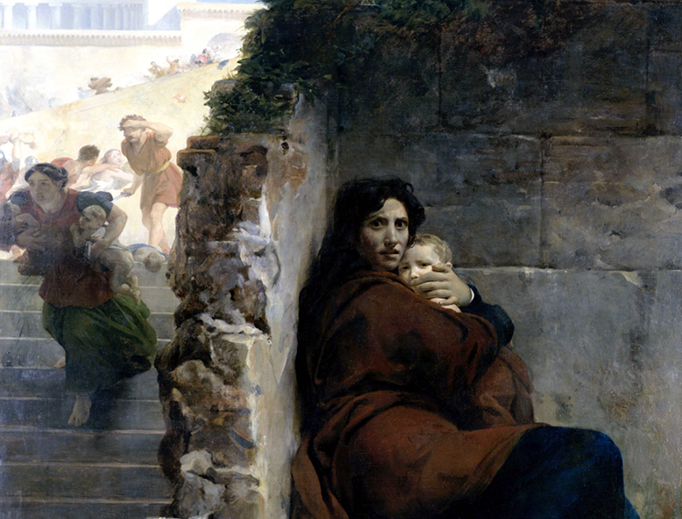
I don't like the feast of the Holy Innocents. That was my main thought as I prayed Morning Prayer at church this morning and chose hymns to play for the morning Mass. In every Jesus movie where the slaughter of the innocents is depicted, I flinch and pull my blanket up a bit to hide. When my children were small I just flat skipped over it. It's a horrible thought and it's even more difficult to figure out how to enter into a liturgical celebration of a horrifying event. Babies saying "yeah! We were killed for Jesus who got away safely!"? What are we doing here, celebrating how great it is to be killed? What will we do next, celebrate child soldiers who join our bloody causes without any ability to comprehend the evils involved?
So I turned these things over in my heart this week. And I found my way clear of that disturbance, to a better and deeper one.
The liturgical calendar can be like the quiet cousin at the Christmas gathering who frequently gets upstaged by the more boisterous guests: feasting, gifting, more feasting, more gifting. But when we learn to celebrate Christmas with the calendar, we are brought right away to martyrdom with St. Stephen, to contemplate loving union with Jesus with St. John, and then to the gory effects of violence and fear in the world with the Holy Innocents. The Incarnation is so incredibly mind-blowing that a lifetime would not exhaust the depths of how God desires to impact us with it. But the liturgical calendar makes it quite clear that union with the incarnate Son of God preps us not only for eternal glory, but also for transformation into His image on earth. And He was "a man of sorrows, and acquainted with grief" (Is. 53:3).
One of the deepest causes of grief is sin which causes innocent people to suffer. That could be simplified: Sin causes grief.
Herod ordered the destruction of life because of his fear, his clutching at power, his arrogance. The thought of sharing the stage with someone, let alone bending his knee to reverence Another, was totally foreign to his soul. Those who carried out his orders were formed in a milieu that accepted force as a higher good rightly served. It's just a few children.
This is the world Jesus came into, as one of the vulnerable. At this point, the Scripture text makes it clear he is totally dependent on Joseph's ability to receive a directive from God's messenger: Take the Child and His mother and flee. I wonder at the role that Israel's far history of pain and suffering, and Joseph's, over Mary's pregnancy, prepared his heart at this moment to respond in complete detachment and obedience to just go. Pain and suffering are evils. Pain and suffering, united with the heart of God, become portals for God's glory to shine on earth. That is redemption. This can be pondered, but it is known most purely in the experience of it. Joseph in this moment obeyed God and this obedience preserved salvation for the whole universe.
I take away two things from this. Union with Christ is a call to His vulnerability. We lay bare our hearts which are wounded and woundable to each other, to God, to our own gaze. I've been the worst at beating and castigating my own self for simply being, believing it to be a great fault. I have walked the path of learning to trust God and wearing Him down at every step, begging for certainty and protection instead of going by faith. I've done the chip on my shoulder, angrily raising walls against others, preemptorily blocking them out of my heart for fear of the harm they might bring. I've done stupid dependence on people who proved I could not ultimately depend on them as my gods. But God's vulnerability draws us into eternal peace. "Nothing will hurt or destroy on all my holy mountain" (Is 11:9). It's true.
Second thing: I must open my heart to the Lord, looking in His light for how I am like Herod. How do my attachments cause me to trample others underfoot? How do I exercise oppression to get what I want? How am I totally cut off from the hearts of others in their joys and sufferings? And how can I experience the same transformation Joseph did, that deep attachment to and freedom for the Lord?
Jesus enters straight into the suffering of the innocent, and union with Him brings us there as well. May we repent of everything in us which is poised to cooperate with Herod. May we entrust ourselves like Joseph, in our own vulnerability, in the interdependence which is ours. May we walk by faith in God who does not exempt us from dark nights, but who is trustworthy.
Sunday, October 30, 2022
Teaching the Our Father, Part One
I teach New Testament Bible stories to 1st through 4th grade students at our local Sonshine Bible Club. This is my 7th year teaching, minus a chunk of 2020. I know I have learned more than anyone as I've taught.
Each year I try to take some theme or plan, and almost always I bite off more than I can chew. This year, at least to begin with, I have decided to teach the Lord's Prayer. Now, it pays to note that we rotate groups of kids through various teaching stations, so I have either three or four groups of kids (depending on the day; I teach twice a week for groups from different schools) for only 12-15 minutes at a time. Part of that time is for settling in. Occasionally that takes much more time than it should. So, I'm usually left with more like ten solid minutes to teach from the Bible.
The kids that I teach typically either do not go to church at all, or are rather unlikely to have any Christian formation coming from their families. Many come from family circumstances that hold a lot of pain and brokenness. When I started talking about the Lord's Prayer, only one or two children in each class knew what this was. A few were able to recite what amounted to a gibberish version of it.
So here's how I've proceeded thus far. I started with talking about God the Father and God the Son. This is one of the things that gets the kids confused a lot; they don't quite get the God and Jesus thing. "Jesus is God" is just a statement of confusion to them, because "God, Jesus, Holy Spirit" is vocabulary they are still figuring out. I use the sign of the cross to "draw" God the Father, God the Son, God the Holy Spirit.
It dawned on me how smart the old basic catechism teachers were. There were people who went before me who taught clueless children and realized where people need to start.
I have a musical setting for the Our Father which is not the traditional Catholic tune. I like it because a friend wrote it and no one knows it and it makes me feel special and like I'm spreading a level playing field for all the kids to use a tune no one knows. So I sang the song for them. Now I've started teaching it by phrases.
Then we talked about Our Father, who art in heaven. Right off, I have to explain KJV English, and some kids are absolutely incredulous that words have been preserved from 400 years ago, like "art" meaning "is." Had to explain that one, of course.
I did not explicitly mention it, but I couldn't help but think of my own experience of coloring my understanding of God with my own experience of my natural father. I decided it is a better thing for these kids, instead of telling them, "Now, your Dad may be absent, or hit you or your Mom, or be in prison or on drugs, but God is not like that," that I would say "Our Father in heaven is all good, all wise, we are precious to Him, He loves you and wants to be with you."
One week, after having covered this opening phrase, I heard this little boy, above the hubbub of the class settling, shouting out, "God is my father!" God is my father!" It didn't dawn on me at the time, but I think this could fill the holes in some little hearts who have lost their fathers in one way or the other.
I talked about the "who art in heaven" part by saying that heaven is a place where God rules, and asking the kids -- where does God want to rule? I may have helped by making a heart shape, but someone eventually responded, "In our hearts!" I explained that, yes, God wants to be the one who rules our hearts. I'm realizing now they probably understand a more slang version of rule than I intended. I accidentally said "reign" once, and they immediately got confused by that. I tell you, teaching kids makes you watch your every word.
Then I told the story of the Woman at the Well. I had a hunch it would serve as an illustration, and I have to say I learned as I was telling it how it does. The kids resonate with the hatred between Samaritans and Jews. They get it that there are groups who hate each other. Jesus talked to her, treating her with dignity, not like an enemy. He started talking to her like He was God, offering her eternal life. Then, he called out her secrets, how she had five husband and now was with a different man. (The kids get this, too.) They see that he doesn't shame her, but says that the Father in heaven in looking for those who will worship him in spirit and truth, from their hearts. Doesn't matter if she was from the hated group, God is her Father, too, and He came to tell her He was the Messiah, come for her, to bring her back to God, just like He came to do that for everyone.
This is how I learn while teaching. It blows my mind sometimes. Every time I teach that story, it really sticks with the kids. One year, they were retelling it to me months later.
So next, I taught "Hallowed be Thy name." Just the English here was a bugger. What in the world does it even mean? Holy be your name? Ok, no help -- now what does THAT mean? Fortunately, I have the Catechism of the Catholic Church. But honestly, after reading and understanding what the CCC says on this, I still was challenged to boil it down for kids. I tried explaining "holy" and God's name as who he is, etc., and saw I was making no progress. In my first group I went impromptu, and said "let me tell you a story," and saw delight sweep across the face of one boy in the front row. I told the story of Adam and Eve and their sin. I explained how God had made everything good and beautiful and peaceful, and then asked them if that's what they see when they look around them. No. I ask if people do things they shouldn't sometimes, and if everyone doesn't at some time do things they should not do. They know that's a yes. I explain that that state of things being not like God made them, the Bible calls the problem of sin. And that God had a plan to fix the sin problem by sending Jesus to come right down into the middle of our mess to be with us, and to pay the price to take away our sin and open heaven again, so that we could follow him there, and start living new lives here on earth.
So I take another stab at saying "hallowed be thy name" meaning that I want to agree with God about what is true and good and beautiful. I don't want to be like Adam and Eve who listened to lies and doubt and mistrust God.
I really need to come back this week and firm that up. There's a lot about praising God, extolling who He is, acknowledging who he is in this petition. And I realize that even though I have known that in my head, this really hasn't been my experience of praying this. I am finding I need to stop and include this kind of praise in my prayer time where I just focus on declaring who God is. I mean, I'm an old time charismatic! It pre-dates me being Catholic! But I have kind of dropped this piece about agreeing, lining up with, getting my thoughts subordinated to, setting my mind on, God's name, God's reality, God's person.
What I planned to teach as a Bible story this week to illustrate this actually just the accounts of Jesus going off at night to pray. As a human being, He communed with His Father. He subordinated all of his activities to His Father's will. He chose according to what the Father showed Him. He emptied Himself and lived as one who is taught. All of that is totally astounding. To do the will of the Father was Jesus' food. He calls us to the same kind of holy life. Totally astounding.
As I tell the kids, the great thing about the Bible is that you can hear simple things when you are 8, and for the next 70 years you can think about them and you will constantly learn something new, because God's word is alive. I realize I do not teach the Bible as something I know; I proclaim it as something God says.
And that's as far as I've gotten. My goal is to write each weekend as prep for my next week's classes. And maybe to report on how they went. We'll see.
Wednesday, June 01, 2022
Well, it was Clear When I Started
Yesterday was the Feast of the Visitation, and something in the Scriptures for the Mass struck me significantly. It wasn't that I felt a sudden awareness or a "naru hodo" moment; it was more like I saw clearly something which was a long time in coming to that point. Like when you travel down a long, flat road and when you arrive at the landmark, you realize you've been looking at it already for some time.
The Scriptures were about how to love in practical terms, and the comparison was made to the perfection of how Mary went in haste to serve Elizabeth in her need, even after receiving the amazing news that Mary is now THE Theotokos.
Rom 12:9-16
Brothers and sisters:
Let love be sincere;
hate what is evil,
hold on to what is good;
love one another with mutual affection;
anticipate one another in showing honor.
Do not grow slack in zeal,
be fervent in spirit,
serve the Lord.
Rejoice in hope,
endure in affliction,
persevere in prayer.
Contribute to the needs of the holy ones,
exercise hospitality.
Bless those who persecute you,
bless and do not curse them.
Rejoice with those who rejoice,
weep with those who weep.
Have the same regard for one another;
do not be haughty but associate with the lowly;
do not be wise in your own estimation.
And here's how it hit me: My life formation was impacted in a fragmenting way by alcoholism, divorce, and mental illness. I wanted all the bad feelings from this to go away, and that was primarily the engine driving my understanding of love. If I couldn't fix the unfixable person, I could hate them, I could blame them, I could avoid them, I could shut them out, or I could hide myself from them so I could at least feel I had some freedom. Not only do I not remember the moment when I realized I couldn't fix the unfixable person, I do remember the feeling of more and more people in my life falling into the pit of a category called "unfixable people." I even started gravitating towards "unfixable people" (addicts, social misfits, impossible relationships).
All of these interactions with unfixables also flooded me with guilt: I couldn't do it. I could make zero impact for the good. In fact, I didn't seem to be able to impact anyone at all.
Now, I do remember grace freeing me, step by step, from hating, from blaming, and from avoiding people who caused me hurt. And let's be honest, that came to be everyone, because that was all I expected from people, and so I dished out distance naturally, and hid behind my walls of hurt and my impenetrable armor. God has indeed freed me significantly.
But here I am. Generally speaking, I don't think of "unfixable" people as people that I must fix. Generally speaking, I have learned to accept people where they are. But, I realize a problem spot, and I think this is what the Holy Spirit is showing me. If I could describe it exactly it wouldn't be a problem spot (which is why the blog exists -- I write so that I understand).
Part of me hasn't let go of the resentment, of the despair, of the experience of having "unfixable" people in my life. I see that I do not accept the broken human condition as a good. It just isn't. But there is a call to action that is stuck in me, when it comes to accepting individuals but not accepting that their brokenness is ok. I have a fiery love which is frustrated.
Also, I give up too early when it comes to concrete actions of love sometimes because I have conceded that my love is impotent. I have at times mildly to grossly miscalculated the impact I can have on another. Generally, all I know for sure is how I respond emotionally to my own actions. I fail at times to even begin to realize how I impact another -- because of years and years of pouring myself out but never seeing it do anything.
So... now that I write this, what seemed clear and too obvious to me to even put into words has turned out to be much more nebulous than I thought. The sincerity of my love is measured in not feeling like I'm going to get something out of what I do for others. I'm not going to generate my own safety by any kind of juju I produce which is going to reunite my parents or stop their drinking or bring my family into peace. I'm never going to change another person by trying to change them. I am not going to ride on anyone's codependency merry-go-round, even if they hate me for it. Trying to feed myself on someone else is evil, and I hate that (Rom. 12:9). Let my love be free, from a desire to do good for another, not to try to win peace, respect, favor for myself or beat back feelings of guilt or whatever. But let my love be God loving through me, and may the frustration be broken open.
Monday, March 28, 2022
Birthing Grace

* TIL: as I searched for an image of Elijah crouching on the ground with his head between his knees, I first observed that I can't find any depictions that are completely faithful to this description, and I second observed that there is a name for this postion in Sanskrit, which translates to: garland, necklace, or..... rosary..... position. You just can't make this stuff up.
Tuesday, March 22, 2022
Unless you Forgive

I gently employed the same prayer approach today at Mass as Sunday, looking for the Lord's gaze at me through the Scriptures. It was then that I recognized a little whisper I had heard a few days before regarding my need to forgive a certain person. Today's gospel reading, and the homily that I heard that unpacked it, were of the walloping sort. Forgive or go to hell. Not exactly an episode of Gentle Jesus, Meek and Mild. But I heard something else in this, other than what can feel like a frightening threat.
Here's the gospel (Mt. 18:21-35):
Peter approached Jesus and asked him,
“Lord, if my brother sins against me,
how often must I forgive him?
As many as seven times?”
Jesus answered, “I say to you, not seven times but seventy-seven times.
That is why the Kingdom of heaven may be likened to a king
who decided to settle accounts with his servants.
When he began the accounting,
a debtor was brought before him who owed him a huge amount.
Since he had no way of paying it back,
his master ordered him to be sold,
along with his wife, his children, and all his property,
in payment of the debt.
At that, the servant fell down, did him homage, and said,
‘Be patient with me, and I will pay you back in full.’
Moved with compassion the master of that servant
let him go and forgave him the loan.
When that servant had left, he found one of his fellow servants
who owed him a much smaller amount.
He seized him and started to choke him, demanding,
‘Pay back what you owe.’
Falling to his knees, his fellow servant begged him,
‘Be patient with me, and I will pay you back.’
But he refused.
Instead, he had him put in prison
until he paid back the debt.
Now when his fellow servants saw what had happened,
they were deeply disturbed, and went to their master
and reported the whole affair.
His master summoned him and said to him, ‘You wicked servant!
I forgave you your entire debt because you begged me to.
Should you not have had pity on your fellow servant,
as I had pity on you?’
Then in anger his master handed him over to the torturers
until he should pay back the whole debt.
So will my heavenly Father do to you,
unless each of you forgives your brother from your heart.”
So, what happens with this being commanded to forgive? When I went back to read the Scripture again after Mass, what I noticed was Jesus says there's a king, who is settling accounts, a debtor, and the debtor's master. It isn't entirely clear to me anymore that the king is the debtor's direct master. Rather, it seems like the king is the one who is now hearing about the conduct of the debtor, the master, and the debtor's fellow servants who complained about the injustice they witnessed. I'm not sure this matters, other than the fact that it would make much more clear that the judgment that God extends is directly about humans interactions with each other, rather than with some abstract moral code that is represented by the king. It would sound like the king is hearing the case pleaded by the master about the debtor's injustice. I'll leave the biblical exegetes to deal with that.
Another question: what is forgiveness, anyway? What is being commanded here? Fr. Drake mentioned in his homily that the Greek text makes it clear that the amount of money owned by the debtor would have taken multiple lifetimes of daily wages to pay off. In other words, it was an impossible, unpayable debt. This clearly represents the human standing before God. We are broken, we fall so far short of divine standing, and we start life out this way. Through the mystery of sin, we simply are not fit by nature for relationship with God, and nothing we can do can get us there. Nada.
So the first movement we see in this story is that the debtor is forgiven his debt. The master of the debtor takes this debt into himself, and takes it away, freeing the debtor and his family from being sold into slavery. In the Old Testament, too, God had a system for forgiving sins. He had prescriptions for offerings, symbolic deaths, symbolic gifts, brought to a symbolic place with symbolic people who offered prayers to wipe out offences. All of this was to point to the one who was to come, was to point to some amazing promise of fulfillment that God would one day send to His faithful people. Israel had a very mixed-bag track record of staying faithful to this type of worship, of all the laws that were to prevent the sins in the first place, and the hope that was to sustain them that God would come as their redeemer.
But Jesus takes it one step further in the story. The forgiven debtor was supposed to, now, have within him the same nature, the same lifeforce that allowed for the unforgiveable debt to be forgiven him. He was to operate with other people the way that God forgave through sacrifice. Yikes! Something stronger than the Old Covenant had to come into play here. Jesus is here expecting that the debtor act like God, not live out of brokenness but live with the divine nature actually present within, to act like God! Wow, Jesus, that's impossible, isn't it?
The heart of the gospel isn't only that God has forgiven us and so we are off the hook and our sins don't matter anymore. The heart of the gospel is that God's divine nature comes to take up residence in us, transforming us, and causing his own life to be active in us and through us. We are made sons in the Son. We are called to live in union with God, like the flame totally consumes the wood.
If that is the Christian call, what does this gospel say about forgiveness? That priest who just was convicted of grossly abusing a vulnerable woman for years with basically spiritual torture -- is she, are we all, just supposed to say "you are forgiven, it's erased, done; you are free"? I actually had a man in my life at one point whose only exposure to Christianity was listening to a few sermons on the radio. He actually suggested to me that I should allow him to sexually violate me, because I was a Christian, and Christians are supposed to forgive everything. Is that what this is?
No, thank the Lord, the command to Christians to forgive is not the command that we provide a pass for violation to romp unchecked. Quite the opposite. We need to know righteous from unrighteous as God knows it.
Note the pattern in the latter portion of the gospel: The forgiven debtor perpetrates violence against one of his equals, overpowers him, and takes up an arrogant position against him, putting him in debtor's prison. The fellow servants are deeply disturbed and report it. The master responds to the deeply distubed report. He declares the wickedness of the arrogant one and declares pity for the fellow servant.
The master has ears for the one who has been sinned against. The master takes it in hand.
I see two things here. First: from experience I know that sometimes it is difficult for a person who has been violated to say, That was wrong for you to do to me. An injustice was done to me. Righteousness would have looked different, this was not it.
I wish parsing righteousness from unrighteousness were never difficult, but at times it is. Consider, for example, a person placed for adoption as a baby. She may have loved her adoptive parents so dearly and exercised so much gratitude for the fact that she was born and cared for, that she may feel grossly disloyal and guilty for acknowledging the feelings surrounding "I had the right to be raised by the mother and father who created me." Consider someone who, at the cost of losing the only scraps of feeling loved they know, cannot admit that the relationship partner has wronged them, or is continually doing so.
Second: when the deeply disturbed report reaches the master's ears, not only forgiveness, but healing is unleashed. We don't hear that debtor #2 was released from prison, but we hear that debtor #1 owed him pity.
Jesus's punchline is that each of us needs to forgive his brother from his heart. How I hear it is not that we say, "that thing you did doesn't matter." It is that we admit, "that thing that you did violated me. I'm punched in the gut." First, our thinking gets corrected about the nature of what happened (righteousness vs unrighteousness). Then, because we are in a community of equals, those around us see, and are deeply disturbed. We experience the healing love and intercession of those to whom we reveal this brokenness. We experience intercession: someone takes my hot mess before God, who responds. Healing pours out.
Because we are all equals, and because each of us needs to be in this process, we are formed as a people who, because we have the very nature of God poured into us in baptism, are constantly being built up in the grace of the Holy Spirit. We are all in varying stages and places of hurting, forgiving, repenting, being forgiven, receiving healing, calling out injustice, interceding. But the one who tramples another faces the king's judgment.
This is Jesus telling us how the new covenant people of God will act.
I'm reminded of John's reminder of sins you pray about so that the other will be forgiven, and sins that lead to death, that you don't just pray about (1 Jn. 5:16-17).
It takes tremendous courage to open up our brokenness, especially those things that happened to us as children or in a particularly vulnerable time. It takes the courage of knowing and trusting that we are loved, by God and by people. These things are not healed immediately, but the power of God absolutely does heal them. The new covenant people of God, the Church, is to be this place where God's healing is unleashed through us, to the world. That is why Jesus begins with "the kingdom of heaven may be likened to..."