Showing posts with label Community. Show all posts

Monday, September 14, 2026

Ave Crux, Spes Unica!

I hesitate to describe my penchant for noting anniversary dates of my life as compulsive, but perhaps ingrained is fair. It is part of my liturgical sense, I think. Repeating annual observances gives space for reflecting on what has changed and how I've grown over the years. The one constant in my life is change. That is certain. 

Thirty-two years ago today was my first day in Japan. The first of 924 days when Japan was my address (although I did spend about a month each in the Philippines and Stateside during that stretch). It is also the Feast of the Exaltation of the Holy Cross, and yes I did choose this date to be my arrival date, just like I chose the Annunciation to be the day I left. 

This year has given me a fresh perspective on today's feast day. And that is the lamest possible way I could make that statement. Let me try to get a running start into unpacking this.

This morning at Mass, with all this date and feast day business humming quietly in the background, I had a strong related memory surface, one that I have turned over and over in my mind over the last three decades. It took me a moment to realize how it is this year's connecting piece. And here it is: when I lived in Japan, I was connected to an order of Sisters as a volunteer. The Sisters lived in two small convents in the immediate area. One of these was connected directly to the school where I taught, and occasionally I stopped by to visit their kitchen, especially in the early days. The one Sister who spoke English fluently lived there. One day when I was there, I noticed she had written on their pen board four words, which I felt were a direct message to me (because they were in English): God lives in Reality. 

If you've ever moved thousands of miles away from home to a place where you know no one, cannot communicate with anyone, and feel completely vulnerable and helpless, you might appreciate how words in your native language can pierce your heart and stay with you forever, like those did that day. And if you haven't, trust me on this. They did.

When human beings experience discomfort, conflict, pain, confusion, demoralization, scandal, injustice, etc, we tend to cope through some type of escape or retaliation. Or both. Escape says this reality is painful, and I want out. Retaliation says this reality needs to be fixed, and I'm going to create my own battleground to fix it. These are understandable human reactions. I think you could say that escape is often its own form of retaliation. These are not indicative of human flourishing, though: this is about survival. 

Human flourishing comes in Christ. Christ comes through His cross. His cross is our only hope (Ave cruz, spes unica!). And here we have the truth: God lives in Reality.

The reality of our lives is full of discomfort, conflict, pain, confusion, etc. The Christian revelation is that God is not sitting in a cloud somewhere, demanding our obesiance, handing down rules, or generally accepting everything that happens and tut-tutting it away, and throwing us candy to make us feel better. The Christian revelation is that God enters our pain. He does not remove it; he comes close to us in it. He conquers it, but appearances show that it conquers Him. His embracing of the ultimate in discomfort, conflict, pain, confusion, demoralization, scandal, injustice, etc, is what swallows death, conquers death, and reveals life and immortality. He calls people to faith in this. He calls people to receive this power and live in it. He calls people to live in reality -- all of it -- by the power of grace, which is His life in us. 

Sin is avoidance. Sin is turning a blind eye to suffering -- that of others, or our own. Sin is refusing God. Sin is turning away from Him and choosing not-God. Unreality. 

Here's the thing: this is the lot we are born into. We have an inclination to this sin. The grace of baptism frees us from being chained into it, but we have to be formed in such a way that we learn to choose good. We need to learn that we are loved by a self-giving God to such an extent that we love Him in return, follow Him, and learn from Him to lay down our lives (that is, enter discomfort et al.) for our brothers. 

Here's another thing: there's a point at which every person is formed by pain and not by love, and we carry our desire to escape reality forward with us. Sometimes we carry it forward in highly complex and sophisticated ways that shape our relationships, our work, and our very sense of self so that, even as Christians, we make a fine art out of avoiding reality. 

I feel like the entire focus of my life comes down to this point of learning for myself, and to help others, to look upon the Pierced One, the Man on the cross, and to embrace -- in the drops that are bearable, as God measures out -- the reality of His love meeting our pain. I'd like to say that in that moment in looking upon the Crucified, our pain is undone. I do believe God lifts certain things from us, granting immediate relief. But often that meeting entails being met in great grief the pain we have tried to silence and stuff down. It is not neat, easy, or quick, but it does heal. The resurrection power of God is real. But God does not do magic. He redeems and restores, and it is a process. It takes our cooperation, our trust, our perseverence, and we need community support through it, so we don't cut and run.  

God lives in reality. If we find reality too much to face, it means we need Mercy. Mercy is God's love meeting us in our pain. It is infinite. The ocean of mercy opened up for the whole world through the crucifixion of Christ, and if we call out for mercy, God will draw us to this whole process of healing. When we cry out for mercy, we must come with open hands, clutching nothing, or at least willing to let go of the things we clutch, trusting that God brings life and not death. Or at least willing to trust. Willing to receive life. Willing to believe that there is more to life than death. God will meet you wherever you are at and will gently guide you forward. His great desire is to give us Himself. 

He can make sense out of everything.


Sunday, July 19, 2026

Words, and Hearts, and Saints

Part of my morning prayer routine is invoking the intercession of my prayer team of saints. I have a standard team that has been with me for I-forget-how-many-years, as well as my patron saint that changes every year at the beginning of Advent, and those I've added as I intercede for several specific individuals in my life.

My relationship with my standard team has been evolving, especialy over the last year to two. And by that, I mean that I'm aware of a change of need in what I think of as their "department." Essentially, I'm asking the Lord for different things.

My team consists of several pairs and a triad: St. Teresa of Jesus and St. John of the Cross; St. Teresa Benedicta of the Cross (Edith Stein) and St. Therese; Holy Father Elijah, St. John the Baptist, and St. Cecelia; and St. Joseph and our Lady of Mount Carmel. They are my constants.

I consider my triad my "words" department. And as I stop and ponder, the recent changes in my life where my "words department" is involved is somewhat overwhelming to take in. As my reality has changed, my prayer has adjusted to it.

For years I have prayed that my words would become a means through which God's power could be made known. I eventually adjusted that to specify the words that I speak, the words I write, and the words I sing, since that covered three major areas of my life. I changed that to include the words that I think, and the words I meditate on or ruminate on, because I realized the importance of what I let go through my mind. I've now added "the words that I battle with in my mind," because I had to admit that some of the words going through my mind are temptations. They come with an agenda to get me to doubt that I am loved and designed for intimate communion with The Word Himself. And my ultimate petition here is that my words in every category would arise from the place within me where I seek to live this union with God.

Words have always been important to me, but I've realized in the last year especially how trauma had impacted my "voice," making speaking up and speaking out -- in some moments and on some levels -- physically impossible. Big shout out to EMDR therapy for reaching into the depths to heal that. 

I feel like I'm exiting a season of healing and excavation, and entering a season of healing and activation. "Use your words" takes on a whole new meaning, here. "Out of the abundance of the heart, the mouth speaks" is true in many ways. I was in a setting recently where I was told I appeared very confident, facing the prospect of a task that would require meeting strangers at their worst, most vulnerable moments. Do I feel ready for that? Of course not! It's very unsettling. But I can indeed find words there if I have gotten comfortable with my own worst, most vulnerable moments. And frankly, the Lord has been walking me through just that. 

So our words (or lack thereof) show our hearts. Our hearts, in the Lord's hands, are safe, despite their breaking and aching, and all the scary traffic in and out of them. Our words reflect the truth of hearts back to ourselves in ways that can be incredibly hard to swallow. But our heart is exactly where the Lord wishes to meet us, exactly as we are.

Friday, August 08, 2025

Yes, I've Changed Parishes

On the morning of the feast of St. Martha (and Mary, and Lazarus), a friend who regularly prays Morning Prayer with our group asked me about my parish status. This became an interior prompt throughout the day (and, ok, it stretched out over a week or so) to finally address the matter of officially changing parish registration. And while I realize that I don't owe anyone an explanation as to why I've done this, for several reasons I think it is worthy of sharing some reflections about this whole thing.

Last September when I began my Spiritual Direction Formation Program with our first in-person intensive, I immediately, and much to my surprise (but totally consonant with the thrust of the program) began to grappling with questions about my identity. I remembered it as arising after meeting the others in my cohort, who are mostly professional people with professional identities. But as I reviewed my journal, I found that this started bubbling up even before I left home. How do I introduce myself? Who am I, and is it based on what I do? This bothered me a lot more than I thought it would. At home, I rarely was in this kind of setting where these things mattered. And before I left the intensive six days later, I found myself telling people "I'm a Church Lady." 

Although I'd been working my way towards that ever since initially becoming a cantor at Holy Family in 2008, since 2017 I had been on turbo boost in this identity. How I got there had its own history, including about six years of formation in community building with a youth/young adult ministry, and my formation as a Secular Carmelite. But at that point I began pouring out with all that was within me, and most of this landed in my parish. By this time last year, I was a serious right hand of my pastor, on parish council, involved up to my shoulders in music ministry, and in fact I was a regular go-to person for any number of parish friends if they either needed to know some detail about what was happening in the parish, or if they needed to connect with the pastor, because they thought I could facilitate that. I also felt interiorly, with alternating senses of self-satisfaction and weight, that when I walked into church, I had a deep responsibility there. 

After I applied for the SDFP, and especially after I came back from that September intensive, I began to notice a small hint of something else. I was weary. My Saturday morning Mass music ministry which I'd carried out since 2013 was starting to feel like I was belly crawling through gravel. This was strange to me, and disconcerting.

Then, as everyone in the parish knows, around Christmas our pastor announced a reorganization of music ministry. Even though it wasn't a complete surprise, it did hit me like a bombshell, and it was something I had to grieve, almost like a death. I say almost, because other factors interior and exterior began developing concurrently, to the point that the first quarter or more of this year was a huge round of reprocessing my entire life and... identity. (And this, concurrent with studying St. Teresa of Avila and the necessity of self-knowledge and humility!)

I think it is important for me to say, for the sake of community life, that I did not leave the parish because I was upset with our pastor. We had lots of open communication about the difficulties involved for both of us, but there was no picking up my marbles and storming off home moment for me. It was much more a moment of hearing "Martha, Martha, you are upset and anxious about many things. Only one thing is needed." I realized that even though my path of discipleship and growth for a season took me through a Martha role of service, now I am being called to something different. It felt like the death of one person, but I know it is really the emergence of a new and deeper identity. 

In the year or two previous to this, I would occasionally take a mini retreat day for myself and go to pray at Blessed Sacrament, where I have just joined. I did this knowing I craved a place I could go for both exterior and interior quiet -- one where I did not feel like I was going to work, and that every glance revealed something that needed to be done. In fact, I had driven to Holy Family so often that my phone identified it as my workplace!

I landed there because the whole choir decided seperately but at the same time to go join Blessed Sacrament's choir. There was no way I could erase from my heart, life, or history the community that I formed by singing together at Holy Family since 2009, even though it is true that we were limping by the time we sang our last for the feast of the Holy Family in 2024. We are now the core of a larger, fluctuating number of singers at BLS, and according to my most severe critic (my daughter) we sing as with one voice, and are actually good. I cantored for my first time there in July, and as I arrived early to set up, I heard two different women whisper loudly to their husbands, "She's going to sing!" That made me chuckle, but it is also interesting that parish communities are fluid enough in this town that I already know a large number of people there, and clearly a lot of people know me from my years of standing in front at Holy Family.

My parish family has always been the closest thing my heart as known as extended family, and so this is not something I chose lightly. I just feel that I'm extending my extended family now, and connecting from a deeper place in my heart. God is good, but the way is weird. Blessed be God forever.


PS: For those who wonder, my husband independently decided that he is going to join the Melkite rite, so he actually removed himself from the Holy Family rolls some time ago. 

You can also still find me every weekday morning at Holy Family praying Morning Prayer. :)

Thursday, October 17, 2024

Slander, Justice, and Freedom

This morning as I was talking with the Lord I was reading Mark 7, where He is interacting with Pharisees. Verse 2 sets up where the difficulties start: "they saw that some of his disciples ate with hands defiled..." You can feel how this observation quickly turned into a judgment of Jesus, as in verse 5 they ask him, "why do your disciples not live according to the tradition of the elders, but eat with hands defiled?"

Jesus had inconsistency in his camp. Some washed, some didn't. Maybe the some who did were mindful of the tradition; maybe it was culturally engrained. Maybe those who didn't were unschooled in the ceremonial practices, or maybe they omitted it intentionally. We don't get any of that commentary. What, to the Pharisees, reflects back on Jesus is that He did not spend enough time enforcing the traditions, or He was not a careful enough rabbi to eliminate from his midst those who weren't doing it right, or simply this slipshod performance did not trouble Him. Clearly, He was either a lousy rabbi or a rebel. This is clear because they were their own standard of righteousness.

Jesus then proceeds to rip into them. From the text, I observe a few things.

First, He quotes Scripture against them (v. 6-7) to point out their hearts are far away, their worship is empty, and they teach human ideas. 

Second, the text is suggesting this was an ongoing exchange, not simply one conversation. Verse 9 says, "And he said to them," and again in verse 14 "And he called the people to him again and said to them." It sounds to me like Jesus often circled back to this theme when he talked with Pharisees and Mark is condensing Jesus' response in this account. I'm no scholar. But what I see in the paragraph begun by verse 9 ("you have a fine way of rejecting the commandment of God..." -- reminds me of Daniel 13 when Daniel is interviewing the two lying letchers who were accusing Susanna, "your fine lie has cost you your head") is that Jesus here is recounting for the Pharisees a detailed example of how they teach human ideas as doctrines of God. To me, this reveals He has spent time meditating on this, interceding with the Father for these wayward men. He is intimately familiar with their hearts, their words, and their deeds. This intimate familiarity is diametrically opposed to tribalism, where separatism rules.

As Jesus teaches his disciples about this exchange, he tries to help them arrive at the understanding which he says the Pharisees lack. And what caught my heart was in verse 22, where Jesus is listing the things which defile, and among these he includes slander

My Gen X heart stopped and did a little sideways glance around. Slander? As in, saying something publicly about someone else's behavior that makes them look bad? Ok, Lord. I just got done reading you ripping into the Pharisees and giving that group pretty much a bad name for the last 2,000 years, but I know that that wasn't slander, and that you are actually differentiating slander as a different thing.

This hits a real sore spot in my soul, one that I know needs healing and strengthening. My head knows that slander involves saying something that isn't true. Let's do some dictionary and catechsim definitions here.

slan·der

/ˈslandər/
noun
Law
  1. the action or crime of making a false spoken statement damaging to a person's reputation.

CCC2477: Respect for the reputation of persons forbids every attitude and word likelyl to cause them unjust injury. He becomes guilty:
--    of rash judgment who, even tacitly, assumes as true, without sufficient foundation, the moral fault of a neighbor;
--    of detraction who, without objectively valid reason, discloses another's faults and failings to person who did not know them;
--    of calumny who, by remarks contrary to the truth, harms the reputation of others and gives occasion for false judgments concerning them.

  1. Another good Catechism quote is paragraph 2479: "Detraction and calumny destroy the reputation and honor of one's neighbor. Honor is the social witness given to human dignity, and everyone enjoys a natural right to the honor of his name and reputation and to respect."

I'll be honest. I have always struggled with saying anything about another person to a third party, even when there is no real question of slander involved. I am certain this came from some confusing childhood circumstances which followed me into adulthood, both when I simply couldn't understand what was going on, and when my attempts to speak or ask questions were met with explicit or implicit demands of secrecy and "we don't talk about this." Or, I simply knew that exposing the truth of my pain would really rattle others in my life, which led me to keep silent about what was happening in me, to make it easier for someone else.

This was deeply formative for me, and not in a good way. I took in that revealing truth was in fact slander and it dishonored people I should honor. My deformation never stopped me from mentally creating a class of people* I felt didn't deserve my honor, and whom I could scapegoat to make me feel better. And of course nothing reminds me of that as much as our political atmosphere in an election year.

Nothing could be further from what Jesus was doing with the Pharisees and his disciples. Jesus was in fact confronting the intimate places in his personal culture that people had skirted away from out of fear: the hypocritical power of religious leaders. I'm sure there were folks who thought it was much wiser to just go along and get along. But Jesus spoke right into the heart of dysfunction with the hopes of change and of pulling people out from under the wreckage that already existed. We do too talk about this might have been his exact attitude. And this is not slander. It is justice. No longer will those who do harm find protection, and those who are wise will gain instruction. 

To me, this shows the difference between learning to pattern my life on Jesus Christ, and learning to be nice. Learning how to show honor starts in a heart where identity and truth are clearly understood.

Oh Lord, conform and transform my heart unto Thine. With St. Elizabeth of the Trinity, make me into a supplemental humanity for You through whom You may live again in this world.


*Generally, this class of people consisted of anyone who did not remind me enough of myself.

Tuesday, July 02, 2024

Traveling Retreat


I just returned from just under a week of travel, so it's time to unpack. My suitcases were emptied yesterday, but this unpacking is for the interior experience.

This trip really wasn't supposed to be a retreat, in the sense that a retreat is a thing you go to with others who are seeking God, and you listen to conferences and process the information you hear. To be honest, several of the formal retreats I've been on in the last several years have felt more frustrating than fruitful. Like I was always waiting for something to happen, trying to engage my interiority but not finding the connecting point in my changed surroundings, or talks, etc. On this recent trip I did in fact have that occasion to go to another place interiorly as well as exteriorly. And I was able to spend most of one day at the Shrine of Mary Help of Christians, better known as Holy Hill, the Carmelite basilica and the heart of my Carmelite Province. 

I had a mixture of facing anxiety and nostalgia. And for once, these met and gave me a practical take-away. I realized that I cannot always take away my anxiety or grow away from it by myself. Really, the thought that I can or should is a cause for anxiety in and of itself. The realization that Mary is the Help of Christians, and therefore my help, too, is a relief. We disciples of the Lord are here to help each other. And Mary can steer me in such a way that suddenly the grace of the Lord is close at hand. Because she knows how to take my hand and draw me through the crowding thoughts in my mind and make it all seem easy.

I realize that God has my needs at heart, and He wants me to have His needs at heart. Anxiety clogs that with so many other things, taking up so many other jobs, pressures, concerns, frustations, imaginary scenarios, etc etc... I am faced regularly with things I can't control, and I can believe that because I am not in control, that horrible things are going to happen. Case in point: yesterday, the Mass I attended got a late start because they were waiting on a pilgrim bus at the shrine. I had picked that location because it was going to be feasible for me to reach home before the post office would close for the day, and I had books to ship. I noticed the moment I was in, and instead of frothing over with frustration, I entrusted my need to the Lord and offered the difficulty for the spiritual good of all those present. It was a little bit of a battle, but I realized that right there was The Point of why I pray for growth in virtue. It all turned out fine, and I was at the post office with time to spare. It made me see how entrusting my needs to the Lord keeps me free to focus on the needs of the people around me instead of on myself, and keeps me from adding to the misery in the world by my attitude, grumbling, harsh words, rage, etc.

God is working on freeing my heart for the bigger picture of life, too. In my parish, I am like a big fish in a very little fishbowl. The fishbowl is to a great degree being created by my own attitude, but I realize it isn't healthy for me or anyone. An attitude adjustment is in order, giving me more room to breathe, and allowing my environment also to change without internalizing some kind of threat from it all. Growth and change are both necessary and inevitable, and God is called a gardener for good reason. I'll let Him carry on with general management of my universe. 

I also spent a good chunk of one day with my Mom's cousin Jane. Jane's parents were both deaf, and she spent a good deal of her life interpreting for them whenever there was a family function, since none of the extended family learned ASL. I recognized from my youngest days that there was a totally different way of communication in her family than, say, with my grandparents, aunt and uncle, and my Mom. They were outgoing and made great efforts to communicate with everyone. Spending the afternoon with Jane and her husband this time made me realize how much they are both story-tellers. They love to share details, and love to hear details, but not in the way I have experienced with some people. They do not tell stories to wall themselves off or to cling to the chance to be heard or exit isolation. They speak to build community. I happened to see a thing on Facebook right after I spent time with them, and it hit the nail on the head. Of course I cannot find it now, but I believe it was a quote from Henri Nouwen that talked about speaking to build relationships, to form community, to welcome others. Like laying down a path from the heart and then encouraging, asking questions, showing interest, that welcomes the conversation partners to do the same. It's like verbal hospitality. Boundaries kept and respect shown, but openness that creates a place for peace, like seats around a campfire. I want to grow in doing this myself. It was lovely.

I decided I never want to live in a big city again. I also love summer nights and summer mornings, and daylight in general. Streets where I live are unbelievably narrow. When did it become socially acceptable for an employee to use the phrase "f***ing stupid" with a customer as a way of commiserating? Travel is good for the soul. Solitude is like oxygen to me. Quiet country roads are so beautiful. I treat my dead ancestors like stars in one of my favorite dramas, and it is enjoyable to me to visit where they are buried and learn details about their lives that even they themselves probably found boring. Rushing is a symptom of anxiety. 

These things and more I have thought.

And now, to live accordingly. 


PS: The photo shows an open field which used to hold the old apartment house where I lived for five years, and the building in which I worked from 1989-1990. 19th and Wisconsin, in Milwaukee.

Saturday, March 30, 2024

The Pain in My Side


Each year during the Triduum, I lead and participate with a group of parishioners who pray the Office of Readings and Morning Prayer together. (Actually, we pray Morning Prayer together daily already, but we tend to gather a few more people during the Triduum.)

One line from the Office of Readings struck me this morning as if I'd never read it before. It is Jesus the Victor speaking to Adam whom he has gone to free from Death. He says, "My side has healed the pain in yours."

For context, there's the whole paragraph:

I slept on the cross and a sword pierced my side for you who slept in paradise and brought forth Eve from your side. My side has healed the pain in yours. My sleep will rouse you from your sleep in hell. The sword that pierced me has sheathed the sword that was turned against you.

The entire reading is of course about the Lord freeing Adam from the death brought upon him through his sin, the sin that lost innocence for the whole human race. By extension, then, of course it is about how we are all freed from bondage to sin by Christ's victory over death.

This ancient homily was written before fundamentalism got its teeth into the book of Genesis. But what struck me is that while the text talks about sin, it was not Adam who opened his own side to create Eve. It was God. God caused the pain, if you will. And then, it says, he heals it. 

But no, I don't think the healed pain that this speaks of is just that God opened Adam's side, and now He's saying, oh, my bad, let me fix you up again. The opening of Adam's side and drawing forth Eve speaks about how on a deep level, human beings are created to be interdependent on one another, needing one another, accountable to one another, and indeed responsible for one another. The pain in Adam's side was that when Eve, a separate person, but also part of himself, faced the dragon, he stood aloof, mute, passive, actionless. The ache in his side, which he passed on to his offspring, was this "Am I my [wife's] keeper?" She's bone of my bone and flesh of my flesh, but I'm totally tuned out from any sense of connection to her, or to myself that would arouse me to act when I see this assult on human dignity. "Ain't no my job."

Salvation is indeed union with God, and union with God entails communion with other human beings. In my days when I identified as a misanthrope, I really struggled to get that. It is the grace and power of God which creates both union and communion, and we are his co-operators in both. Love of God and love of neighbor are of a piece. And we will struggle with both until we accept and care for ourselves as the locus of receiving and giving of this love, and allow the pain in Christ's side to heal the pain in ours, where we mourn how our connections with others involve failure.

Thursday, February 08, 2024

My Body Will Rest in Safety

I've pretty much always had a social circle of people older than I am. One such friend mentioned his uncomfortable awareness that everyone's chatter now gravitates towards aches and pains and doctor visits. It makes sense. Pain makes us vulnerable and we need to know we aren't alone with our fears of losing ourselves. 

When I briefly cared for my Mom while she was dying in hospice, I made a mental note to change my relationship with my body. I had always softly scoffed at the idea of going to the gym and doing exercises. My farmwoman epigenetics sang a distant song, to the tune that the goal was the work hard rather than sectioning off body movement away from normal daily activities. Eventually I had to admit that I was not chopping wood, plowing fields or drawing water from wells on any regular basis, and I was, in fact, a cushy modern. Through trial and error (and a lot of back pain) I figured out which kind of exercises I needed, and I've gradually worked towards actually doing them. 

Lately I've been doing a program called Hips Like Honey which focuses on strength and flexibility. It doesn't do much for cardio stamina, but even though it is rather gentle, it has really done its job. I love the feeling of waking up in the morning and doing that huge reach across to the other side of the bed to turn off my alarm, and lay down again, and not only not throw my back out, but to feel solid. 

So today I had my monthly chiropractic visit. I am still actively learning to stop tensing my body all the time, and the doc was showing me an exercise to help me out with that. The moment gave me something to ponder. Essentially he said that the tension in my sacrum comes from my back muscles trying to do the work that my core muscles are designed to handle. It's like two siblings going around together, and the loud, overbearing one is always doing all the talking, leaving the quiet, reserved one unskilled in initiating and carrying out a conversation. The overbearing one is tired and overused, and the quiet one needs focused, gentle attention. As he showed me the exercise, I realized, I don't do gentle very well. Farmwoman is out there, hoisting bales of hay overhead and throwing them. I need to find my interior delicate crystal goblet, or.... something like that. I guess when I find it I'll know what it is.

Something significant happened last month, and it is still settling in. Speaking of tension, lately I feel my mouth relaxing in just an incredibly unusual way. In my experience, I feel tension only after letting go of it, and my jaw and my teeth are apparently not clenched anymore. The other amazing thing is that as I read Scripture, or pray it, or hear it read, I feel like it is all about joy, peace, and God's incredible goodness. And safety. And rest. 

If there's a way to tie together these rambly thoughts, maybe it is this realization. Somewhere in my soul, a pre-verbal baby Marie has, for more than five decades, beheld a fear: that joy, and peace, and safety, and rest, and love, and important people, all disappear. And that little girl is powerless to stop it. Using all my might, and tensing myself silly isn't going to stop it. Like aging, like dying, it's a point of incredible vulnerability. But into that moment of vulnerability, someone has come. And He is Love. And Love is eternal. And I realized I will never lose Him. And more than that, every day I live in Him, I will never lose, either. Part of how I do that is I share my woes with others, and they share theirs with me, and the Lord is there (Mal. 3:16). We live our lives together, and even though we grow weak and die, this is where we find joy.

And in the meantime, the exercises that remind me that I'm weak -- I'll do those. Maybe I'll even become friends with gentle and vulnerable and make a soft nook for Farmwoman to rest in. 

Saturday, January 06, 2024

A New (Leg of the) Journey

 New years and new things may suggest each other, but I'm not one to choose some big newness project on January 1. Gosh, even writing that feels exhausting. Life is exhausting enough normally; I don't need to resolve myself any further.

This new leg is more something I am sensing I need and agreeing to. 

I think it just follows on what the Holy Spirit nudged me with last Good Friday with this line "everybody suffers." The second biggest take-away I had after I started praying the Seven Sorrows Rosary was that the suffering we experience is not meant to be a place to camp in, but a place to pass through, on our way to the glory of God. This little revelation came to me as I was out for a walk one Spring day, and I think these little revelations are like slow-blooming flowers, and they are meant to hold my attention for a long time, because they are gonna need awhile to really sink in.

I slipped into a blog post here and there last year that I've been dealing with anxiety more frequently than ... well, more frequently than I'd like to be the case, and more frequently than I'd like to admit. And more intensely than what has been normal for me. In fact, one Spring day I had a full blown panic attack, which hasn't happened for years, and really only happened to me one other time in my life, to my recollection. In the same time period I also had two episodes of anxiety hives, which was completely new. This got my attention and both by plan and sort of by happenstance I made some health changes, including ditching my exercise plan which was itself stressful and taking up one that fit me so much better, and was more demanding in good ways. I also completely gave up drinking coffee. I can't tell you how much good that did me. Between the two of these, my cortisol belly has all but disappeared, and my clothes fit me happily again. I'm also not completely freezing and interiorly curling up into a ball all of the time, despite the fact that our furnace has been functioning questionably for a solid month.

So all these are good things. But I know they aren't all that I need to address. I don't know -- yet, completely -- what I don't know, but I recognize certain sticking points in my life that don't just come out of nowhere. 

One tell-tale thing happened New Year's Eve. I read a friend's Facebook post that was a list of "23 ways I have seen Jesus' love in 2023," with the challenge to follow suit and post your own. I tried it. I started, but I couldn't finish it. I found myself focused on, Oh, that thing -- it wasn't nearly as bad as it could have been and I was worried about this, but it turned out ok and This really sad thing we survived ... It was all so heavy. And I thought of a few uplifting things but found myself afraid to share them publicly. Now, that's kind of a new one for me. I didn't like how this whole thing felt. 

Normally I pray about stuff like this, but I've really got nothing, there. No gush of words tumbling from the heart faucet. But I've been going back to St. Ivo and thinking of the Holy Spirit as the Advocate. So, I've prayed the Veni, Sancte Spiritus. Come, Holy Spirit. 

My favorite Carmelite, Fr. Iain Matthew, OCD, mentioned in one of his talks that, when it comes to allowing God to love us, one of our biggest difficulties is that 90% of us is in the deep freeze. It's there, we have it, but we can't really access this part of ourselves. This image and phrase has been tumbling around a bit, in this process. I want to love God with more of me. I want access to more of me to love God with. He deserves it.

So, I'm praying this way, and as I'm working through my used book inventory, getting stuff listed, I come across the book More Than Words: the Freedom to Thrive after Trauma by Margaret Vasquez (who just happens to be a regular at my parish). I set it aside to read, because it look valuable -- for someone else I know and what they are going through. (heh) 

So, I read it.

We pause here for the classic peanut butter and chocolate collision meme, signifying the creation of a new wonderful reality.

So I've ordered her second book, Fearless: Abundant Life through Infinite Love, and I've begun listening to her podcast about the integration of spirituality and human formation. This is a theme that Dr. Peter Malinowski also speaks and writes on at Souls and Hearts.com that I've been loosely following for a couple of years. But I know there is something for me to address, and I'm going to guess I'm going to discover it as I kind of make this my winter's work. 

One line that struck me from one of her videos was to the effect that God has more love for me than I need to heal my trauma symptoms. 

I think new avenues of growth await me. These often involve a good deal of falling apart, but I figure I'm gonna do that, regardless; or if I don't fall apart I'll just get stony and unfeeling, and I really don't want that. I really don't. 

So, here's to the journey.


Monday, November 20, 2023

Greater Safety

Back in July of this year, I wrote a post about a line in the Anima Christi that struck me. And around that time, I had entered a period of detoxing from anxieties that had been too much with me. 

It's time, apparently, for another layer of to be attended to. 

This year I have found a wholistic approach both necessary and useful in addressing things I may have tried to approach only spiritually in the past. That in and of itself can create spiritual problems and anxieties. 

So, physical exercise really and truly has taken up a place in my life disciplines. (In my younger days I liked to think I could ignore my body and it would always serve me fine. Hah.) One phrase I hear in my exercise programs has also been helpful in my discernment: What is coming up for you? Can you just be with it? As in, this stretch is uncomfortable! But if I stay with it (no pain lasts forever, as St. Teresa reminds me) it will be easier to do next time. 

Well, right now I feel something coming up for me, and I've learned that what I need to do is bring it into prayer. Allow it into my honest attention, and bring myself before the Lord without trying to hide from the fear and discomfort it brings up. And not to try to handle it myself (which almost always is going to mean giving myself an easy pass on an immoral path, or even more likely for me, to judge and beat myself mercilessly for struggling in the first place, and to end up a ball of anxiety.)

Bring it to the Lord, and be with it. Honestly. Openly.

A somewhat suprising interaction the other day sent up an immediate flair of anxiety. On the surface, it could have been considered obvious why it was so, but of course surface level answers are wholly untrustworthy and porous. Easy answers like control, and they fear getting deposed by the pursuit of hard truths.

Fortuantely I have many people in my life who have set themselves to pursue God's presence, where truth is love, and love is truth: namely my Carmelite community, and my daily Mass community. They help me bring this anxiety flair before the Lord, honestly and openly, to be defused.

And the Lord says, behold! I am your safety, but I need to you know me as your place of safety more deeply than you do now. For you to live in this world in peace, not reactive, not fearful, facing real and actual dangers, facing real and actual temptations, I need you to hide yourself in Me more deeply. I am the only place where you are going to find serenity, strength, courage, and clarity.

I'm going to quote myself for my own record, from last July:

What I see now is that I had always been separated from God to a degree by my anxious clinging, my fear of abandonment, my lack of ability to trust that He would keep me safe. He was doing a series of surguries in my soul. Really, before each painful one in that series there was an implant of joy and safety. Hard to explain, but in retrospect, it's extremely clear. 

And then he basically crushed the deformed measure I had made for Him. 

And it took time, but a new thing grew in its place, and is still growing. It is vibrant, and it is beautiful. 

Separated from You, let me never be. 

It is sin that separates us, and it is His love that unites us to Him. But it isn't only our active, personal sins that separate us. It is also these areas of weakness due to woundings which have never gotten full Son exposure. It's the ways we have responded in our own power to our wounds. Our flaws and cracks from mishandling can be not just sealed up, but completely transformed to bear the glory of God. And the more we know that we are weak, the more Christ's power can rest on us. Lord, teach me really what it is to delight in my weaknesses. 

It would seem this is a call to delight in my weakness. Right now the only safe place for that is in the secret of prayer. I guess that's why I'm a Carmelite. My design is to live from that place, lest I completely fall apart. 

Only in God is my soul at rest; in Him comes my salvation.


Wednesday, August 23, 2023

A Woman in a Woman's World


Yesterday I had, well, let's call it an interesting experience. You know how you can be going through life, facing forward, living in the present, dealing, coping, stretching, learning. Doing the little advances that successful day-to-day life is all about. Then suddenly something comes along that has you stopping and looking back, looking far around you at places you once traveled through. Small thickets of confusion that are familiar in a distant way. That's what I did yesterday.

But it wasn't just in my memory. It was a concrete thing in front of me, invading my present. 

My parish is running a women's Bible study this fall. 

Now here's the funny thing. Maybe a year ago I visited a parish across the river for confession, and I saw that it was offering the same women's Bible study. I shared it on my Facebook page, being ever the promoter of things. I'm all for it, in theory, and I think I even momentarily looked into what it would take to offer it in my town. 

And I was asked to take a leadership role, similar to what I had done in our parish ChristLife, which satisfied my inclusion needs (aka ego. I was sought out. Thank you.). But ultimately I passed on it. Because to be honest, just the idea of being part of a women's Bible study sends me into the small thickets of confusion.

And I spent a chunk of yesterday spinning this around in my mind and checking out some interesting emotions that it conjured. 

It is intended not only as a Bible study but also as a community building thing. And this is where I needed to admit to myself what, for me, makes for community building. That would be work. That's why I liked the feeling of being offered the logistics and communication job. I even asked if I could do that part without actually going to the Bible study, but no, that wasn't the vision. That's ok. 

Shared work is probably my primary "love language" if you buy that expression. This is something I like about choirs and music; it requires that everyone work together. This is why I tend to take on huge tasks with a lot of excitement -- like the year our Bishop gifted our parish (and every parish) with hundreds of copies of one of Matthew Kelley's books, and my daughter and I gift wrapped every single one. I questioned the size of that undertaking, but my (then 8 or so year old) daughter proclaimed it "a labor of love," and so there was no turning back for me then. When parishes were reopened after our short COVID shutdown, I was asked to buy some rope from Lowes to make the required social distancing thingies look somewhat dignified. Oh no. My daughter and I braided ropes out of white tshirts and figured out a way to keep them firmly on the pews but also made them easily adjustable. That felt so good to be able to do that, whatever your thoughts on social distancing. 

Yeah, so what I don't find a helpful way to give myself is to sit in a group of women chatting about how Scripture impacts my day-to-day life, or study guide questions. Spiritual direction; yes. Theological discussion; yes. Lexical study, historical study; yes, yes. Pretty tablecloths, conversations where words fly fast and emotions fly faster, or women connect emotions to sensible things in attempts to "feel comfortable sharing..." I don't even know how to do that. And generally it makes me feel the opposite of community-built. I tend to sit there with my mouth shut, trying to track (or tuning out, depending on how my day has gone) and mostly feeling a thousand miles away. These days, my thoughts just dash to other things I could be doing. In the past, I sat there wondering why I did not know how to be a woman. Because I figured A Woman's World was what I was looking at.

Yes, yesterday I felt again that jab of feeling like an unwomanly woman. Like maybe I should try harder. Like maybe I was being weak or selfish or inadequate or unholy or rebellious or (insert more) for not wanting to participate. Like I really should. I thought of, and even played, that song by Wendy Talbot from the 80s "Woman of the Word" where she asked questions popular of the day about what women "should" do. It dawns on me now: we think the question "What is a woman?" is newly controversial. (Some) Christians have been making it difficult to answer that question, on a non-biological level, for decades.

In the midst of questioning myself yesterday, I found it extremely difficult to do the work that was actually in front of me. Suddenly I wasn't sure I could do anything.

If you diligently read this blog (😂) you'll realize I've been sinking deeply into the Seven Sorrows rosary in the last few months. After all these years as a Catholic, I am *just starting to sink deeper into understanding the Blessed Virgin Mary as woman par excellence. And as I've been meditating on her sorrows, I realize she has a lot of strength, born of emotional and spiritual pain. She probably did enjoy beautiful objects and she probably did chat with women friends. But there was only one Blessed Mother. In a common way, there is also only one of each of us. I have never been given to conformity, but I haven't always been at peace with being myself, either. It has struck me with terror; it has confused me. But humility says, I am who God made me, no more, no less. I will be me, because it is God's will for me.

This morning, as happens to me occasionally after a day on mental frappe setting, I woke with everything clear in my mind. Following the Lord is not a path full of should. Or as one priest once quipped, "Stop should-ing all over me." One must not should oneself, either. Jesus says, "Follow me and live." He commands, he invites, he speaks to us about reality, but he doesn't guilt us into things, so we need to refrain from responding to that kind of motivation. Ok, I need to stop it. Respecting freedom is super important, and it is grossly counter-productive to Christian life to not respect freedom.

I'm not guilty of being me; I'm responsible to be me, and to learn how to do it well. I need people in my life in order for me to be me well, but I also need space from people, and I can't expect that anyone is going to understand what I need unless I understand my own needs and make them known as necessary. I'm actually responsible to God to invest well the raw material of myself He's given me to work with, to try to gain a return. 

See -- it all boils down to shared work! 😉


*Everything in the spiritual life is always just beginning.

Tuesday, May 02, 2023

St. Joseph and the Desperation for Consolation

I was chatting with a priest friend recently about praying the Liturgy of the Hours, and I found that something poked at me like when a metal bra underwire cuts through the fabric and jabs you in the tender underside. So let's draw that out a bit and see what that was all about.

We were discussing the obligatory nature of praying the hours (for priests, same as for Secular Carmelites such as myself), and how he rarely or never finds priests remotely interested in or planning for praying the Office in common. Apparently he finds the norm to be priests always pray this privately, individually. He also mentioned how it takes time to pray this everyday, especially if one is to do so prayerfully, reflectively, with the freedom to pause and ponder, to take it in contemplatively, etc. I know he had mentioned in another conversation having been given the advice to prayerfully pray at least one section of the hours daily, and to be content with recitation of the other hours. The thought of praying all seven hours, for someone who is busy with apostolic life, is just nuts, basically.

Granted. Obviously the Church changed the structure of the Hours at the Council precisely because of the onerosity of an obligation to "make it through" huge chunks of Scripture daily, and how it became a burden to crank it out and plow through it all. Prayer, clearly, it not to be about merely cranking through.

What I found myself taking umbrage with, as one who daily drags myself out of bed to lead public chanting of Morning Prayer, at a consistent hour that I KNOW I would never keep up with, were I not committed to this small group who meets, is the notion that prayerful is consonant with comfortable. Something occurs to my mind, and I want to stop and nest on it, sucking the sweetness out, delighting in my mind, allowing it to speak to me. Vibe: suck it up, buttercup. Sometimes I am delighting in my rest, my thoughts, my privacy, and I don't want to discomfort myself by driving in the morning to meet people at church. Sometimes I'm physically not ready. Sometimes I don't want to sing. I switch it on so that other people can enter into prayer, and to help others with the discipline.

Sometimes a beautiful contemplative thought has struck me during the day, and then a child yells for homework help. Or the doorbell rings. Or there is no lovely thought, but there are whiny children who have required me to step out of the worship space during Mass and I have to set my will like a diamond stylus to engage in what is happening in the consecration -- and this happens more often than not for months or years. I learn prayer ain't all about me and my thoughts and feelings. Sometimes I can't access either of them. It is an act of my will, and it is joining to something larger than myself. Sometimes every step forward for years feels like a sheer act of will against tremendous pressure pushing me the other way.

The Liturgy of the Hours definitely is not mere private prayer. It is the public prayer of the Church. Yes, it can validly be prayed privately, but ultimately participating in it is giving voice to Christ present in His Church, for His Church, as a vehicle of salvation for the world. Ok, objective subject covered.

Ok, then screaming interior stuff. I'm tired. I'm tired of chronic responsibility, and I'm tired of feeling alone in it. I'm tired from a sense of trauma as a child, sensing the adults were falling apart, and I should step up to put them back together. I'm tired from having such a keen eye for every problem in the room and working out how I could solve it before other people are aware of it. I'm tired from being good at things and jumping into serving, and thereby training others to expect me to do things. I'm tired from taking a break and then finding the problems growing weightier and weightier when I step away from them. I'm tired from feeling like it is impossible for me to stop being responsible.

As a Carmelite, I'm called to pray for priests. I've got some anger stuck in there somewhere. I don't feel sorry for someone looking for a few seconds of mental or spiritual consolation. Maybe that's because I am desperate for a few seconds of mental or spiritual consolation. Maybe it is because I would really appreciate someone seeing my need, anticipating my need, and taking up my need as his own. 

I had this meditation the other day about St. Joseph, at the Presentation. The rite of purification was for the mother of the child. But the NAB mentions "when the days were completed for their purification," "they took him to Jerusalem." The law required it of Mary, but Joseph made it his. And it wasn't only because he was a wonderful husband and cared about Mary; he did, but more than that, he understood that this was God's will. It was an act of worship, an act of consecration to God. How he treated Mary was about how he obeyed God. Everything about St. Joseph is not just gratuitous fru-fru care, a nice but technically unnecesary extra, even though it strikes me like that. St. Joseph is absolutely necessary for Jesus' humanity, and for Mary's life, even though she is the sinless Virgin and the Queen of Heaven. God provided Mary and Jesus with Joseph. But Joseph had a human will of his own; he obeyed. He gave his own fiat. 

St. Teresa was of course an ardent devotee of St. Joseph, and taught her nuns to be rooted in, focused on, the humanity of Jesus. I'm seeing those two as inseparable. I don't think you can separate the humanity of Jesus from the person of St. Joseph. All I know right now is that is the antidote to the anger I've felt poking me. 

And maybe I want priests especially to see themselves like St. Joseph. 


Tuesday, February 21, 2023

Whether Paul or Apollos, or Charismatic or Latin

In 1991, when I first responded to the Lord's call to enter the Catholic Church, I belonged to an interdenominational charismatic fellowship. My first bridge into Catholic life was through a charismatic prayer group which was led by the parents of the worship leader at my fellowship (who was an ex-Catholic). The members of that prayer group befriended me and walked with me through my 18 month journey into the Church, and celebrated my Confirmation with me. 

But what formed me the most deeply during that time was my attendance at daily Mass. Going to daily Mass was something the Lord impressed on me within days of my saying yes to Him. As I recall, though, it took me the better part of a year to be obedient on that point. I finally began when I realized I could go to Mass after work. Most of the time I went to Gesu parish on the Marquette University campus, but sometimes, when I got off work early, I went to St. Bernard's in Wauwatosa. From the time I began this practice until I moved to Japan in September of 1994 I was stunned over and over again by how much grace the Lord could pour forth in a 25-30 minute Mass with no music, no fanfare, no lector, especially in the very plain basement church at Gesu. Time and time again, the Lord met me powerfully from the moment I entered the door. He met my miserable heart and began a radical transformation of my soul and mind. 

When I planned to leave Japan and had no idea of what to do next, I came to Steubenville in part because of its reputation as a focal point of Catholic charismatic renewal (and in part because I didn't know of any options for graduate school.) And while I mentally associated the charismatic renewal as something that led me to the Catholic Church, I knew full well that the destination of my soul was... the Catholic Church, or rather the kingdom of God through her. I did not like to label myself as a charismatic Catholic because this is redundant. Being Catholic is the fullness. As John Michael Talbot says, to be Catholic is to be "full gospel."

These days I see a trend that reminds me a lot of the charistmatic renewal in both its good and bad aspects, and that is the Latin liturgical movement. I believe that it is an authentic prompting of the Holy Spirit to draw Christians closer into conformity with Jesus Christ, to purify them for belonging to each other in the Church and bringing the lost to salvation. 

But I hope that these won't become "Latin Mass advocates." I hope that they will become disciples and apostles of the Lord Jesus Christ and of his gospel. I have always cringed hard when I hear people equate the charismatic renewal with a certain style of music, of worship, of prayer, or of anything external. It is about the person of the Holy Spirit, the one who overshadowed the Virign Mary, the one who guides us into all truth, the one sent by the Father and who establishes our identity in His Son. We can and do have our aesthetic tastes, and we do have documents from the Church guiding us in valid celebration of the liturgy. But earthly spiritual attachments form us in beginning stages of growth. St. John of the Cross teaches us that even these need to be surrendered. We long for our senses to be richly engaged in worship, and that is right and good, but we also must eventually leave the world of the senses and die to this to rise to deeper delights directly from God. 

I loved, and was deeply attached to, the powerful way we worshipped in my charismatic fellowship. But God called me to surrender that and to trust He could meet me in liturgy. I grew up with Lutheran liturgy and thought I was entering greener pastures when I left it -- and in some ways I was. All I knew of it was lifelessness. One form of worship or another is not, ultimately, where we find life. Liturgical or free, Extraordinary or Novus Ordo -- it isn't about that. It is about following Jesus Christ in obedience.  

Let us all, together, enter into life.

Wednesday, December 28, 2022

Disturbing Feast Day

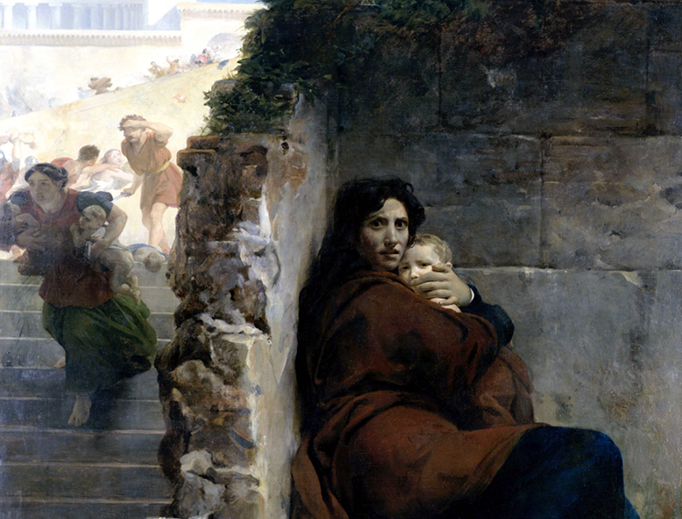
Léon Cogniet (1794-1880), “The Massacre of the Innocents” (photo: Public Domain)

I don't like the feast of the Holy Innocents. That was my main thought as I prayed Morning Prayer at church this morning and chose hymns to play for the morning Mass. In every Jesus movie where the slaughter of the innocents is depicted, I flinch and pull my blanket up a bit to hide. When my children were small I just flat skipped over it. It's a horrible thought and it's even more difficult to figure out how to enter into a liturgical celebration of a horrifying event. Babies saying "yeah! We were killed for Jesus who got away safely!"? What are we doing here, celebrating how great it is to be killed? What will we do next, celebrate child soldiers who join our bloody causes without any ability to comprehend the evils involved?

So I turned these things over in my heart this week. And I found my way clear of that disturbance, to a better and deeper one.

The liturgical calendar can be like the quiet cousin at the Christmas gathering who frequently gets upstaged by the more boisterous guests: feasting, gifting, more feasting, more gifting. But when we learn to celebrate Christmas with the calendar, we are brought right away to martyrdom with St. Stephen, to contemplate loving union with Jesus with St. John, and then to the gory effects of violence and fear in the world with the Holy Innocents. The Incarnation is so incredibly mind-blowing that a lifetime would not exhaust the depths of how God desires to impact us with it. But the liturgical calendar makes it quite clear that union with the incarnate Son of God preps us not only for eternal glory, but also for transformation into His image on earth. And He was "a man of sorrows, and acquainted with grief" (Is. 53:3). 

One of the deepest causes of grief is sin which causes innocent people to suffer. That could be simplified: Sin causes grief. 

Herod ordered the destruction of life because of his fear, his clutching at power, his arrogance. The thought of sharing the stage with someone, let alone bending his knee to reverence Another, was totally foreign to his soul. Those who carried out his orders were formed in a milieu that accepted force as a higher good rightly served. It's just a few children. 

This is the world Jesus came into, as one of the vulnerable. At this point, the Scripture text makes it clear he is totally dependent on Joseph's ability to receive a directive from God's messenger: Take the Child and His mother and flee. I wonder at the role that Israel's far history of pain and suffering, and  Joseph's, over Mary's pregnancy, prepared his heart at this moment to respond in complete detachment and obedience to just go. Pain and suffering are evils. Pain and suffering, united with the heart of God, become portals for God's glory to shine on earth. That is redemption. This can be pondered, but it is known most purely in the experience of it. Joseph in this moment obeyed God and this obedience preserved salvation for the whole universe.  

I take away two things from this. Union with Christ is a call to His vulnerability. We lay bare our hearts which are wounded and woundable to each other, to God, to our own gaze. I've been the worst at beating and castigating my own self for simply being, believing it to be a great fault. I have walked the path of learning to trust God and wearing Him down at every step, begging for certainty and protection instead of going by faith. I've done the chip on my shoulder, angrily raising walls against others, preemptorily blocking them out of my heart for fear of the harm they might bring. I've done stupid dependence on people who proved I could not ultimately depend on them as my gods. But God's vulnerability draws us into eternal peace. "Nothing will hurt or destroy on all my holy mountain" (Is 11:9). It's true.

Second thing: I must open my heart to the Lord, looking in His light for how I am like Herod. How do my attachments cause me to trample others underfoot? How do I exercise oppression to get what I want? How am I totally cut off from the hearts of others in their joys and sufferings? And how can I experience the same transformation Joseph did, that deep attachment to and freedom for the Lord? 

Jesus enters straight into the suffering of the innocent, and union with Him brings us there as well. May we repent of everything in us which is poised to cooperate with Herod. May we entrust ourselves like Joseph, in our own vulnerability, in the interdependence which is ours. May we walk by faith in God who does not exempt us from dark nights, but who is trustworthy.

Wednesday, April 27, 2022

Who Am I, Anyway

 I love the song "The Secret of Time" by Charlie Peacock. There's a line in there that speaks to me today: "The moment I found out who You were, I found out who I was..." 

If I see the truth of who God is, with clarity, I will see who I am, with clarity. 

As I see who I am, with clarity, I can see, with clarity, how I should act and what I should do.

This is the way that the pursuit of knowing God gives me practical discernment. 

This is, I image, why Holy Mother Teresa says that self knowledge is so very important, as well as humility. "We will never succeed in knowing ourselves unless we seek to know God" says she in Interior Castle. It makes sense that in opening ourselves to the one who made us, we come to see ourselves as we truly are. Not that we won't gag at much of what we see. But, to poorly paraphrase Fr. Iain's explanation in one of his talks on St. Teresa, God sees us in Christ in our full potential reached, as we are in Him in heaven, while we experience ourselves journeying towards this. God knows us as we really are. What we really are, we who have the power of Christ residing in us by entering Him in baptism, is fully alive in Christ. It remains for me to become who I am. 

So it remains for me, as long as I am alive, to seek truth, to long for truth, to love Truth and abide with Him. 

This stands in direct opposition to all the thoughts of the post I wrote four or five back -- all the competing voices who were willing to tell me with certainty what God will is for me. 

It always needs to be God Himself that I seek. I think if one puts too much on seeking the will of God, what one is really looking for is shelter for ones insecurity. It is fine and good to admit ones insecurity. But what we need more than knowledge of a particular thing to do is to know to whom we belong. We find security in belonging, but to whom do I belong? 

The Christian Church is primarily a place of belonging -- to Christ first, but also to each other and to the world, the needy, the suffering. 

I've been praying for years that God would teach us how to belong to one another. Yet, we don't know, until we learn what it is to belong to God. 

Part of belonging is knowing that I matter. What I do matters. What I do has an effect, for good or for bad. I can bless, and I can hurt. Part of belonging is to be willing to go without anesthesia -- the various things that block our pain. Part of belonging is knowing what to do with the pain we feel because of being together. 

I cannot know who I am without knowing God, and I cannot completely know who I am apart from community. This explains both why people are hungry for Christian community and why others want to avoid it. 

In part, I think God has made me a trumpet. A clarion. Here's the sounding: it's time to move together, it's time to respond. It's time to pay attention to what is happening in you, and around you. It's time to get ready to see people who are moving towards you, and to see the people to move towards. Time to get into position. 

Monday, April 11, 2022

Gratia non tollit naturam, sed perficit; And Community


The Lord has been faithful to pour out His graces to me this Lent; and I hope to be more faithful than I have been to be attentive and responsive to what He gives. 

Today's thought: if the enemy of our souls cannot pick apart our faith, he will try to pick apart our fruitfulness. One way he can do this is by muting our spiritual gifts, burning us out, heaping up the opposition, blocking the edification; causing us to doubt them, "sacrifice them" in trying to "practice detachment" from exercising them and thinking we are doing a good, unselfish thing. If we do not employ the means God has given us to build up others, we ourselves will be less purified, and there will be less praise and glory rising up from those who are meant to see what God has given us, and rejoice in the help it gives them. 

When we come to serve the Lord, we can expect refining, says Sirach chapter 2. Serving the Lord implies putting the gifts he has given us to work. I love the phrasing of St. Thomas Aquinas: Gratia non tollit naturam, sed perficit, or "Grace does not destroy nature, but perfects it." There are such things as natural gifts, certain talents or potencies we are born with. These we are called to live fully, and they are to be integrated into our relationship with Jesus. As we give Him our hearts, we are giving Him everything about us; everything we have, everything we are. This includes all of our abilities (and our disabilities!). Everything finds its place in Jesus' heart. 

Not everything easily finds its place in this world, though, and so we face this process of refining. We entrust ourselves to Jesus, and we live in this world. This fallen world is bound to hurt us. We are bound, at some point, to not fit, to be told we in our very essence are wrong, bad, untalented, lacking, worthless. If we aren't very careful, we will internalize these voices (and we will have demonic help with this). If we aren't careful again, we will spend our lives fighting representatives of all the warring voices, spending ourselves in self-protection, self-justification, or self-rejection. Or all of the above.

Grace does not destroy nature, but perfects it. To live as human beings in grace in a fallen world, we must first believe in the love God has for us. We must acknowledge the worth He says we have. We must embrace the identity He says is ours as children engrafted into Him by the new covenant. We must stop fighting the warring voices and listen to the One who shows us who we are. We must live in truth. We must internalize truth. 

When we then turn our hearts over to Him daily, asking for His grace, we are not asking for the destruction of our nature. We must stop cooperating with every aspect of the agenda of the enemy here. We must instead seek his purification. We find this purification as we live out the gifts he has given. We allow ourselves to be seen as we truly are. We bring our vulnerable hearts out of their coffin storage. If we have pushed them down too hard and too far, they'll come springing out like tennis balls under water. It might be embarrasing to us and mess with those who try to manage everything efficiently. Conflict might very well erupt with those who don't know how to deal with our nature and try to force us back into our coffins, thinking that coffin is where holiness is to be formed. We might misunderstand the correction we are given, thinking we are being forced back into our coffins, when in fact we simply lack a category in our understanding for what lived virtue actually looks like. 

This right here is the life of Christian fraternal community. Grace perfects nature. I'm not likely to have all the wisdom to perfect you. I'm certainly not likely to have all the wisdom to perfect me. You are not likely to have all the wisdom to perfect me (and this hearkens back to the post I wrote last week, about all the voices telling me what is the will of God, and me gloming on to each individual one as authoritative). What it takes is community.

So many times, what has powerfully spoken to me was not words spoken to me at all, but something I observed pass between two other people. For example (and it almost makes me shudder, now), I recall overhearing a choir member telling our director that he wouldn't be at rehearsal the next week or two. In response: "Ok." Today, this seems like such a normal exchange. But at the time I was just coming out of a relationship that was so cloyingly weird, where an announcement of someone being away would have been met with effusions of how the person would be missed and was so valuable and on and on until you just about wanted to puke... that that "ok" spoke to me as the voice of respectful freedom, instead of the emotional manipulation that I felt compelled to sell my soul to. Yuck.

So what do you do when you need to stand up and say "yuck"? Well, you are going to need fortitude. You are going to need strong internalized truth, and a knowledge of your identity in Christ. You are going to need to exercise the role of the prophet, perhaps, to speak out, or you are going to need to exercise discernment to realize it is time to move out of an unhealthy group, to help it fall apart and disintegrate.

All Christians need a healthy community where we become who we are, where we exercise and grow in our gifts, where we are supported by one another, where we are lifted out of lonliness and learn to belong to one another. Without it, we get desperate and we do desperate things. Without it, the church suffers. Without it, the lost stay lost, and more and more of the baptized drift away and become lost. God gives each of us gifts for the upbuilding of the others. We have to get to the point where we are with others and allowing this upbuilding to happen, open-heartedly allowing grace to perfect our nature.