Wednesday, August 23, 2023

A Woman in a Woman's World


Yesterday I had, well, let's call it an interesting experience. You know how you can be going through life, facing forward, living in the present, dealing, coping, stretching, learning. Doing the little advances that successful day-to-day life is all about. Then suddenly something comes along that has you stopping and looking back, looking far around you at places you once traveled through. Small thickets of confusion that are familiar in a distant way. That's what I did yesterday.

But it wasn't just in my memory. It was a concrete thing in front of me, invading my present. 

My parish is running a women's Bible study this fall. 

Now here's the funny thing. Maybe a year ago I visited a parish across the river for confession, and I saw that it was offering the same women's Bible study. I shared it on my Facebook page, being ever the promoter of things. I'm all for it, in theory, and I think I even momentarily looked into what it would take to offer it in my town. 

And I was asked to take a leadership role, similar to what I had done in our parish ChristLife, which satisfied my inclusion needs (aka ego. I was sought out. Thank you.). But ultimately I passed on it. Because to be honest, just the idea of being part of a women's Bible study sends me into the small thickets of confusion.

And I spent a chunk of yesterday spinning this around in my mind and checking out some interesting emotions that it conjured. 

It is intended not only as a Bible study but also as a community building thing. And this is where I needed to admit to myself what, for me, makes for community building. That would be work. That's why I liked the feeling of being offered the logistics and communication job. I even asked if I could do that part without actually going to the Bible study, but no, that wasn't the vision. That's ok. 

Shared work is probably my primary "love language" if you buy that expression. This is something I like about choirs and music; it requires that everyone work together. This is why I tend to take on huge tasks with a lot of excitement -- like the year our Bishop gifted our parish (and every parish) with hundreds of copies of one of Matthew Kelley's books, and my daughter and I gift wrapped every single one. I questioned the size of that undertaking, but my (then 8 or so year old) daughter proclaimed it "a labor of love," and so there was no turning back for me then. When parishes were reopened after our short COVID shutdown, I was asked to buy some rope from Lowes to make the required social distancing thingies look somewhat dignified. Oh no. My daughter and I braided ropes out of white tshirts and figured out a way to keep them firmly on the pews but also made them easily adjustable. That felt so good to be able to do that, whatever your thoughts on social distancing. 

Yeah, so what I don't find a helpful way to give myself is to sit in a group of women chatting about how Scripture impacts my day-to-day life, or study guide questions. Spiritual direction; yes. Theological discussion; yes. Lexical study, historical study; yes, yes. Pretty tablecloths, conversations where words fly fast and emotions fly faster, or women connect emotions to sensible things in attempts to "feel comfortable sharing..." I don't even know how to do that. And generally it makes me feel the opposite of community-built. I tend to sit there with my mouth shut, trying to track (or tuning out, depending on how my day has gone) and mostly feeling a thousand miles away. These days, my thoughts just dash to other things I could be doing. In the past, I sat there wondering why I did not know how to be a woman. Because I figured A Woman's World was what I was looking at.

Yes, yesterday I felt again that jab of feeling like an unwomanly woman. Like maybe I should try harder. Like maybe I was being weak or selfish or inadequate or unholy or rebellious or (insert more) for not wanting to participate. Like I really should. I thought of, and even played, that song by Wendy Talbot from the 80s "Woman of the Word" where she asked questions popular of the day about what women "should" do. It dawns on me now: we think the question "What is a woman?" is newly controversial. (Some) Christians have been making it difficult to answer that question, on a non-biological level, for decades.

In the midst of questioning myself yesterday, I found it extremely difficult to do the work that was actually in front of me. Suddenly I wasn't sure I could do anything.

If you diligently read this blog (😂) you'll realize I've been sinking deeply into the Seven Sorrows rosary in the last few months. After all these years as a Catholic, I am *just starting to sink deeper into understanding the Blessed Virgin Mary as woman par excellence. And as I've been meditating on her sorrows, I realize she has a lot of strength, born of emotional and spiritual pain. She probably did enjoy beautiful objects and she probably did chat with women friends. But there was only one Blessed Mother. In a common way, there is also only one of each of us. I have never been given to conformity, but I haven't always been at peace with being myself, either. It has struck me with terror; it has confused me. But humility says, I am who God made me, no more, no less. I will be me, because it is God's will for me.

This morning, as happens to me occasionally after a day on mental frappe setting, I woke with everything clear in my mind. Following the Lord is not a path full of should. Or as one priest once quipped, "Stop should-ing all over me." One must not should oneself, either. Jesus says, "Follow me and live." He commands, he invites, he speaks to us about reality, but he doesn't guilt us into things, so we need to refrain from responding to that kind of motivation. Ok, I need to stop it. Respecting freedom is super important, and it is grossly counter-productive to Christian life to not respect freedom.

I'm not guilty of being me; I'm responsible to be me, and to learn how to do it well. I need people in my life in order for me to be me well, but I also need space from people, and I can't expect that anyone is going to understand what I need unless I understand my own needs and make them known as necessary. I'm actually responsible to God to invest well the raw material of myself He's given me to work with, to try to gain a return. 

See -- it all boils down to shared work! 😉


*Everything in the spiritual life is always just beginning.

Tuesday, August 15, 2023

Submission Revisited

This morning, let's say it was by the time Mass ended, I realized I now have a refined understanding of submission. 

Sometimes spiritual insights just click, becn ause a grace God gives grabs hold of words that are spoken, and both goes to a place of past experiences, and then it all elevates, it changes key, and something new is perceptible. 

And this happened today regarding the reality of what it means to be in submission.

Fr. Mike Schmitz was addressing this in recent episodes of Catechism in a Year, because the topic has been the Sacrament of Matrimony. He was discussing the verses in Ephesians that tell wives to be submissive to their husbands, and husbands and wives to submit to one another out of reverence for Christ. Now, I've heard any number of takes on Christian submission, but how it landed in my mind was that submission means saying yes to what someone with valid authority tells you to do. I wrote a blogpost about this way back in 2007. Fr. Mike's definition of submission (CIAY, Day 224) is "to place yourself under the mission of the other person."

And I think those words just sunk in and hit a very deep part of my awareness today.

It's the Feast of the Assumption of Mary. Now, Mary was totally submitted to the mission, the plan, of the Blessed Trinity. She was totally on-board with the salvation of the world, the sanctification of the world, and bringing total glory to God in and through her every breath. She was also totally submitted to the mission of Joseph, who was specifically made Guardian of the Redeemer. He, in turn was totally submitted to Mary's mission as Mother of the Redeemer. Their marriage was a partnership in the mission God had entrusted to each of them. They were submitted to one another out of reverence for Christ, literally. 


And so it has to be with us. Our lives are about the mission: the Great Commission, to call to bring all souls to life in God through Jesus Christ in the Holy Spirit. 

Ok, so even as I'm writing this, I'm coming up a sense of well, duh

The changed key, the newly perceptible truth stems from an interior shift. How can I struggle this out into words...

In the aforementioned blogpost, I gave the example of how I might respond to the Bishop saying he was closing my parish. I said it would hurt, but I'd go with it. And that was pretty much my take on submission. Responding to something that happened. But if I place myself under the mission of Jesus Christ, or more concretely if I place myself under the mission of a particular human being, then I am going to employ all of my energies, all of my creativity, all of my resources into furthering that mission, that aim, that goal. This is how the dynamic of my life has been leaning for some years now, but today it clicked. This employing of my energies -- that is submission. It is not passive. I don't sit and wait for orders. I'm not a harem member that waits to be summoned. To waste my energies -- to spend them all on myself or my entertainment, or to fret myself away in anxiety or nitpicking, instead of love -- that's not submission. To chase after financial security or a name or success -- that's not submission. 

I would posit that spouses submitting to each other is not about each other; ultimately, it is also about Christ. It is about serving God, the common good, and learning where each other fits within that (because God always makes space for us). And it definitely is not about simply saying, "Yes, dear" and doing what the other person selfishly says or wants. It might keep peace, but it is not a way to grow holiness. If there's no mutual discernment of a virtuous path and an active desire to seek the Lord's will and way, then trouble ensues.

Several years ago, I had the strange experience of being contacted by an acquaintance who was leaving society to join a monastery. He had a few months as he transitioned into his new life, and just during this time he challenged me to write a song every week. He asked if I'd be willing to take it as a formal challenge and submit the new songs to him every week, and then he'd give me a new tweak in the challenge for the next week. I was intrigued, so I said yes. I had not written new music in a long time, but during that time I cranked out several new songs. I was very aware that I needed that piece of being called forth. Then he abruptly had to cut off communication, and that was that. I stopped writing, because I no longer had a mission to place myself under. That experience stayed with me a long time, and I didn't know what to call that powerful impetus. I think it is the power of submission. And I think one of my central life frustrations has been to rarely find a healthy person with a Christ-focused ability to say, I have this mission; join it. Well, I know now I am a Carmelite and I do have a mission there, but even there, we are still figuring out how to respond. Why are we so slow to live this reality in the Church? Why is it so unclear to engage the mission of Christ with our whole selves? Is it because we are not in possession of our whole selves? 


Saturday, July 01, 2023

Full Range of (E-)motion

One of the promises that Our Lady made to the visionary Marie Claire in Kibeho, regarding praying the Seven Sorrows rosary is this: 

Those who say it often... shall obtain clear understanding of their weaknesses and flaws causing them to sin, and those things we don't like about ourselves and thought were a part of our character, shall change.

That... sounds good to me! 

And while I didn't start praying it to cash in on promises, I have to admit that I am finding the promises delivered upon anyway.

In previous posts I've been reflecting on my sadness, and the love in which I know myself to be surrounded. Another significant theme of my life recently has been the need for me to enter into rest, and especially to deal with physical stress and anxiety (also mentioned here recently). I've been pursuing a new exercise program which is less about heart rate and pushing muscles and more about flexibility, and stretching. While I no longer have the back issues I once did (because I now have core muscles!) I am very aware of how much tension I carry in my body. So I've been learning how to purposefully move so as to release that tension as much as possible. The instructor pointed out that sometimes emotions can get released right along with the physical tension. We are integrated beings, and physical tension and emotional tension are connected. 

So I feel like all of this is converging for me for some needed change. It's all in process.

And today I went to confession, which is sort of like the power-wash of grace. Tension has a way of reinforcing my natural bent in on myself. Physically, it even looks like a pulling in, a squishing down. It's all about me exerting energy to try to get something to happen, but in a way that's like digging a pit in sand. Futile energy expenditure that wears me down and cuts off my awareness of the Life around me, the joy that weaves through small things, and the Voice of God in the still, small whisper. All of this self-reliance was clear to me today.

For my penance, I was told to slowly and meditatively pray the Anima Christi prayer. It goes like this: 


So I prayed... and then I got to the line that hit me: Separated from You let me never be. I had to repeat it over and over again for a couple of minutes as it all washed over me. I handed over old fears and even recent incarnations of my misplaced struggles with childhood abandonment. Although my parents divorced when I was five, my father was an elusive presence even before that time, due to him taking teaching jobs at some distance (the first about two hours away, another 11 hours away, so that he only came home on occasional weekends). When I was about six, my oldest sister moved away, and my second sister a few years later. One day when I was fifteen, my brother announced at dinner that he was moving out the next day. In our family dynamics, these were not relocations; they were severances. I panicked whenever friends at school talked about the possibility of moving.  And while it doesn't bother me to admit this now, for a long time I could not even admit to myself that I had recurrent bouts of absolute panic, until age 19, whenever my Mom came home after I went to bed and left in the morning before I got up, because I was absolutely certain that she had moved away and left me alone to fend for myself. 

Separated from You, let me never be.

I did a lot of self-protection by clinging to things that felt certain: knowledge, my academic abilities, God, as I understood Him. God has a wonderful way of dealing patiently with exceptionally messed up people who want Him on their own terms, but are still open to whatever really is true. That was me. 

To make that long story short, God duped me and I allowed myself to be duped (Jer. 20:7). It's a long story, but finally he brought me through two different experiences where I felt myself abandoned, by people, yes, but especially by God Himself, in that suddenly I did not understand Him anymore. 

What I see now is that I had always been separated from God to a degree by my anxious clinging, my fear of abandonment, my lack of ability to trust that He would keep me safe. He was doing a series of surguries in my soul. Really, before each painful one in that series there was an implant of joy and safety. Hard to explain, but in retrospect, it's extremely clear. 

And then he basically crushed the deformed measure I had made for Him. 

And it took time, but a new thing grew in its place, and is still growing. It is vibrant, and it is beautiful. 

Separated from You, let me never be. 

It is sin that separates us, and it is His love that unites us to Him. But it isn't only our active, personal sins that separate us. It is also these areas of weakness due to woundings which have never gotten full Son exposure. It's the ways we have responded in our own power to our wounds. Our flaws and cracks from mishandling can be not just sealed up, but completely transformed to bear the glory of God. And the more we know that we are weak, the more Christ's power can rest on us. Lord, teach me really what it is to delight in my weaknesses. 

Friday, June 30, 2023

Sadness, and Love

Photo by Jan Axelson
Cherokee Marsh, Madison, WI

Yesterday, we buried our pastor. There is still a tinge of the surreal to it for me. I'd really only known him for fifteen years, but I am a completely different person today than I was fifteen years ago. And so much of that change happened in the context of the community which he lead. It's going to take awhile for me to wrap my mind and heart around the new day that it is. 

The last two weeks were intense. They were intense on a social level, because my parish community has been grieving together. Our daily Mass community has been grieving together. Several people randomly spoke to me or got in touch with me to tell me their experiences, and several of us who see each other more often were able to check in with each other, sometimes several times a day as we gathered for our prayer vigil. It struck me how several years ago I would have thought it stupid to ask a grieving person "How are you doing?" because I knew how they were doing -- they were sad. But that was the old me, the person who stood outside, away from my emotions, and observed other people -- with significant awkward discomfort -- experiencing their emotions. Hoping they wouldn't splash up on me. Because I would look at them like they were rocks. Or rather, like I was a rock.

But there was none of that for me in these two weeks. My parish is my family. I was going to say it is more a family than my extended family has ever been, but really, it is just my family. I'm realizing as I write that the only reason I can feel that word at all is because of my parish. I mean, yes, it's because of the grace of God. But the grace of God doesn't come wafting down invisibly as I sit cross-legged and vocalize in an empty room with my eyes closed. It comes through the Incarnation, extended in time and space: the Church. And the Church comes to us through our local parish.

So even though I have been sad, the sadness I feel shows me the measure of the love that is normal to me. Without love, sadness becomes depression, despair, hopelessness. Been there, done that. So one thing these intense weeks have been is a surprise inspection of my heart. 

Before all this developed, my primary meditation had been revolving around the Seven Sorrows rosary. This theme came up for me: Do not camp in your sorrow. Now I see this is a coin, and on the other side it says: Do not run from your sorrow. Be with it. Right now there seems incredible peace and wisdom in this, and I see that it means that my life really is not my own. I was bought with the precious blood of Jesus Christ (1 Pet. 1:9), and God lives in me. And He is Lord. So when sorrow comes, be with it. When joy comes, be with it. Our Bishop's homily at the funeral made this statement: "Jesus instructs us that to be credible Christians is to have and to express human emotion, not taking a stoic stance." Old me really wasn't a credible Christian, for this reason. I was so stuck, emotionally. Despair and hopelessness froze me. I did not know myself held by one stronger than myself, free to feel things that passed. Free. 

To be free, one has to know oneself to be loved. And more than I ever have before, I do.

Monday, June 26, 2023

I am Sad


Yesterday, I told a friend, "If grief comes in waves, my waters are pretty choppy right now." 

On Saturday evening, the pastor of my parish passed away after just over a week in hospice care. He had been battling health problems for just about 18 months, but eschewed retirement (though he came of age to do so) and every report he gave on his health condition was that he was feeling better all the time. The last time he was present at church for the after-morning-Mass coffee gatherings [about a month ago] he was famous for having started, he was telling stories and passing on information in such an oddly intentional way that I commented to my daughter on the way home, "He was telling stories like someone who knows he is going to die." 

After he went into hospice I was compelled to organize a week-long prayer vigil. First, it struck me that when he was ordained a deacon, he made a promise to pray the Liturgy of the Hours daily. If he was no longer able to pray the hours, I wanted the parish family to be able to pray the hours "for" him. I've been told we've always been a bit of a pastor's dream parish, because there are lots of people in place to take care of many aspects of parish life, freeing the pastor for his actual ministry (instead of maintenance and such). There's a lot I can't do, but as a Carmelite, at least I can pray, and lead people in chanting. 

Also, I realized that sometimes people need to physically move their bodies into church and produce words with other people, in order to process difficult news. When my mother died and my sister did not hold a funeral until six weeks later, it was extremely hard for me to not have anyone to gather with. 

Another also, last week meshed with a very free week for me at home since I was home alone (or far more alone than usual) most of the time. And while I knew the schedule would get a little intense, I need things to be a little intense in order for me to match the intensity going on inside me emotionally.

And still when I got the phone call, and in the hours that have followed, I'm bouncing from disbelief, shock, tears, joy, gratitude, anger, more tears, and, well, blogging.

What I realized throughout the week is that it is one thing to lose a person you love. It is another thing to lose a person you love who has been with you at and through your life's most difficult moments and most joyful moments. Because there is not only the sadness of losing their presence, their very felt presence. There is also the re-opening of both the gratitude and the entire drama of pretty much everything you've ever felt deeply in their company.

Maybe that's obvious to some, but I think this is the first time in my life for such an experience.

There's more to say on this in connection with my Seven Sorrows rosary journey, but I'll save that for later.

Monday, June 19, 2023

Cleaning, Anxiety, and Magical Thinking

I feel things moving and changing in good ways. I've giving -- sometimes unintentionally -- developments a few days to marinate before I write about them. But I want to be sure to write, to grasp well the good things.

I had a revelation the other day about cleaning and housework. I know I'm not alone in having some odd emotional connections (or disconnections) where housekeeping is concerned. I've realized that as I am praying the Seven Sorrows rosary and handing over my anxieties and developing new practices, my emotional relationship with housekeeping is one of the moving pieces.

I have distinct childhood memories of cleaning out of anxiety. One memory is of knowing my mom was expecting some kind of business man coming for an appointment (insurance salesman, maybe a contractor, I don't remember) one certain late afternoon or early evening. Being the Gen-X kid that I was, I was home by myself after school on a regular basis for a couple of hours before my mom returned home from work in my elementary school years. So on this day, I knew that this appointment was coming, and I looked around the living room and saw it was a total wreck. I was anxious over the fact that the time was getting really close and my mom wasn't home yet. I couldn't let someone come into our house and see it be such a wreck, so I quickly got to work and cleaned everything. My mom came home at almost the same time that the man came for the appointment. When he left, she thanked me for cleaning up.

I also witnessed my mom stress-cleaning on occasion. I suppose the stress was induced by my dad's drinking and calling our house when he was drunk, because that was usually the thing. I know it left me in distress, too, but watching my mom stress-clean stressed me out all the more, and without knowing it I believe I drank in that the way to deal with emotional threats was to try to fix unrelated problems, such as our dirty sink. Magical thinking gets cemented this way, and carried over beyond the age of reason, I think, when there is no discussion or acknowledgment of the step that belongs between threat and response, i.e. coping strategy.

Ultimately, in my example, I was stressed because of my mom's absence and my sense that I, as a child, had to take on responsibility, rather than accept direction from my family's leadership team. Because there wasn't one. The way I understand it, my mom's stress led her to scour dirt, because it was something she had control over, unlike the relational mess of her former marriage. 

Fast forward to my adult life. Dirt is an objective reality of living in a house, regardless of what my emotional baggage contains. For many years I have noticed that whenever I go through a time where I feel emotionally strengthened, I clean and get rid of old junk with a good degree of joy. It's a feeling of liberation. But I've noticed as well periods of time where I avoid, avoid, avoid certain tasks. "I'm not a visual person," I say, and that is true. I don't get as easily bothered by clutter or grime as some people do. Plenty of times I have grumbled that other people could be helping me, even while feeling like asking someone to take on certain tasks wouldn't be quite right or good of me. I'm really the one who *should* do things, but if others spontaneously just knew and did, they would be higher quality human beings. So goes the endless ping pong game. Hiding inside, like cobwebs and giant dustbunnies, were a lot of unexamined and unresolved emotional issues that were fueling the endless back and forth between two losing options.

At holidays, I willingly welcomed the panicked stress-clean. We're having visitors, so, CLEAN! I treated this like a treasured childhood recipe, a necessary part of the celebration. Other times, I felt like the put-upon maid, the servant of my family, whose job it was to do everything because everyone else was lame (or a child). (Cue subsequent guilt and shame for these feelings.) There was also a good dose of, No, I'm not the maid, and I don't have to stress. And guess what? The house became a wreck. And I don't like that, either. So I plod along, just clean it, with mind turned off and tuned out.

So the revelation that has hit me is that there is another way to live with this. There is a way to find actual joy. I can approach housekeeping as caring -- in the first place, for my own self. I can tidy the kitchen because a tidy kitchen makes me happy. It frees me feel at home, to want to be there, and to do whatever I'm doing with a little note of the joy of being alive. (Ooh, the glory of God is man fully alive. There we go.) And then, if there is something else that really needs to take priority at the moment, I can peacefully realize that the task at hand just needs to wait; it doesn't become a threat. And I can say to the person next to me: "Could you do xyz?" I don't have to do everything. My family can learn to be a team, especially if I figure out how to lead the team that way.

I suppose I've gotten very close to working this way most of the time over the years, but having this as a conscious operating system is stunningly new. 

And you know what else? I can even engage in stress-cleaning effectively, if I acknowledge to myself that doing something physical would really feel good right about now, and it would help me release some of the pent-up anxiety or stress I have going on. 

I have found that emotional baggage is an enormous energy drain. The subconscious avoiding of messes because they represent my lack of being God, or at least not a magic fairy who makes all things bright, glittery, and happy -- yeah, it numbs a big swath of my heart, mind, soul, and strength. I need those for other purposes. Time for the anesthesia to come off. 

But everybody suffers. And the Seven Sorrows rosary is teaching me how to face my own pain and to live in virtue instead. Thanks be to God.


Real-time photo of my "office"


Thursday, June 15, 2023

Good Morning, and Welcome to my Anxiety

Writing has always been a key way for me to access and relieve the pressure built up in me by feelings and thoughts that develop as I journey through life. I am still meta-surprised to find I am human (surprised that I am still learning and encountering new chapters). And right now I am poking at my experience of anxiety, learning what is in it and listening for what the Holy Spirit is saying to me about it. 

And since it is a story, I'll back this up a bit and narrate from my last three blog posts as a starting point.

This little phrase that spoke to me on Good Friday has been growing into a strong, tall sapling: Everyone suffers. About a week after I began mulling on that, I was scrolling Facebook and found that a Carmelite friend of mine had posted about a conference he attended called (drumroll) "Everyone Suffers." I didn't need twenty nudges to check out the website, and saw that it was about praying the Seven Sorrows rosary or the daily prayer* which focuses on virtues and beatitudes. This linking of virtues and the Beatitudes sounded so much like what my OCDS formation group is working on right now that I immediately incorporated that prayer into my daily meditation. I also contacted a friend who makes rosaries and asked her to make me a Seven Sorrows rosary. 

My observation here is that I normally hesitate over moves like this. On a rare occasion, I listen to a speaker who is excited about something and I mesh with that excitement enough to go "rah rah" over whatever s/he is promoting, but those bursts of learning or practice are usually short-lived. This involved no one speaking, just seeing something concrete in front of me that had an undeniable connection to a word I heard God speak interiorly. I hesitate at the still, small voice sometimes because of a fear of getting burned. I know I have a capacity to get super excited over things, and it can make me feel unglued, scattered, and lost. I know that if I never follow any leads, I'll never end up feeling unglued, scattered, and lost. But there's a high price to pay interiorly for not following any leads.

So my friend finished my rosary, and it is beautiful. Oh, I have a picture:


One day, out for a walk, learning to pray this rosary, I had a foundational revelation about the grace I was being given. I'd say the Blessed Mother was teaching me that her sorrows, or the sorrows of Jesus, were not a place to camp. They passed through their sorrows on the way to glory. And I was to realize the same. My sorrows are not a place for me to camp or get stuck. And to the extent that I am stuck, what I need is the practice of virtues, according to the Beatitudes, which is basically Jesus' road map to the kingdom. One way that I repeatedly get stuck is that I measure my life by my own standard, and that standard is usually impossibly high, unrealistic, constantly shifting, or trying to be at peace with those who are not holy (including myself). It doesn't really matter which of these is the resulting mess -- the core problem is that I put myself in a wrestling lock against Jesus' Lordship. And it's usually because of my innate tendency to suspect incompetence everywhere, even in God. And because I'm a fool.

Basically the Blessed Mother has invited me to walk with her and learn to release my sorrows to the Lord.

And lo and behold, I find that my sorrows seem to be wrapped up in anxiety. More on that later.

When I started learning to pray the Seven Sorrows rosary, I remembered that somewhere in my vast collection of printed materials in my house, I had a booklet on how to pray it. I dug it out, and while I have not yet been able to really connect with those prayers (I tend to focus more on Carl Brown's prayer linked above), the booklet was by Immaculee Ilibagiza, whom I have known of by reputation and an occasional mention by my elderly Nigerian friend. I knew she was the woman who survived the Rwandan genocide by hiding in a bathroom, but I didn't know much more than that. 

Once again I did not squash an inspiration with excessive hesitancy, but went to Immaculee's website and ordered a copy of every book she's written. I have finished the first three, am in the middle of the fourth, and have three more that I have yet to start. 

Now, I had actually thought to write here earlier about this journey that began for me on Good Friday, but part of me wanted to wait to digest everything Immaculee wrote first. Clearly I've decided that it is ok to write while in process -- I mean, when am I not "in process." If there was ever a life which speaks to what the Blessed Mother is teaching me -- that sorrows are to lead us to glory -- then it is Immaculee's life and testimony. In brief, it seems that a big part of getting stuck is refusing to face or accept the suffering while still trusting in a Good God. Holding both. I can't summarize the intensity of her experience here, but if it intrigues you I certainly recommend you read her books. The scope of them is more than personal, because he also deals with the Marian apparitions of Kibeho which effectively predicted the genocide. It's huge, and more than I can even touch on right now. But it isn't strange to realize that any one of our little lives, in God, touches all of eternity. 

So, all of that is how I've gotten to the place today. For the last couple of months I have occasionally been experiencing unusual physical symptoms of anxiety, I mean, much more than is typical for me. As I look back on my life, I realize I have had chronic anxiety, even from childhood. But it was so normal for me that I didn't know there was another way to be. I recall a physical exam in my 30s where the doctor was trying to test reflexes in my elbow. He wanted me to raise my arm in an L-shape, letting my forearm dangle downward. I held my arm out like a concrete L. "Just relax," he said. "I am relaxed," I replied. I really could not tell the difference between tension and relaxation in my body.

I used to only notice anxiety when a new situation tested it, but that was pretty much all the time. Later, I started to only notice anxiety when I was able to feel rested inside; I began to notice a contrast. There's some strange looping going on there. In the last fifteen years or so the rest has greatly increased, and my ability to cope with new situations has increased. But down in between all of this, there is still more freedom that the Lord wishes for me.

Ah, another piece. A few days ago as I deep-cleaned my "cooktop," I listned to my favorite Carmelite, Fr. Iain Matthew, OCD give this talk: Making Life an Offering: Teresa's Experience of Life in the Trinity. In fact, I listened to it about four times in a row. The word that I needed to glean from it at the time was this notion of spaciousness in God. That St. Teresa's experience of God shaped how she related with people, and it was that there was space for her to be her. She could be playful. She could be a tad audacious. She could be free. She could be herself -- when she prayed and as she lived. The nature of God draws us to this. "Where the Spirit of the Lord is, there is freedom" (2 Cor. 3:17). 

This word reverberated around and around in me. Physically, anxiety makes me contract and pull in on myself, and it hurts my muscles and my back. This notion of space, spaciousness, of opening wide to God... it's all in the opposite direction of anxiety. No creature opens wide where there is no trust.

All of these things, physical, emotional, spiritual, mental... these are all where I'm at right now. It's good. It's in process. I see a lifetime yet of practicing these things ahead of me, though. Maybe this is wisdom of age starting to take root. 


*August 2023 Edit: Carl has taken down his old website, and the new one does not include that prayer. The text of it is below.

Seven Sorrows Prayer

Mary, by your example in hearing and accepting the prophecy of Simeon, may I learn the virtue of humility, and live the Beatitude: Blessed are the poor in spirit, the kingdom of God is theirs.

Through your example of selflessness in the flight into Egypt, may I learn the virtue of generosity, and live the Beatitude: Blessed are the sorrowful, they shall be consoled.

As you were single-hearted in searching for Jesus when you lost him for three days, may I learn the virtue of purity, and live the Beatitude: Blessed are the pure of heart, for they shall see God.

When things don’t go my way, may I practice the virtue of patience as you did, while watching Jesus carry his cross to Calvary, and live the Beatitude: Blessed are the peacemakers, for they shall be called sons of God.

When I’m tempted to escape difficulties through self-indulgence, may I be inspired to practice temperance as you did when you stood at the foot of the cross with your son, Jesus, and live the Beatitude: Blessed are those who hunger and thirst for holiness, they shall have their fill.

When others harm me or those I love, may I grow in the virtue of the kindness that you demonstrated in receiving the dead body of your Son into your arms, and live the Beatitude: Blessed are the merciful, for mercy shall be theirs.

When I’m tempted to despair or become despondent may I recall your diligence at the burial of Jesus, and live the Beatitude: Blessed are those persecuted for holiness, the kingdom of God is theirs.

Amen.

Sunday, May 07, 2023

Following up on Things Previously Said

Clearly I don't blog much anymore, so when I do write something, it helps me keep track of my interior landscape all the better. On April 14 I wrote about my Lenten gleanings and noticed a grace that seemed like God was "reaching in to heal a blockage." And then last week I wrote out of a place of mounting burn-out and frustration. 

And then it happened.

I had a panic attack.

I rarely have anything remotely like a panic attack, although I have had low grade consistent anxiety for a lot longer than I've actually been aware of. And I haven't experienced an actual panic attack for roughly ten years. So this was WEIRD and I firmly noted it as such as it began happening...

But I realize I got into this place with this interior forewarning, and it makes me really happy to say I emerged from that place having avoided certain knee-jerk go-tos. The first thing I did was I let it happen. I didn't go to the "this isn't happening" place. I accepted that I was losing it and I let it be lost. Then I went to my prayer spot and I just "was." I didn't try to form words or thoughts, but I just shared my "letting it happen" with Jesus. No trying to manage or understand. If there is something to "Jesus take the wheel" I suppose it is that surrender of things sometimes looks more about acceptance than it does like trying to dig a deeper ditch. When I hear people talk about "a deeper place of surrender" it often sounds to me like I need to put more work into it. But I do think it is more about acceptance: here's the reality. My eyes are wide open, and I'm seeing it. And I'm seeing it with Jesus. He's seeing it with me. That's where I was.

Then I refrained from making it a spectacle. Sometimes in the past I have shared things with people as a replacement for accepting these things. Maybe that sounds strange, but I think that's the truth. If I tell someone else, it sure SOUNDS like I'm embracing this enough, owning it enough to share. But I think somewhere in there sharing has been a step in self-rejection. Like telling on myself. Gossiping about myself. "You wouldn't believe what I just did...." There's a judgment, a lack of mercy in that. I held myself back from it in several directions, several times. It feels good to have chosen differently.

And then, because thanks be to God I had a previously scheduled spiritual direction appointment, in the right time and in the right setting and in the right way, I unpacked the whole thing, from the interior forewarning, through the event, and down to the terrifying question lurking underneath. And into that place of acceptance that turns a threat into an opportunity for compassion. 

I know that this spot will get poked at and tested in the days to come. It doesn't take any interior knowing to realize that; I can look at my calendar. But this was a concrete event of life, healing other concrete events in life. This is why life in God is not boring. This is a testimony to God's faithfulness and the reality that GRACE HEALS.

Tuesday, May 02, 2023

St. Joseph and the Desperation for Consolation

I was chatting with a priest friend recently about praying the Liturgy of the Hours, and I found that something poked at me like when a metal bra underwire cuts through the fabric and jabs you in the tender underside. So let's draw that out a bit and see what that was all about.

We were discussing the obligatory nature of praying the hours (for priests, same as for Secular Carmelites such as myself), and how he rarely or never finds priests remotely interested in or planning for praying the Office in common. Apparently he finds the norm to be priests always pray this privately, individually. He also mentioned how it takes time to pray this everyday, especially if one is to do so prayerfully, reflectively, with the freedom to pause and ponder, to take it in contemplatively, etc. I know he had mentioned in another conversation having been given the advice to prayerfully pray at least one section of the hours daily, and to be content with recitation of the other hours. The thought of praying all seven hours, for someone who is busy with apostolic life, is just nuts, basically.

Granted. Obviously the Church changed the structure of the Hours at the Council precisely because of the onerosity of an obligation to "make it through" huge chunks of Scripture daily, and how it became a burden to crank it out and plow through it all. Prayer, clearly, it not to be about merely cranking through.

What I found myself taking umbrage with, as one who daily drags myself out of bed to lead public chanting of Morning Prayer, at a consistent hour that I KNOW I would never keep up with, were I not committed to this small group who meets, is the notion that prayerful is consonant with comfortable. Something occurs to my mind, and I want to stop and nest on it, sucking the sweetness out, delighting in my mind, allowing it to speak to me. Vibe: suck it up, buttercup. Sometimes I am delighting in my rest, my thoughts, my privacy, and I don't want to discomfort myself by driving in the morning to meet people at church. Sometimes I'm physically not ready. Sometimes I don't want to sing. I switch it on so that other people can enter into prayer, and to help others with the discipline.

Sometimes a beautiful contemplative thought has struck me during the day, and then a child yells for homework help. Or the doorbell rings. Or there is no lovely thought, but there are whiny children who have required me to step out of the worship space during Mass and I have to set my will like a diamond stylus to engage in what is happening in the consecration -- and this happens more often than not for months or years. I learn prayer ain't all about me and my thoughts and feelings. Sometimes I can't access either of them. It is an act of my will, and it is joining to something larger than myself. Sometimes every step forward for years feels like a sheer act of will against tremendous pressure pushing me the other way.

The Liturgy of the Hours definitely is not mere private prayer. It is the public prayer of the Church. Yes, it can validly be prayed privately, but ultimately participating in it is giving voice to Christ present in His Church, for His Church, as a vehicle of salvation for the world. Ok, objective subject covered.

Ok, then screaming interior stuff. I'm tired. I'm tired of chronic responsibility, and I'm tired of feeling alone in it. I'm tired from a sense of trauma as a child, sensing the adults were falling apart, and I should step up to put them back together. I'm tired from having such a keen eye for every problem in the room and working out how I could solve it before other people are aware of it. I'm tired from being good at things and jumping into serving, and thereby training others to expect me to do things. I'm tired from taking a break and then finding the problems growing weightier and weightier when I step away from them. I'm tired from feeling like it is impossible for me to stop being responsible.

As a Carmelite, I'm called to pray for priests. I've got some anger stuck in there somewhere. I don't feel sorry for someone looking for a few seconds of mental or spiritual consolation. Maybe that's because I am desperate for a few seconds of mental or spiritual consolation. Maybe it is because I would really appreciate someone seeing my need, anticipating my need, and taking up my need as his own. 

I had this meditation the other day about St. Joseph, at the Presentation. The rite of purification was for the mother of the child. But the NAB mentions "when the days were completed for their purification," "they took him to Jerusalem." The law required it of Mary, but Joseph made it his. And it wasn't only because he was a wonderful husband and cared about Mary; he did, but more than that, he understood that this was God's will. It was an act of worship, an act of consecration to God. How he treated Mary was about how he obeyed God. Everything about St. Joseph is not just gratuitous fru-fru care, a nice but technically unnecesary extra, even though it strikes me like that. St. Joseph is absolutely necessary for Jesus' humanity, and for Mary's life, even though she is the sinless Virgin and the Queen of Heaven. God provided Mary and Jesus with Joseph. But Joseph had a human will of his own; he obeyed. He gave his own fiat. 

St. Teresa was of course an ardent devotee of St. Joseph, and taught her nuns to be rooted in, focused on, the humanity of Jesus. I'm seeing those two as inseparable. I don't think you can separate the humanity of Jesus from the person of St. Joseph. All I know right now is that is the antidote to the anger I've felt poking me. 

And maybe I want priests especially to see themselves like St. Joseph. 


Friday, April 14, 2023

Suffering, and Lenten Lessons Learned

 Here we are, a week after Good Friday. Time to take a break and reflect on what stood out to me at the end of Lent. Sometimes, without stopping to examine, I'm likely to lose or ignore the gifts I've received.

Right at the end of Lent, something was happening in my heart regarding suffering. I found grace reaching in to heal a blockage, with the simultaneous revealing to my conscious mind that it was even there. This blockage entailed a denial of suffering. Not a distaste for it, not a fear of it, but a refusal to accept that suffering happens, and is an unavoidable part of life. Oh, I'd heard and spoken words about this all my life, and on one level I knew what was true. But I discovered a part of me that insisted "This is not happening." A part that shuts down in the face of suffering. 

And now I'm remembering a meditation on the psychological suffering of Jesus in Gethsemane that I listened to on Wednesday of Holy Week. In it, Dr. Peter Malinoski looked at human responses to deep trauma, including this kind of total shutdown in the face of grief. (Remembering these pieces and how they fit together is exactly why I write this stuff out! Would lose it otherwise!) Jesus, bearing unimagineable pain from all the sins committed of all time, went through the same psychological processes we would, except without short-circuiting and beginning to malfunction. I, on the other hand, had been living with parts of me going into shut down mode. And it all seemed to revolve around a faulty sense of responsibility: It's my job to make sure no one suffers.

I had a weird sense of relief with the Veneration of the Cross on Good Friday. Everyone suffers. Scripture even says "Christ had to suffer..." (Luke 24:26). Mary suffered. This is of course one of those theological topics that one could spend a lifetime studying, but in the moment, the blockage removed from me was that somehow I and I alone bear guilt and responsibility for the suffering of the world. This realization frees me from weight and also frees to me receive the grace and power to then respond to suffering with compassion, with the LOVE that literally drew Christ into suffering in the first place. 

As Dr. Peter points out in that reflection, Jesus was crushed under the weight of sorrow, but then as he passed through all of that and Judas came with the crowd to arrest Him, He was in command of the situation and was actively acting in love, not being dragged along in their nets like a victim. I really need to go back and listen to that reflection again.

Tuesday, February 21, 2023

Whether Paul or Apollos, or Charismatic or Latin

In 1991, when I first responded to the Lord's call to enter the Catholic Church, I belonged to an interdenominational charismatic fellowship. My first bridge into Catholic life was through a charismatic prayer group which was led by the parents of the worship leader at my fellowship (who was an ex-Catholic). The members of that prayer group befriended me and walked with me through my 18 month journey into the Church, and celebrated my Confirmation with me. 

But what formed me the most deeply during that time was my attendance at daily Mass. Going to daily Mass was something the Lord impressed on me within days of my saying yes to Him. As I recall, though, it took me the better part of a year to be obedient on that point. I finally began when I realized I could go to Mass after work. Most of the time I went to Gesu parish on the Marquette University campus, but sometimes, when I got off work early, I went to St. Bernard's in Wauwatosa. From the time I began this practice until I moved to Japan in September of 1994 I was stunned over and over again by how much grace the Lord could pour forth in a 25-30 minute Mass with no music, no fanfare, no lector, especially in the very plain basement church at Gesu. Time and time again, the Lord met me powerfully from the moment I entered the door. He met my miserable heart and began a radical transformation of my soul and mind. 

When I planned to leave Japan and had no idea of what to do next, I came to Steubenville in part because of its reputation as a focal point of Catholic charismatic renewal (and in part because I didn't know of any options for graduate school.) And while I mentally associated the charismatic renewal as something that led me to the Catholic Church, I knew full well that the destination of my soul was... the Catholic Church, or rather the kingdom of God through her. I did not like to label myself as a charismatic Catholic because this is redundant. Being Catholic is the fullness. As John Michael Talbot says, to be Catholic is to be "full gospel."

These days I see a trend that reminds me a lot of the charistmatic renewal in both its good and bad aspects, and that is the Latin liturgical movement. I believe that it is an authentic prompting of the Holy Spirit to draw Christians closer into conformity with Jesus Christ, to purify them for belonging to each other in the Church and bringing the lost to salvation. 

But I hope that these won't become "Latin Mass advocates." I hope that they will become disciples and apostles of the Lord Jesus Christ and of his gospel. I have always cringed hard when I hear people equate the charismatic renewal with a certain style of music, of worship, of prayer, or of anything external. It is about the person of the Holy Spirit, the one who overshadowed the Virign Mary, the one who guides us into all truth, the one sent by the Father and who establishes our identity in His Son. We can and do have our aesthetic tastes, and we do have documents from the Church guiding us in valid celebration of the liturgy. But earthly spiritual attachments form us in beginning stages of growth. St. John of the Cross teaches us that even these need to be surrendered. We long for our senses to be richly engaged in worship, and that is right and good, but we also must eventually leave the world of the senses and die to this to rise to deeper delights directly from God. 

I loved, and was deeply attached to, the powerful way we worshipped in my charismatic fellowship. But God called me to surrender that and to trust He could meet me in liturgy. I grew up with Lutheran liturgy and thought I was entering greener pastures when I left it -- and in some ways I was. All I knew of it was lifelessness. One form of worship or another is not, ultimately, where we find life. Liturgical or free, Extraordinary or Novus Ordo -- it isn't about that. It is about following Jesus Christ in obedience.  

Let us all, together, enter into life.

Wednesday, February 08, 2023

Intercession, or "Praying to Saints"

 In my conversations with non-Catholic Christians, I find that one of the most difficult doctrines to discuss is our relationship with others in the Body of Christ. Such a double irony, right? We struggle with relating to each other because we struggle with how Jesus teaches us to relate to each other.

This was one of my biggest bugaboos on my way into the Church as well. After all, when we talk about prayer, we touch on the secret sanctuary of our thoughts. It's hard enough to conceive of God being able to read everything that is written there before we even have the courage to dip in and pick out our worries, fears, needs, pain, exultation, and joys, hold these open to God and start to lay them bare to Him. How in the world do other mere human beings get in on this conversation? Are they omniscient, like Him, to hear my prayers and read my secred thoughts? Are they substitutes for God? Do we go to them because we are afraid of Him, or we aren't important enough to trouble Him? Are saints put in charge of specialties, like the Greek and Roman gods? Is this a syncretism carryover? Doesn't the Bible clearly say that there is one mediator between God and men, the man Christ Jesus? If Jesus is the one mediator, doesn't that mean that anyone else going to God on our behalf is unbiblical?

So, let's start with that last point. The eternal Son of God who took on flesh in Jesus Christ is the only way that we come back into relationship with the Blessed Trinity, a relationship broken historically by the Fall. He is the only one who has taken on the penalty for our sins and has now opened heaven for us and welcomes us back into union with the Blessed Trinity. 

But the mediation of the Son of God is not the same thing as intercessory prayer, and that is illustrated all over the Bible, where we are commanded and taught to pray for each other. "Pray for those who persecute you," for example, from Jesus' own lips. And oodles of other references.

St. Paul also teaches us that in the Body of Christ, the eye cannot say to the hand "I do not need you." All of the parts are made to belong to one another. 

We don't cease to belong to the Body of Christ when we die. In fact, death leads to our glory in heaven, where after thorough purification from sin, we enter the Most Holy Place, where Jesus Himself is. There, union with God is no longer mediated by faith. We are known fully, even as we are fully known. Union is complete, to whatever degree our creation has been filled by Him. 

When we go to confession, one of the aspects of sin that we have to grapple with is that no sin is private, even when it is completely secret. Choices in favor of not-God ripple out from us. We seek reconciliation to heal not only our own hearts and our relationship with God, but also the relationship with the Body of Christ. 

So when I pray, you bet your booties I seek the intercession of those already in heaven. The way I experience it is like this: My soul comes before the Lord, in the majestic splendor of His glory, His heaven. (This actually exists, by his grace, within my soul.) As I pour out my heart to Him, praising Him for His grace and mercy and favor and soaking in His love, I also acknowledge the help that I need to live from this place. After I'm done praying, I need to not snap back into me being Lord and Ruler of all, Caller of all shots, Namer of good and bad, right and wrong. I soak in Reality, and I need to live out of that place of peace, even in the face of suffering, pain, responsibility, work, and all the rest. I call upon saints that I have gotten to know, who have run the race and fought the fight, and by God's grace have won the crown. They have learned to do what I am now wanting to do. Kneeling before the Lord, I ask them now to come in the Spirit and "lay their hands on me," invoking the Holy Spirit through their human love for me to send me that which I need, especially what they can see that I need that I cannot. 

I trust people on earth to do this for me. Or rather, I trust that when my friends obey God's command to intercede, that He will answer. I trust that God will answer as my friends in heaven ask Him, too. How can they hear me? I am speaking to the Head, and they are his members. I don't know if I can find this line in the Catechism, but if Jesus is the head, perhaps the Holy Spirit is the central nervous system. The same Holy Spirit that bids me call out Abba, Father, that bids me draw near Jesus, fills them and compels them. We can't really imagine what the communion of heaven is like, but it is perfect love both for God and for neighbor, because that's how love works. 

The impoverishment of the Christian faith leaves out the glory God gives us in being secondary causes, cooperators with His grace, agents of His love, fully alive in His Spirit, bonded intimately with Him, sharing His own loves and concerns for those still in the race.

Friday, December 30, 2022

Both Sides Now

 When I was younger, I prided myself on everything.

Other people seemed so lazy. They would tell me of the one thing they had planned for that afternoon, and I thought how I could do that in five minutes and thirty other things as well. Other people seemed so stupid. They struggled with things that had such obvious answers to me, as if they didn't even know how to think. They were always complaining of their struggles. I forced myself through things and pushed all the pain away. When I had breakdowns and couldn't cope, other people were uncaring and went on about their business around me in the most callous way. It was clear to me that I was superior in practically every category, and that if people would just listen to me, they would learn a lot.

When I was younger, I was really lonely.

I was filled with anxiety and didn't even realize it. I was afraid at every turn that I would be literally abandoned by those who were supposed to care for me, or that my house would burn down or that I would be killed. I had no reassurance that any other human being had my back in any way that I could rely on tangibly. The good in my world had to come from me, and therefore had to come from the few things I could do well. Working hard to be independent was survival and mandatory. I was always disppointed that I seemed to struggle far harder than I was rewarded for; the crisis was always too small for my effort.

I thought people were hell. God had to teach me that heaven was people. Community. Communion. Outside myself, or rather, people allowed in. All the people, all the way. God's own way.

Jesus Christ gave me His body and blood, soul and divinity. He said, it's for you, and for all. When I came to Him for peace, He told me He's a package deal. "Unless you love the brother you have seen, you cannot love God whom you have not seen." 

"I will take from you your heart of stone, and give you a heart of flesh." (Ez, 36:26). 

God's design was never for me to be a prideful machine or to be lonely. Humility enables intimacy to be, thrive and grow. Jesus Christ wants us to learn meekness and humility from Him so that we can actually experience joy and life, beginning here and now. Purification from our sin hurts like hell. But living in our sin hurts like hell. It all depends whether we face going deeper into anesthesia or farther out into freedom. 

I choose the pain of life, freedom, and love.

Wednesday, December 28, 2022

Disturbing Feast Day

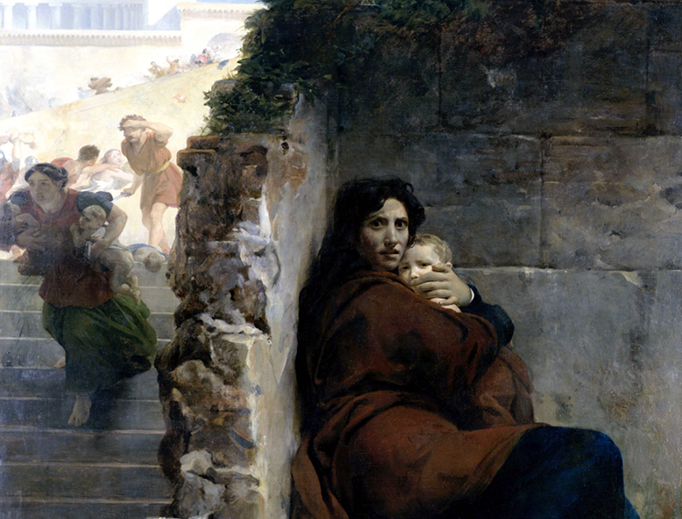
Léon Cogniet (1794-1880), “The Massacre of the Innocents” (photo: Public Domain)

I don't like the feast of the Holy Innocents. That was my main thought as I prayed Morning Prayer at church this morning and chose hymns to play for the morning Mass. In every Jesus movie where the slaughter of the innocents is depicted, I flinch and pull my blanket up a bit to hide. When my children were small I just flat skipped over it. It's a horrible thought and it's even more difficult to figure out how to enter into a liturgical celebration of a horrifying event. Babies saying "yeah! We were killed for Jesus who got away safely!"? What are we doing here, celebrating how great it is to be killed? What will we do next, celebrate child soldiers who join our bloody causes without any ability to comprehend the evils involved?

So I turned these things over in my heart this week. And I found my way clear of that disturbance, to a better and deeper one.

The liturgical calendar can be like the quiet cousin at the Christmas gathering who frequently gets upstaged by the more boisterous guests: feasting, gifting, more feasting, more gifting. But when we learn to celebrate Christmas with the calendar, we are brought right away to martyrdom with St. Stephen, to contemplate loving union with Jesus with St. John, and then to the gory effects of violence and fear in the world with the Holy Innocents. The Incarnation is so incredibly mind-blowing that a lifetime would not exhaust the depths of how God desires to impact us with it. But the liturgical calendar makes it quite clear that union with the incarnate Son of God preps us not only for eternal glory, but also for transformation into His image on earth. And He was "a man of sorrows, and acquainted with grief" (Is. 53:3). 

One of the deepest causes of grief is sin which causes innocent people to suffer. That could be simplified: Sin causes grief. 

Herod ordered the destruction of life because of his fear, his clutching at power, his arrogance. The thought of sharing the stage with someone, let alone bending his knee to reverence Another, was totally foreign to his soul. Those who carried out his orders were formed in a milieu that accepted force as a higher good rightly served. It's just a few children. 

This is the world Jesus came into, as one of the vulnerable. At this point, the Scripture text makes it clear he is totally dependent on Joseph's ability to receive a directive from God's messenger: Take the Child and His mother and flee. I wonder at the role that Israel's far history of pain and suffering, and  Joseph's, over Mary's pregnancy, prepared his heart at this moment to respond in complete detachment and obedience to just go. Pain and suffering are evils. Pain and suffering, united with the heart of God, become portals for God's glory to shine on earth. That is redemption. This can be pondered, but it is known most purely in the experience of it. Joseph in this moment obeyed God and this obedience preserved salvation for the whole universe.  

I take away two things from this. Union with Christ is a call to His vulnerability. We lay bare our hearts which are wounded and woundable to each other, to God, to our own gaze. I've been the worst at beating and castigating my own self for simply being, believing it to be a great fault. I have walked the path of learning to trust God and wearing Him down at every step, begging for certainty and protection instead of going by faith. I've done the chip on my shoulder, angrily raising walls against others, preemptorily blocking them out of my heart for fear of the harm they might bring. I've done stupid dependence on people who proved I could not ultimately depend on them as my gods. But God's vulnerability draws us into eternal peace. "Nothing will hurt or destroy on all my holy mountain" (Is 11:9). It's true.

Second thing: I must open my heart to the Lord, looking in His light for how I am like Herod. How do my attachments cause me to trample others underfoot? How do I exercise oppression to get what I want? How am I totally cut off from the hearts of others in their joys and sufferings? And how can I experience the same transformation Joseph did, that deep attachment to and freedom for the Lord? 

Jesus enters straight into the suffering of the innocent, and union with Him brings us there as well. May we repent of everything in us which is poised to cooperate with Herod. May we entrust ourselves like Joseph, in our own vulnerability, in the interdependence which is ours. May we walk by faith in God who does not exempt us from dark nights, but who is trustworthy.

Sunday, October 30, 2022

Teaching the Our Father, Part One

 I teach New Testament Bible stories to 1st through 4th grade students at our local Sonshine Bible Club. This is my 7th year teaching, minus a chunk of 2020. I know I have learned more than anyone as I've taught.

Each year I try to take some theme or plan, and almost always I bite off more than I can chew. This year, at least to begin with, I have decided to teach the Lord's Prayer. Now, it pays to note that we rotate groups of kids through various teaching stations, so I have either three or four groups of kids (depending on the day; I teach twice a week for groups from different schools) for only 12-15 minutes at a time. Part of that time is for settling in. Occasionally that takes much more time than it should. So, I'm usually left with more like ten solid minutes to teach from the Bible. 

The kids that I teach typically either do not go to church at all, or are rather unlikely to have any Christian formation coming from their families. Many come from family circumstances that hold a lot of pain and brokenness. When I started talking about the Lord's Prayer, only one or two children in each class knew what this was. A few were able to recite what amounted to a gibberish version of it.

So here's how I've proceeded thus far. I started with talking about God the Father and God the Son. This is one of the things that gets the kids confused a lot; they don't quite get the God and Jesus thing. "Jesus is God" is just a statement of confusion to them, because "God, Jesus, Holy Spirit" is vocabulary they are still figuring out. I use the sign of the cross to "draw" God the Father, God the Son, God the Holy Spirit. 

It dawned on me how smart the old basic catechism teachers were. There were people who went before me who taught clueless children and realized where people need to start. 

I have a musical setting for the Our Father which is not the traditional Catholic tune. I like it because a friend wrote it and no one knows it and it makes me feel special and like I'm spreading a level playing field for all the kids to use a tune no one knows. So I sang the song for them. Now I've started teaching it by phrases.

Then we talked about Our Father, who art in heaven. Right off, I have to explain KJV English, and some kids are absolutely incredulous that words have been preserved from 400 years ago, like "art" meaning "is." Had to explain that one, of course. 

I did not explicitly mention it, but I couldn't help but think of my own experience of coloring my understanding of God with my own experience of my natural father. I decided it is a better thing for these kids, instead of telling them, "Now, your Dad may be absent, or hit you or your Mom, or be in prison or on drugs, but God is not like that," that I would say "Our Father in heaven is all good, all wise, we are precious to Him, He loves you and wants to be with you." 

One week, after having covered this opening phrase, I heard this little boy, above the hubbub of the class settling, shouting out, "God is my father!" God is my father!" It didn't dawn on me at the time, but I think this could fill the holes in some little hearts who have lost their fathers in one way or the other.

I talked about the "who art in heaven" part by saying that heaven is a place where God rules, and asking the kids -- where does God want to rule? I may have helped by making a heart shape, but someone eventually responded, "In our hearts!" I explained that, yes, God wants to be the one who rules our hearts. I'm realizing now they probably understand a more slang version of rule than I intended. I accidentally said "reign" once, and they immediately got confused by that. I tell you, teaching kids makes you watch your every word.

Then I told the story of the Woman at the Well. I had a hunch it would serve as an illustration, and I have to say I learned as I was telling it how it does. The kids resonate with the hatred between Samaritans and Jews. They get it that there are groups who hate each other. Jesus talked to her, treating her with dignity, not like an enemy. He started talking to her like He was God, offering her eternal life. Then, he called out her secrets, how she had five husband and now was with a different man. (The kids get this, too.) They see that he doesn't shame her, but says that the Father in heaven in looking for those who will worship him in spirit and truth, from their hearts. Doesn't matter if she was from the hated group, God is her Father, too, and He came to tell her He was the Messiah, come for her, to bring her back to God, just like He came to do that for everyone.

This is how I learn while teaching. It blows my mind sometimes. Every time I teach that story, it really sticks with the kids. One year, they were retelling it to me months later.

So next, I taught "Hallowed be Thy name." Just the English here was a bugger. What in the world does it even mean? Holy be your name? Ok, no help -- now what does THAT mean? Fortunately, I have the Catechism of the Catholic Church. But honestly, after reading and understanding what the CCC says on this, I still was challenged to boil it down for kids. I tried explaining "holy" and God's name as who he is, etc., and saw I was making no progress. In my first group I went impromptu, and said "let me tell you a story," and saw delight sweep across the face of one boy in the front row. I told the story of Adam and Eve and their sin. I explained how God had made everything good and beautiful and peaceful, and then asked them if that's what they see when they look around them. No. I ask if people do things they shouldn't sometimes, and if everyone doesn't at some time do things they should not do. They know that's a yes. I explain that that state of things being not like God made them, the Bible calls the problem of sin. And that God had a plan to fix the sin problem by sending Jesus to come right down into the middle of our mess to be with us, and to pay the price to take away our sin and open heaven again, so that we could follow him there, and start living new lives here on earth.

So I take another stab at saying "hallowed be thy name" meaning that I want to agree with God about what is true and good and beautiful. I don't want to be like Adam and Eve who listened to lies and doubt and mistrust God. 

I really need to come back this week and firm that up. There's a lot about praising God, extolling who He is, acknowledging who he is in this petition. And I realize that even though I have known that in my head, this really hasn't been my experience of praying this. I am finding I need to stop and include this kind of praise in my prayer time where I just focus on declaring who God is. I mean, I'm an old time charismatic! It pre-dates me being Catholic! But I have kind of dropped this piece about agreeing, lining up with, getting my thoughts subordinated to, setting my mind on, God's name, God's reality, God's person. 

What I planned to teach as a Bible story this week to illustrate this actually just the accounts of Jesus going off at night to pray. As a human being, He communed with His Father. He subordinated all of his activities to His Father's will. He chose according to what the Father showed Him. He emptied Himself and lived as one who is taught. All of that is totally astounding. To do the will of the Father was Jesus' food. He calls us to the same kind of holy life. Totally astounding.

As I tell the kids, the great thing about the Bible is that you can hear simple things when you are 8, and for the next 70 years you can think about them and you will constantly learn something new, because God's word is alive. I realize I do not teach the Bible as something I know; I proclaim it as something God says.

And that's as far as I've gotten. My goal is to write each weekend as prep for my next week's classes. And maybe to report on how they went. We'll see.