Showing posts with label Joseph. Show all posts

Tuesday, August 15, 2023

Submission Revisited

This morning, let's say it was by the time Mass ended, I realized I now have a refined understanding of submission. 

Sometimes spiritual insights just click, becn ause a grace God gives grabs hold of words that are spoken, and both goes to a place of past experiences, and then it all elevates, it changes key, and something new is perceptible. 

And this happened today regarding the reality of what it means to be in submission.

Fr. Mike Schmitz was addressing this in recent episodes of Catechism in a Year, because the topic has been the Sacrament of Matrimony. He was discussing the verses in Ephesians that tell wives to be submissive to their husbands, and husbands and wives to submit to one another out of reverence for Christ. Now, I've heard any number of takes on Christian submission, but how it landed in my mind was that submission means saying yes to what someone with valid authority tells you to do. I wrote a blogpost about this way back in 2007. Fr. Mike's definition of submission (CIAY, Day 224) is "to place yourself under the mission of the other person."

And I think those words just sunk in and hit a very deep part of my awareness today.

It's the Feast of the Assumption of Mary. Now, Mary was totally submitted to the mission, the plan, of the Blessed Trinity. She was totally on-board with the salvation of the world, the sanctification of the world, and bringing total glory to God in and through her every breath. She was also totally submitted to the mission of Joseph, who was specifically made Guardian of the Redeemer. He, in turn was totally submitted to Mary's mission as Mother of the Redeemer. Their marriage was a partnership in the mission God had entrusted to each of them. They were submitted to one another out of reverence for Christ, literally. 


And so it has to be with us. Our lives are about the mission: the Great Commission, to call to bring all souls to life in God through Jesus Christ in the Holy Spirit. 

Ok, so even as I'm writing this, I'm coming up a sense of well, duh

The changed key, the newly perceptible truth stems from an interior shift. How can I struggle this out into words...

In the aforementioned blogpost, I gave the example of how I might respond to the Bishop saying he was closing my parish. I said it would hurt, but I'd go with it. And that was pretty much my take on submission. Responding to something that happened. But if I place myself under the mission of Jesus Christ, or more concretely if I place myself under the mission of a particular human being, then I am going to employ all of my energies, all of my creativity, all of my resources into furthering that mission, that aim, that goal. This is how the dynamic of my life has been leaning for some years now, but today it clicked. This employing of my energies -- that is submission. It is not passive. I don't sit and wait for orders. I'm not a harem member that waits to be summoned. To waste my energies -- to spend them all on myself or my entertainment, or to fret myself away in anxiety or nitpicking, instead of love -- that's not submission. To chase after financial security or a name or success -- that's not submission. 

I would posit that spouses submitting to each other is not about each other; ultimately, it is also about Christ. It is about serving God, the common good, and learning where each other fits within that (because God always makes space for us). And it definitely is not about simply saying, "Yes, dear" and doing what the other person selfishly says or wants. It might keep peace, but it is not a way to grow holiness. If there's no mutual discernment of a virtuous path and an active desire to seek the Lord's will and way, then trouble ensues.

Several years ago, I had the strange experience of being contacted by an acquaintance who was leaving society to join a monastery. He had a few months as he transitioned into his new life, and just during this time he challenged me to write a song every week. He asked if I'd be willing to take it as a formal challenge and submit the new songs to him every week, and then he'd give me a new tweak in the challenge for the next week. I was intrigued, so I said yes. I had not written new music in a long time, but during that time I cranked out several new songs. I was very aware that I needed that piece of being called forth. Then he abruptly had to cut off communication, and that was that. I stopped writing, because I no longer had a mission to place myself under. That experience stayed with me a long time, and I didn't know what to call that powerful impetus. I think it is the power of submission. And I think one of my central life frustrations has been to rarely find a healthy person with a Christ-focused ability to say, I have this mission; join it. Well, I know now I am a Carmelite and I do have a mission there, but even there, we are still figuring out how to respond. Why are we so slow to live this reality in the Church? Why is it so unclear to engage the mission of Christ with our whole selves? Is it because we are not in possession of our whole selves? 


Tuesday, May 02, 2023

St. Joseph and the Desperation for Consolation

I was chatting with a priest friend recently about praying the Liturgy of the Hours, and I found that something poked at me like when a metal bra underwire cuts through the fabric and jabs you in the tender underside. So let's draw that out a bit and see what that was all about.

We were discussing the obligatory nature of praying the hours (for priests, same as for Secular Carmelites such as myself), and how he rarely or never finds priests remotely interested in or planning for praying the Office in common. Apparently he finds the norm to be priests always pray this privately, individually. He also mentioned how it takes time to pray this everyday, especially if one is to do so prayerfully, reflectively, with the freedom to pause and ponder, to take it in contemplatively, etc. I know he had mentioned in another conversation having been given the advice to prayerfully pray at least one section of the hours daily, and to be content with recitation of the other hours. The thought of praying all seven hours, for someone who is busy with apostolic life, is just nuts, basically.

Granted. Obviously the Church changed the structure of the Hours at the Council precisely because of the onerosity of an obligation to "make it through" huge chunks of Scripture daily, and how it became a burden to crank it out and plow through it all. Prayer, clearly, it not to be about merely cranking through.

What I found myself taking umbrage with, as one who daily drags myself out of bed to lead public chanting of Morning Prayer, at a consistent hour that I KNOW I would never keep up with, were I not committed to this small group who meets, is the notion that prayerful is consonant with comfortable. Something occurs to my mind, and I want to stop and nest on it, sucking the sweetness out, delighting in my mind, allowing it to speak to me. Vibe: suck it up, buttercup. Sometimes I am delighting in my rest, my thoughts, my privacy, and I don't want to discomfort myself by driving in the morning to meet people at church. Sometimes I'm physically not ready. Sometimes I don't want to sing. I switch it on so that other people can enter into prayer, and to help others with the discipline.

Sometimes a beautiful contemplative thought has struck me during the day, and then a child yells for homework help. Or the doorbell rings. Or there is no lovely thought, but there are whiny children who have required me to step out of the worship space during Mass and I have to set my will like a diamond stylus to engage in what is happening in the consecration -- and this happens more often than not for months or years. I learn prayer ain't all about me and my thoughts and feelings. Sometimes I can't access either of them. It is an act of my will, and it is joining to something larger than myself. Sometimes every step forward for years feels like a sheer act of will against tremendous pressure pushing me the other way.

The Liturgy of the Hours definitely is not mere private prayer. It is the public prayer of the Church. Yes, it can validly be prayed privately, but ultimately participating in it is giving voice to Christ present in His Church, for His Church, as a vehicle of salvation for the world. Ok, objective subject covered.

Ok, then screaming interior stuff. I'm tired. I'm tired of chronic responsibility, and I'm tired of feeling alone in it. I'm tired from a sense of trauma as a child, sensing the adults were falling apart, and I should step up to put them back together. I'm tired from having such a keen eye for every problem in the room and working out how I could solve it before other people are aware of it. I'm tired from being good at things and jumping into serving, and thereby training others to expect me to do things. I'm tired from taking a break and then finding the problems growing weightier and weightier when I step away from them. I'm tired from feeling like it is impossible for me to stop being responsible.

As a Carmelite, I'm called to pray for priests. I've got some anger stuck in there somewhere. I don't feel sorry for someone looking for a few seconds of mental or spiritual consolation. Maybe that's because I am desperate for a few seconds of mental or spiritual consolation. Maybe it is because I would really appreciate someone seeing my need, anticipating my need, and taking up my need as his own. 

I had this meditation the other day about St. Joseph, at the Presentation. The rite of purification was for the mother of the child. But the NAB mentions "when the days were completed for their purification," "they took him to Jerusalem." The law required it of Mary, but Joseph made it his. And it wasn't only because he was a wonderful husband and cared about Mary; he did, but more than that, he understood that this was God's will. It was an act of worship, an act of consecration to God. How he treated Mary was about how he obeyed God. Everything about St. Joseph is not just gratuitous fru-fru care, a nice but technically unnecesary extra, even though it strikes me like that. St. Joseph is absolutely necessary for Jesus' humanity, and for Mary's life, even though she is the sinless Virgin and the Queen of Heaven. God provided Mary and Jesus with Joseph. But Joseph had a human will of his own; he obeyed. He gave his own fiat. 

St. Teresa was of course an ardent devotee of St. Joseph, and taught her nuns to be rooted in, focused on, the humanity of Jesus. I'm seeing those two as inseparable. I don't think you can separate the humanity of Jesus from the person of St. Joseph. All I know right now is that is the antidote to the anger I've felt poking me. 

And maybe I want priests especially to see themselves like St. Joseph. 


Wednesday, December 28, 2022

Disturbing Feast Day

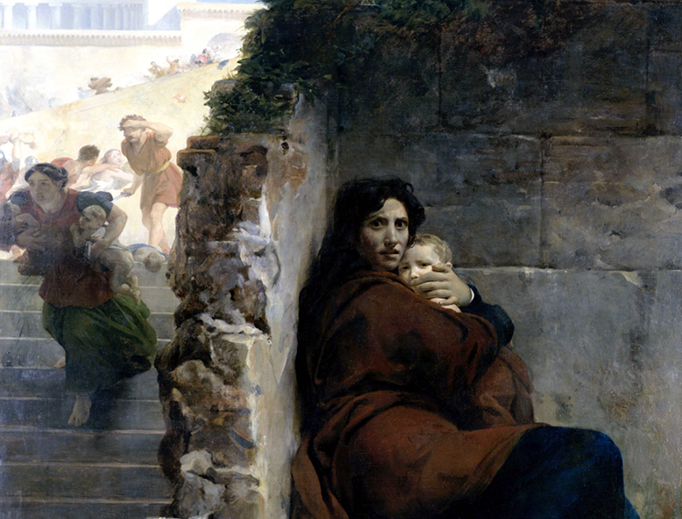
Léon Cogniet (1794-1880), “The Massacre of the Innocents” (photo: Public Domain)

I don't like the feast of the Holy Innocents. That was my main thought as I prayed Morning Prayer at church this morning and chose hymns to play for the morning Mass. In every Jesus movie where the slaughter of the innocents is depicted, I flinch and pull my blanket up a bit to hide. When my children were small I just flat skipped over it. It's a horrible thought and it's even more difficult to figure out how to enter into a liturgical celebration of a horrifying event. Babies saying "yeah! We were killed for Jesus who got away safely!"? What are we doing here, celebrating how great it is to be killed? What will we do next, celebrate child soldiers who join our bloody causes without any ability to comprehend the evils involved?

So I turned these things over in my heart this week. And I found my way clear of that disturbance, to a better and deeper one.

The liturgical calendar can be like the quiet cousin at the Christmas gathering who frequently gets upstaged by the more boisterous guests: feasting, gifting, more feasting, more gifting. But when we learn to celebrate Christmas with the calendar, we are brought right away to martyrdom with St. Stephen, to contemplate loving union with Jesus with St. John, and then to the gory effects of violence and fear in the world with the Holy Innocents. The Incarnation is so incredibly mind-blowing that a lifetime would not exhaust the depths of how God desires to impact us with it. But the liturgical calendar makes it quite clear that union with the incarnate Son of God preps us not only for eternal glory, but also for transformation into His image on earth. And He was "a man of sorrows, and acquainted with grief" (Is. 53:3). 

One of the deepest causes of grief is sin which causes innocent people to suffer. That could be simplified: Sin causes grief. 

Herod ordered the destruction of life because of his fear, his clutching at power, his arrogance. The thought of sharing the stage with someone, let alone bending his knee to reverence Another, was totally foreign to his soul. Those who carried out his orders were formed in a milieu that accepted force as a higher good rightly served. It's just a few children. 

This is the world Jesus came into, as one of the vulnerable. At this point, the Scripture text makes it clear he is totally dependent on Joseph's ability to receive a directive from God's messenger: Take the Child and His mother and flee. I wonder at the role that Israel's far history of pain and suffering, and  Joseph's, over Mary's pregnancy, prepared his heart at this moment to respond in complete detachment and obedience to just go. Pain and suffering are evils. Pain and suffering, united with the heart of God, become portals for God's glory to shine on earth. That is redemption. This can be pondered, but it is known most purely in the experience of it. Joseph in this moment obeyed God and this obedience preserved salvation for the whole universe.  

I take away two things from this. Union with Christ is a call to His vulnerability. We lay bare our hearts which are wounded and woundable to each other, to God, to our own gaze. I've been the worst at beating and castigating my own self for simply being, believing it to be a great fault. I have walked the path of learning to trust God and wearing Him down at every step, begging for certainty and protection instead of going by faith. I've done the chip on my shoulder, angrily raising walls against others, preemptorily blocking them out of my heart for fear of the harm they might bring. I've done stupid dependence on people who proved I could not ultimately depend on them as my gods. But God's vulnerability draws us into eternal peace. "Nothing will hurt or destroy on all my holy mountain" (Is 11:9). It's true.

Second thing: I must open my heart to the Lord, looking in His light for how I am like Herod. How do my attachments cause me to trample others underfoot? How do I exercise oppression to get what I want? How am I totally cut off from the hearts of others in their joys and sufferings? And how can I experience the same transformation Joseph did, that deep attachment to and freedom for the Lord? 

Jesus enters straight into the suffering of the innocent, and union with Him brings us there as well. May we repent of everything in us which is poised to cooperate with Herod. May we entrust ourselves like Joseph, in our own vulnerability, in the interdependence which is ours. May we walk by faith in God who does not exempt us from dark nights, but who is trustworthy.

Saturday, March 06, 2021

The Prodigal, The Fatherless, and St. Joseph

This morning's Mass has shaken loose quite a bit of useful thought fodder, so here I am to sort it all out.

The gospel reading was the parable of the Prodigal Son, famous of course for the son who squanders wealth, the father who compassionately welcomes him back after long expectation, and the brother who resents both of them. 

The homily I heard, though, was one of those ripping the needle off the record moments that backhandedly spoke into my personal situation and also has me pondering this year of St. Joseph.

Father mentioned, reminiscent of the writer to the Hebrews, that "we have all had that moment where we did something wrong, and we awaited that moment of how our fathers were going to deal with us about it." As Hebrews 12:9-10 puts it, "we have all had earthly fathers to discipline us and we respect them...they disciplined us for a short time at their pleasure, but [God] disciplines us for our good..."

The needle ripped off the record because, no, I don't have any childhood memories like that. In fact, the first thing I thought of was my experience of being corrected for singing harmonies out of turn when I joined our parish choir. I was ... 41 at the time. 

What felt so odd was to have this discussed as a universal human experience from which we all learned something about God. I went to that same category interiorly, and came up empty. That's not to say that God hasn't abundantly compensated that emptiness for me, because He has.

 My second thought went to the 23% of American households with children that are currently headed by single parents. And the divorce rate in the era of the childhoods of my generation (1970s and 1980s) that was at nearly 50%. And the trend, also prevalent within my generation of what Dr. Jonice Webb calls Childhood Emotional Neglect, where even physically present parents can be emotionally absent to their children. All of this is so much a given in my awareness of life around me that frankly Father's comments struck me like data from a different planet.

But my concern is not really with sociological trends, nor with Family Privilege, my personal experience or anyone else's per se. The direction these thoughts have taken me have been about human formation, and how that impacts spiritual formation.

I love what my Secular Carmelite Constitutions have to say about this: 

Both initial and ongoing formation in the teachings of Teresa and John of the Cross, help to develop in the Carmelite Secular a human, Christian and spiritual maturity for service to the Church. Human formation develops the ability for interpersonal dialogue, mutual respect and tolerance, the possibility of being corrected and correcting with serenity, and the capacity to persevere commitments. (OCDS Constitutions, No. 34)

Pope Francis has been insistent on reminding us that God meets us with His great spiritual riches on the peripheries of society and on the peripheries of our own hearts. The more clearly we see our poverty, our need, our lack, our misery, the more immediately God bestows His abundant grace. This is exactly why I say God has abundantly compensated me for the empty category I have felt in my human formation; though it did not always feel a blessing, I realize I have been tremendously blessed in being solidly in touch with my misery and crying out to God over it. It has taken me a few decades, but here I am!

I am now vigorously curious to learn how to help others in their human formation in this regard. Human formation happens when my human experience butts up against your human experience, and we both act with the graces God has given us. There is plentious room for correction and being corrected, for learning respect, to learn to tolerate persons and accept them as they are, not as we want them to be. The end result is to be that we both learn to persevere in our baptismal commitments, having been refined by the other. Multiply this by many people, many human experiences, much grace. This is an element that dare not be missing from spiritual formation (entailing learning Scriptural, doctrinal and spiritual truths). For dry bones to live we need both spirit and flesh to take part in resurrection.

And then my thoughts went to Our Lord Jesus. At the beginning of his life, he went straight for our vulnerable edges, in the persons of Mary and Joseph. Biblical scholars still debate over the nature of their legal and moral status at the time of Jesus' conception. They were betrothed but had not lived together as husband and wife; did this mean that Jesus' birth was legitimate or illegitimate? Regardless of how the eyes of the law looked upon them, or what people thought of Mary and Joseph, I can't imagine that Joseph avoided a dark night of faith. He knew that Jesus was not his child. Scripture clearly says he was of a mind to divorce Mary quietly. Some scholars say this was only because Joseph knew he was not worthy to be the father of the Son of God, and not that he doubted Mary or didn't know or believe that she was the mother of the Messiah until this was revealed by the angel (as if human Joseph having merely human thoughts somehow detracts from his holiness or vocation.) Mary also had to have needed to exercise dark faith in what the angel told her. I remember those early weeks of pregnancy where, in my case, I was sure I had lost my baby because I felt absolutely nothing. Mary had no advantage of seeing the blue line show up on her pregnancy test. In this very intimate, unprecidented and singular event of the pregnancy with the Son of God, both Mary and Joseph were pressed to the human limits of faith that God's word is to be believed above all else, including the entire natural order. I highly doubt that there were not intense conversations during that time that shaped and prepared them to live in their society in a radically, profoundly different way from anyone else. Their bond had to be a profound solitude that God transformed with every manner of compassion, wisdom, worship, and strength.

Jesus did not come to remove troubles by sanitizing humanity. He came to sanctify us by redeeming our broken humanity, and making sons of those whom sin had completely alienated. He entered into our human experience, sharing everything but sin, in order to drink the dregs and fill all with his healing and powerful presence, to make of us a people who witness to his presence in a broken world. As he raises us up to share in his divine nature, he fulfills through human beings what he promised in Psalm 10:18, "to vindicate the fatherless and the oppressed, that the men of the earth may strike terror no more."

Sunday, March 19, 2017

Retreat: St. Joseph

This weekend I was on a retreat that focused on St. Joseph.

My Carmelite community does a weekend retreat each year. This year actually less than half were able to participate in this one, and it was not exclusively a Carmelite retreat, but as Carmelites we follow our Holy Mother's special devotion to St. Joseph, so it's all good.


This is how I see Joseph. Not an old, dried up geezer, but a handsome, manly man.
The Church Fathers tend to agree with me.
Do you know the feeling when you go to work or are doing your responsibilities, but all you really want inside is to sit at the beach, or curl up in a blanket and sleep? Well, I can be a bit of the opposite. Sometimes, I really want to be intense and I long to burn tons of energy, but instead I am called by God to rest and be at peace. That was this retreat. No matter from which direction we come, God calls us to live by His energy and unto His will. And in this season in my life, I am learning to love and be loved, to receive, to rest, to share and not manage, to stop the interior drumming of demand and to sing the interior song of gratitude, praise, wonder, love. To burn energy not like a car with the accelerator stuck, but to behold the immensity of His fiery love, bring all the aching needs of the world there, but most of all to know the peace and rest that He is in the core of that.

St. Joseph and I don't really have an extensive relationship (though that might change, now). But back in 2009, he did sort of drop something down deep into my soul, which I wrote about here. It struck me then that love, exemplified in the fiery and virginal love of Joseph and Mary, is a death, a complete, sacrificial, handing over of oneself, a crucifixion -- which also lasts but a time before the glory of the resurrection is revealed.

A love which is completely human, yet completely transformed by self-gift to God in holiness seems to challenge our thinking (in which we generally tend to hold up ourselves as the highest standard of holiness we can imagine -- God help us). Did Joseph have to be an old man in order to not have sexual relations with Mary? Did God design a creepy family, like the child brides we all recoil from seeing in modern news (14 year old girl, 70 year old man?!) Or does God work with real human beings, real lives, real love, and real sanctity? Yes, that's it.

When people saw Peter and John after Pentecost, what was noted as striking about them? That they had been with Jesus. Well, Joseph and Mary are the hidden ones who not only had been with Jesus, but were given the vocation and the accompanying gifts to raise Him as parents. Was that a holy setting? Oh, you bet. Was it flashy, attention-getting, the hot news in Nazareth? Apparently not. When Jesus started His publicly ministry, his neighbors made "Who is this guy?" complaints. The most holiness ever in one domicile, and apparently it was all wasted on normal life. Huh.

Joseph's tables didn't survive. Cloth that Mary wove or the meals she made went they way of earth. But the virtue they lived endures in them for all eternity, and they share with all the children of the Church, and all who are called to it. So we can ask Joseph and Mary to teach us to be with Jesus in our normal life like they were, and thereby to be sanctified, like they were. They share everything. This is kingdom life. This is cool.