Today is the feast of Our Lady of Sorrows, and I've been wanting to sit down and map some thoughts out for myself that connect here. It's been a hairy day, so I'm not coming to this from some great place of recollection. I'm going to dive in and swim through it.
Yesterday I wrote about the Triumph of the Cross and all those anniversarial thoughts. Today's feast has an obvious connection to yesterday's. Mary is the model of the Church -- whatever we see in her is what God intends, generally, for the Church. Of course her personal role is unique, because no one else carried the Son of God in her womb. But we are all called to bring Christ into the world. And we do it through participation in grace, just as she did, although in the way specific to us, and general to the Church.
And Mary at the foot of the cross is of course unique. And yet she means something for all of us there.
She means something for me there.
The homily I heard this morning made me aware that not everyone pulls out exact the thing from this feast that I cannot help but pull out. I feel like, for whatever reason, the Lord has formed me in a certain way where this is concerned. The homily focused on how Mary is with us to comfort us in our sorrow. In a way I guess she was there to comfort Jesus -- I mean, where else would she have been right then?
But that's not what stays with me here. Somewhere in this blog I have probably written about a dream I had when I lived in Japan that stayed with me in a way only a few dreams have in my life. It stayed in a deeply instructive way that I've returned to again and again. Ah yes, here it is. It was just this April when I wrote about this. It didn't completely register with me that this dream is specifically about Our Lady of Sorrows. There has definitely been an invitation for me in this for decades: this call that she seemed to extend to me was to enter into this mysterious work, specifically of Our Lady of Sorrows. And it is about calling people to the deeper conversion of life specifically through no longer ignoring the reality of their own pain (shades of yesterday's post). The vice we tend to go for when we want to ignore the reality of our own pain in something akin to intemperance: gluttony, lust, excess. Addictions come in to play here, and numbing. All the various ways we voluntarily or involuntarily reach for the off switch for our pain.
Now, about a year before I began even thinking about the spiritual direction formation program I have just finished, I had an encounter with Our Lady of Sorrows and the seven sorrows rosary. I wrote about that here, which links to several other pieces of the story as well. The kicker there was that as I started praying the seven sorrows rosary, I got the distinct impression that the Blessed Mother was teaching me that the sorrows of life are not a place to camp out; they are a place to move through, towards the glory, Granted, life is full of sorrows. We are never free from sorrow while we are on this earth. That's a true, general principle. But the particular principle, the personal lesson, seemed to be a nudge from her that I had set my camp -- my mind -- in sorrow, and that it was time for an identity shift.
Now the absolute kicker of all kickers dawned on me the other day. Two years ago this evening, I was winding up the last piece of my very first in person Intensive of the SDFP. I encountered a line in a meditation that knocked me on my butt so hard that it also became a benchmark moment for me. And I just realized that, although it was Sunday and not observed that year, it was the feast of Our Lady of Sorrows when this happened. I suppose I wrote about it several times, but this is the first time the story appears. On this blog, at least. And I realized then that Jesus was calling to me to follow Him. That if I had thought I knew before what it was to follow Him, I was about to have quite a different experience.
And I was to get extricated from an identity rooted in sorrow.
And I was to learn authenticity in following Christ. Christ is Aslan, not a lapdog. He is Lord and King, not my accessory.
And I hear and feel the searing heat coming through those words.
There has been a work going on. I've had to just look at a lot of very painful realities in my history. Some of these I tried to look away from for years. Some had to tear through feelings older than words in me, and it felt like my psyche itself was rending apart. And just look has also turned into just act, and I'm still working on that. So much reality to contend with.
So I came here to look at how Our Lady of Sorrows weaves through this. One of the things that was impressed on me that day that I was praying the seven sorrows rosary and walking through the park was that now, Mary lives in glory. Yes, she accompanies us in our sorrow, but she herself lives in glory. I can go way, way back to my days when I was on my way into the Catholic Church and recall another day that I was walking and praying and struggling with the issues of conversion. The Lord gave me a lot of graced helps in those days. I didn't actually have any human beings present in my life at the time who were helping me on my conversion road (only friends I wrote to -- back in the days before computers!). So the Lord came to help me very generously. And that day as I walked, He impressed on me these words: I want the glorious to become commonplace in your life. I don't know that I'm there yet, or that I've ever been close. Oh, wait of course it is true. It simply rarely feels like it in the moment. But that's a poor measure of reality. For one, I've been going to daily Mass (with a few chunks of exception) since 1992. That's glorious. But when I think of that, I think of my interior experience. I would love to feel glorious. Maybe that's not how this works. But I know that camping out in sorrow (and the anxiety and etc that goes with it) does not help matters. Again, it's the personal call. I've been experiencing God re-rooting my identity to align with Him, to align with reality.
I don't know exactly where we go next, but it is fascinating to put all these things together and ponder them.
The cross of Christ is the most horrible and horrifying, absurd event in human history. It is also the catalyst that changes everything, conquers death, unleashes divine mercy, and ushers human kind into eternal life. That's some awesome, glorious thing to be standing near.
Tuesday, September 15, 2026
Our Lady of Sorrows


Monday, September 14, 2026
Ave Crux, Spes Unica!
I hesitate to describe my penchant for noting anniversary dates of my life as compulsive, but perhaps ingrained is fair. It is part of my liturgical sense, I think. Repeating annual observances gives space for reflecting on what has changed and how I've grown over the years. The one constant in my life is change. That is certain.
Thirty-two years ago today was my first day in Japan. The first of 924 days when Japan was my address (although I did spend about a month each in the Philippines and Stateside during that stretch). It is also the Feast of the Exaltation of the Holy Cross, and yes I did choose this date to be my arrival date, just like I chose the Annunciation to be the day I left.
This year has given me a fresh perspective on today's feast day. And that is the lamest possible way I could make that statement. Let me try to get a running start into unpacking this.
This morning at Mass, with all this date and feast day business humming quietly in the background, I had a strong related memory surface, one that I have turned over and over in my mind over the last three decades. It took me a moment to realize how it is this year's connecting piece. And here it is: when I lived in Japan, I was connected to an order of Sisters as a volunteer. The Sisters lived in two small convents in the immediate area. One of these was connected directly to the school where I taught, and occasionally I stopped by to visit their kitchen, especially in the early days. The one Sister who spoke English fluently lived there. One day when I was there, I noticed she had written on their pen board four words, which I felt were a direct message to me (because they were in English): God lives in Reality.
If you've ever moved thousands of miles away from home to a place where you know no one, cannot communicate with anyone, and feel completely vulnerable and helpless, you might appreciate how words in your native language can pierce your heart and stay with you forever, like those did that day. And if you haven't, trust me on this. They did.
When human beings experience discomfort, conflict, pain, confusion, demoralization, scandal, injustice, etc, we tend to cope through some type of escape or retaliation. Or both. Escape says this reality is painful, and I want out. Retaliation says this reality needs to be fixed, and I'm going to create my own battleground to fix it. These are understandable human reactions. I think you could say that escape is often its own form of retaliation. These are not indicative of human flourishing, though: this is about survival.
Human flourishing comes in Christ. Christ comes through His cross. His cross is our only hope (Ave cruz, spes unica!). And here we have the truth: God lives in Reality.
The reality of our lives is full of discomfort, conflict, pain, confusion, etc. The Christian revelation is that God is not sitting in a cloud somewhere, demanding our obesiance, handing down rules, or generally accepting everything that happens and tut-tutting it away, and throwing us candy to make us feel better. The Christian revelation is that God enters our pain. He does not remove it; he comes close to us in it. He conquers it, but appearances show that it conquers Him. His embracing of the ultimate in discomfort, conflict, pain, confusion, demoralization, scandal, injustice, etc, is what swallows death, conquers death, and reveals life and immortality. He calls people to faith in this. He calls people to receive this power and live in it. He calls people to live in reality -- all of it -- by the power of grace, which is His life in us.
Sin is avoidance. Sin is turning a blind eye to suffering -- that of others, or our own. Sin is refusing God. Sin is turning away from Him and choosing not-God. Unreality.
Here's the thing: this is the lot we are born into. We have an inclination to this sin. The grace of baptism frees us from being chained into it, but we have to be formed in such a way that we learn to choose good. We need to learn that we are loved by a self-giving God to such an extent that we love Him in return, follow Him, and learn from Him to lay down our lives (that is, enter discomfort et al.) for our brothers.
Here's another thing: there's a point at which every person is formed by pain and not by love, and we carry our desire to escape reality forward with us. Sometimes we carry it forward in highly complex and sophisticated ways that shape our relationships, our work, and our very sense of self so that, even as Christians, we make a fine art out of avoiding reality.
I feel like the entire focus of my life comes down to this point of learning for myself, and to help others, to look upon the Pierced One, the Man on the cross, and to embrace -- in the drops that are bearable, as God measures out -- the reality of His love meeting our pain. I'd like to say that in that moment in looking upon the Crucified, our pain is undone. I do believe God lifts certain things from us, granting immediate relief. But often that meeting entails being met in great grief the pain we have tried to silence and stuff down. It is not neat, easy, or quick, but it does heal. The resurrection power of God is real. But God does not do magic. He redeems and restores, and it is a process. It takes our cooperation, our trust, our perseverence, and we need community support through it, so we don't cut and run.
God lives in reality. If we find reality too much to face, it means we need Mercy. Mercy is God's love meeting us in our pain. It is infinite. The ocean of mercy opened up for the whole world through the crucifixion of Christ, and if we call out for mercy, God will draw us to this whole process of healing. When we cry out for mercy, we must come with open hands, clutching nothing, or at least willing to let go of the things we clutch, trusting that God brings life and not death. Or at least willing to trust. Willing to receive life. Willing to believe that there is more to life than death. God will meet you wherever you are at and will gently guide you forward. His great desire is to give us Himself.
He can make sense out of everything.

Thursday, July 02, 2026
Thoughts from Today's Gospel: Jesus Heals the Paralytic
Today's gospel reading is Matthew 9:1-8, the account of Jesus healing the paralytic. (If you are like me, when you hear this it is hard not to picture how The Chosen rendered this scene. That's helpful, because it is almost word-for-word, with imaginative context added.)
What strikes me in the text is, first, three points of action. It says, "Jesus saw their faith." Their faith was expressed in pressing in to make a way to get the man to Jesus. Matthew's gospel actually omits the detail that they let him down through the roof; Mark and Luke pick this up. Then, Jesus commands an action: "Rise, pick up your stretcher, and go home." His healing entails the man doing something, not just feeling it in his heart or embracing a new attitude. Jesus is more concrete than that. Then the last point of action was the crowd's response: "[T]hey were struck with awe and glorified God who had given such authority to men." They saw Jesus' action, and it landed like a seed of transformation in their souls. Some of them may have walked away from witnessing this without ever deciding to follow Jesus or believe in Him. But for others, it may have been a turning point that changed how they lived from then on. We readers, with them, are left with that grappling.
Another point. Jesus speaks boldly in a way that reveals His divinity to the crowd, but He isn't provoking the observing crowd or goading them on. He speaks that way because He is in an intimate exchange with the paralyzed man. Someone, recognizing his utter need, has come to Jesus. That's when Jesus acts in power. It's for the human need of the vulnerable. Jesus says to him, "Courage, child, your sins are forgiven."
And what kind of response does this evoke from the scribes? (Luke throws in the Pharisees.) Accusations of blasphemy. Their thoughts were not on salvation. Their hearts did not quiver at the prospect of forgiveness and reconciliation with God. They were judging Jesus by comparing what He did to themselves, as if He were just a man. Self rules, for them. And the text says Jesus knows this and calls out their "evil thoughts." Why are your hearts not fixed on God? Why are they stuck on yourselves? That's the definition of evil, here.
And so the work of healing that Jesus does has two different effects. It is a work of salvation for the paralytic, which evokes praise and awe from those who witness and accept Jesus' testimony that this miracle confirms His authority -- from God -- to forgive sins, even though theologically this is a big pill to swallow at the time. It is a work of consternation for those stuck on themselves. It calls to everyone to make a decision about which camp you are in. Do I brush off Jesus' power, not out of a desire to reject God, but maybe because I lack the faith to believe His power could do anything in my life? Brushing it off is brushing it off, regardless. Do I feel the awe and cultivate that awe, and start thinking about bringing all the stretchers and paralytics I know (and am) to the Lord in faith?
Thursday, October 17, 2024
Slander, Justice, and Freedom
This morning as I was talking with the Lord I was reading Mark 7, where He is interacting with Pharisees. Verse 2 sets up where the difficulties start: "they saw that some of his disciples ate with hands defiled..." You can feel how this observation quickly turned into a judgment of Jesus, as in verse 5 they ask him, "why do your disciples not live according to the tradition of the elders, but eat with hands defiled?"
Jesus had inconsistency in his camp. Some washed, some didn't. Maybe the some who did were mindful of the tradition; maybe it was culturally engrained. Maybe those who didn't were unschooled in the ceremonial practices, or maybe they omitted it intentionally. We don't get any of that commentary. What, to the Pharisees, reflects back on Jesus is that He did not spend enough time enforcing the traditions, or He was not a careful enough rabbi to eliminate from his midst those who weren't doing it right, or simply this slipshod performance did not trouble Him. Clearly, He was either a lousy rabbi or a rebel. This is clear because they were their own standard of righteousness.
Jesus then proceeds to rip into them. From the text, I observe a few things.
First, He quotes Scripture against them (v. 6-7) to point out their hearts are far away, their worship is empty, and they teach human ideas.
Second, the text is suggesting this was an ongoing exchange, not simply one conversation. Verse 9 says, "And he said to them," and again in verse 14 "And he called the people to him again and said to them." It sounds to me like Jesus often circled back to this theme when he talked with Pharisees and Mark is condensing Jesus' response in this account. I'm no scholar. But what I see in the paragraph begun by verse 9 ("you have a fine way of rejecting the commandment of God..." -- reminds me of Daniel 13 when Daniel is interviewing the two lying letchers who were accusing Susanna, "your fine lie has cost you your head") is that Jesus here is recounting for the Pharisees a detailed example of how they teach human ideas as doctrines of God. To me, this reveals He has spent time meditating on this, interceding with the Father for these wayward men. He is intimately familiar with their hearts, their words, and their deeds. This intimate familiarity is diametrically opposed to tribalism, where separatism rules.
As Jesus teaches his disciples about this exchange, he tries to help them arrive at the understanding which he says the Pharisees lack. And what caught my heart was in verse 22, where Jesus is listing the things which defile, and among these he includes slander.
My Gen X heart stopped and did a little sideways glance around. Slander? As in, saying something publicly about someone else's behavior that makes them look bad? Ok, Lord. I just got done reading you ripping into the Pharisees and giving that group pretty much a bad name for the last 2,000 years, but I know that that wasn't slander, and that you are actually differentiating slander as a different thing.
This hits a real sore spot in my soul, one that I know needs healing and strengthening. My head knows that slander involves saying something that isn't true. Let's do some dictionary and catechsim definitions here.
slan·der

- the action or crime of making a false spoken statement damaging to a person's reputation.
CCC2477: Respect for the reputation of persons forbids every attitude and word likelyl to cause them unjust injury. He becomes guilty:-- of rash judgment who, even tacitly, assumes as true, without sufficient foundation, the moral fault of a neighbor;-- of detraction who, without objectively valid reason, discloses another's faults and failings to person who did not know them;-- of calumny who, by remarks contrary to the truth, harms the reputation of others and gives occasion for false judgments concerning them.
- Another good Catechism quote is paragraph 2479: "Detraction and calumny destroy the reputation and honor of one's neighbor. Honor is the social witness given to human dignity, and everyone enjoys a natural right to the honor of his name and reputation and to respect."
Thursday, July 11, 2024
Ponderings from Dear Master, Part One
I want to draw out and mull over two points that struck me as I was reading the other day. The book involved is Dear Master: Letters on Spiritual Direction Inspired by Saint John of the Cross. It's a clunky title, and the premise of the book, objectively speaking, is a little strange to me. But I leave that aside to focus on these two bits that helped me clarify two episodes of my interior journey.
The first point is on page 4, where Susan Muto writes (in the voice of St. John of the Cross to his directee Ana Penalosa): "...let us be...like the Samaritan woman, who forgot her water jar as soon as she tasted the living waters offered to her by the Lord (Jn. 4:28)."
First, this admonition implies we have a choice to forget something. And having a choice to forget something requires the ability to distinguish between or among things. The "thing" in this passage is natural water versus the living water which Jesus gave this woman through their encounter. Ponder with me on this a moment.
The woman came to the well to get water. This was a normal, daily task, and she may not have been very mindful about what she was there to get, being in the sort of auto-pilot mode in which we frequently live. Functioning practically, but not very tuned in. Our primary energy expenditure is on some kind of survival, the endless cycle of trying to keep impending doom from overtaking life. For her it may have been social rejection, a shame and identity of worthlessness that broke her heart. She'd lost at least five lovers. This defined her life.
Jesus came to give her access to a very different interior well, one that could meet needs that screamed so loud she could not hear them, one that would redefine her life. Immersion into the very interior of God that He was coming to reveal. And he pierces from the normal daily task, into her hidden interior, finally into the mystery of Trinitarian life. All by talking with her.
She feels the power of the mystery even from His first words. Why are you talking with me? This is so different from my normal life. This jars me out of auto-pilot and suddenly I'm aware again that I'm a person.
A lot of things get stirred up in her: old issues she needs to understand. Hurts that are real, but at a safe distance, like the struggles between Samaria and Israel.
Then her personal heart is pierced, and her longing for The One who will come is laid bare. And when The One is longed for, He answers immediately: I who am speaking with you, is He.
In the gospel, she then drops her jars and runs and tells everyone. But in my experience, where this drama of encounter did not take place in a ten minute conversation, but over years, this part looked a little different. And it seems that this author implies that St. John of the Cross would say this is a real step in the spiritual journey: choosing to drop the jar, and seeing the difference between the natural and the supernatural gift from God.
Because (indulge me in some imagination here, a moment) what if the Samaritan woman had gotten confused at that point between realizing she has just met the Messiah, and instead realizing she had just met a man who finally understood her. What if she had not had this instant conversion, touching into the heart of the Trinity and finding her ultimate purpose fulfilled, and instead embraced the penultimate healing of her sad history of relating with men who either died, or left her, or repudiated her, or however it was the she had gone through her sad history that now left her devaluing herself with Lover Six who wouldn't even marry her. What if it took her a minute to stop at the way station of psychological and emotional healing, and maybe in the process even became inordinately attached to the Jesus of Her Dreams as potential Number Seven as she reveled in the purely natural gift of knowing that human being that she forgot she was, was actually created by God to be loved, not as chattel?
The beauty of the real Scriptural episode is that the grace of God present through this conversation with Jesus was so powerful that she left completely changed. Grace can and does operate differently, as God wills it, for different purposes. This woman would not have time for years of processing; Jesus was moving in power during His ministry and He had a world-transforming Church to establish.
And He still does, but now we live in the long haul phase, where He gives the world witnesses to transforming interior power, like the fire in wood that St. John was so fond of talking about.
For one who starts out deeply wounded and mired in indignity, there needs to be the step of first even being able to appreciate the natural gift, the natural state God intends for human beings. Children are not meant for abuse or neglect; adults are not meant to be slaves, handing their lives over to anxiety, job, debt, the expectations of others. Religion is not meant to be fearful or grudging or guilty submission to rules and rituals. There is a natural wholeness into which Jesus desires to bring us by freeing us from the idolatry of sin and breaking the bonds of the world over us.
But wait, there's more!
We weren't just created to not be used and abused. Re-creation in Christ calls us to union with the Trinity, to divinization, to become glorious. The supernatural gift from God causes us to drop our natural water jars, ah, but causes us to see that there's a choice there. And at and the same time the choice is such a no-brainer that it is hardly a quandry. Because finally, love compels us. Love has pierced into our old, broken identity, healed it, and made us sons in the Son, the spouse of the Beloved. The living water springs up inside me, and I don't need to fear being without Him again.
I guess this says to me that it is so important to know that the interior life, the life of prayer, the life of relationship with God has somewhere to go. To me, this is the vital importance of the Carmelite charism. I probably should write about that in its own post. Suffice it to say St. Teresa's seven mansions, St. John's journey up the Ascent of Mount Carmel, these tell us we don't just come to faith in Jesus and then wait to die. There's growth, there's progression, there's a journey to undertake. God has adventures waiting for us. There's somewhere to go, something to look forward to. And you aren't lost, and you aren't alone if you are somewhere along this path.
Well, point two will have to wait for another time.
Saturday, March 30, 2024
The Pain in My Side

Each year during the Triduum, I lead and participate with a group of parishioners who pray the Office of Readings and Morning Prayer together. (Actually, we pray Morning Prayer together daily already, but we tend to gather a few more people during the Triduum.)
One line from the Office of Readings struck me this morning as if I'd never read it before. It is Jesus the Victor speaking to Adam whom he has gone to free from Death. He says, "My side has healed the pain in yours."
For context, there's the whole paragraph:
I slept on the cross and a sword pierced my side for you who slept in paradise and brought forth Eve from your side. My side has healed the pain in yours. My sleep will rouse you from your sleep in hell. The sword that pierced me has sheathed the sword that was turned against you.
The entire reading is of course about the Lord freeing Adam from the death brought upon him through his sin, the sin that lost innocence for the whole human race. By extension, then, of course it is about how we are all freed from bondage to sin by Christ's victory over death.
This ancient homily was written before fundamentalism got its teeth into the book of Genesis. But what struck me is that while the text talks about sin, it was not Adam who opened his own side to create Eve. It was God. God caused the pain, if you will. And then, it says, he heals it.
But no, I don't think the healed pain that this speaks of is just that God opened Adam's side, and now He's saying, oh, my bad, let me fix you up again. The opening of Adam's side and drawing forth Eve speaks about how on a deep level, human beings are created to be interdependent on one another, needing one another, accountable to one another, and indeed responsible for one another. The pain in Adam's side was that when Eve, a separate person, but also part of himself, faced the dragon, he stood aloof, mute, passive, actionless. The ache in his side, which he passed on to his offspring, was this "Am I my [wife's] keeper?" She's bone of my bone and flesh of my flesh, but I'm totally tuned out from any sense of connection to her, or to myself that would arouse me to act when I see this assult on human dignity. "Ain't no my job."
Salvation is indeed union with God, and union with God entails communion with other human beings. In my days when I identified as a misanthrope, I really struggled to get that. It is the grace and power of God which creates both union and communion, and we are his co-operators in both. Love of God and love of neighbor are of a piece. And we will struggle with both until we accept and care for ourselves as the locus of receiving and giving of this love, and allow the pain in Christ's side to heal the pain in ours, where we mourn how our connections with others involve failure.
Friday, December 30, 2022
Both Sides Now
When I was younger, I prided myself on everything.
Other people seemed so lazy. They would tell me of the one thing they had planned for that afternoon, and I thought how I could do that in five minutes and thirty other things as well. Other people seemed so stupid. They struggled with things that had such obvious answers to me, as if they didn't even know how to think. They were always complaining of their struggles. I forced myself through things and pushed all the pain away. When I had breakdowns and couldn't cope, other people were uncaring and went on about their business around me in the most callous way. It was clear to me that I was superior in practically every category, and that if people would just listen to me, they would learn a lot.
When I was younger, I was really lonely.
I was filled with anxiety and didn't even realize it. I was afraid at every turn that I would be literally abandoned by those who were supposed to care for me, or that my house would burn down or that I would be killed. I had no reassurance that any other human being had my back in any way that I could rely on tangibly. The good in my world had to come from me, and therefore had to come from the few things I could do well. Working hard to be independent was survival and mandatory. I was always disppointed that I seemed to struggle far harder than I was rewarded for; the crisis was always too small for my effort.
I thought people were hell. God had to teach me that heaven was people. Community. Communion. Outside myself, or rather, people allowed in. All the people, all the way. God's own way.
Jesus Christ gave me His body and blood, soul and divinity. He said, it's for you, and for all. When I came to Him for peace, He told me He's a package deal. "Unless you love the brother you have seen, you cannot love God whom you have not seen."
"I will take from you your heart of stone, and give you a heart of flesh." (Ez, 36:26).
God's design was never for me to be a prideful machine or to be lonely. Humility enables intimacy to be, thrive and grow. Jesus Christ wants us to learn meekness and humility from Him so that we can actually experience joy and life, beginning here and now. Purification from our sin hurts like hell. But living in our sin hurts like hell. It all depends whether we face going deeper into anesthesia or farther out into freedom.
I choose the pain of life, freedom, and love.
Wednesday, December 28, 2022
Disturbing Feast Day
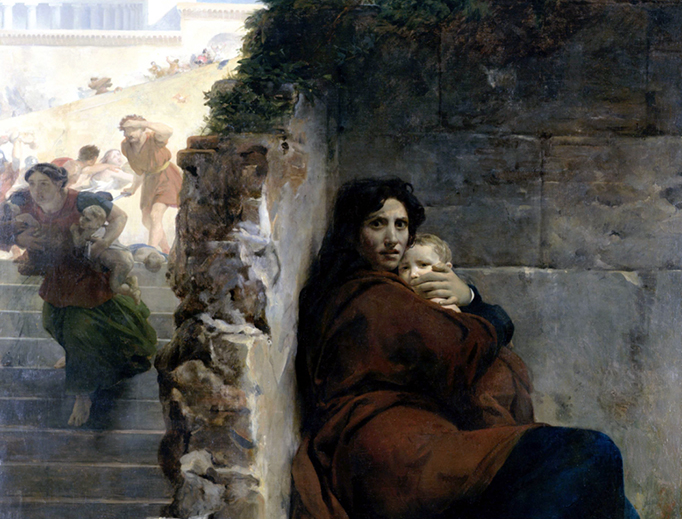
I don't like the feast of the Holy Innocents. That was my main thought as I prayed Morning Prayer at church this morning and chose hymns to play for the morning Mass. In every Jesus movie where the slaughter of the innocents is depicted, I flinch and pull my blanket up a bit to hide. When my children were small I just flat skipped over it. It's a horrible thought and it's even more difficult to figure out how to enter into a liturgical celebration of a horrifying event. Babies saying "yeah! We were killed for Jesus who got away safely!"? What are we doing here, celebrating how great it is to be killed? What will we do next, celebrate child soldiers who join our bloody causes without any ability to comprehend the evils involved?
So I turned these things over in my heart this week. And I found my way clear of that disturbance, to a better and deeper one.
The liturgical calendar can be like the quiet cousin at the Christmas gathering who frequently gets upstaged by the more boisterous guests: feasting, gifting, more feasting, more gifting. But when we learn to celebrate Christmas with the calendar, we are brought right away to martyrdom with St. Stephen, to contemplate loving union with Jesus with St. John, and then to the gory effects of violence and fear in the world with the Holy Innocents. The Incarnation is so incredibly mind-blowing that a lifetime would not exhaust the depths of how God desires to impact us with it. But the liturgical calendar makes it quite clear that union with the incarnate Son of God preps us not only for eternal glory, but also for transformation into His image on earth. And He was "a man of sorrows, and acquainted with grief" (Is. 53:3).
One of the deepest causes of grief is sin which causes innocent people to suffer. That could be simplified: Sin causes grief.
Herod ordered the destruction of life because of his fear, his clutching at power, his arrogance. The thought of sharing the stage with someone, let alone bending his knee to reverence Another, was totally foreign to his soul. Those who carried out his orders were formed in a milieu that accepted force as a higher good rightly served. It's just a few children.
This is the world Jesus came into, as one of the vulnerable. At this point, the Scripture text makes it clear he is totally dependent on Joseph's ability to receive a directive from God's messenger: Take the Child and His mother and flee. I wonder at the role that Israel's far history of pain and suffering, and Joseph's, over Mary's pregnancy, prepared his heart at this moment to respond in complete detachment and obedience to just go. Pain and suffering are evils. Pain and suffering, united with the heart of God, become portals for God's glory to shine on earth. That is redemption. This can be pondered, but it is known most purely in the experience of it. Joseph in this moment obeyed God and this obedience preserved salvation for the whole universe.
I take away two things from this. Union with Christ is a call to His vulnerability. We lay bare our hearts which are wounded and woundable to each other, to God, to our own gaze. I've been the worst at beating and castigating my own self for simply being, believing it to be a great fault. I have walked the path of learning to trust God and wearing Him down at every step, begging for certainty and protection instead of going by faith. I've done the chip on my shoulder, angrily raising walls against others, preemptorily blocking them out of my heart for fear of the harm they might bring. I've done stupid dependence on people who proved I could not ultimately depend on them as my gods. But God's vulnerability draws us into eternal peace. "Nothing will hurt or destroy on all my holy mountain" (Is 11:9). It's true.
Second thing: I must open my heart to the Lord, looking in His light for how I am like Herod. How do my attachments cause me to trample others underfoot? How do I exercise oppression to get what I want? How am I totally cut off from the hearts of others in their joys and sufferings? And how can I experience the same transformation Joseph did, that deep attachment to and freedom for the Lord?
Jesus enters straight into the suffering of the innocent, and union with Him brings us there as well. May we repent of everything in us which is poised to cooperate with Herod. May we entrust ourselves like Joseph, in our own vulnerability, in the interdependence which is ours. May we walk by faith in God who does not exempt us from dark nights, but who is trustworthy.
Tuesday, August 09, 2022
A Gift of Grace
Six years ago today, something profound happened. In fact, it was so profound that six years later I know I'm only beginning to take it in and live by its truth.
At the time, I wrote about it here, surrounding the main event in lots of context. By the sheer grace of God, I had the rare presence of mind to take a short video while this striking thing was happening. You won't see what happened, because it was interior, (you won't see much of anything due to camera and videographer quality) but you will hear something lovely:
Looking back, here are the graces I have received:
I know that God is Love.
I know that God loves me.
Tuesday, December 21, 2021
Inflating my Christmas Hope
I admit it; Christmas has been going flat for me. As a small child there was, I suppose, glitz that even I managed to be excited about, and as an older child, there was plenty to weigh down my soul with sadness, and later I brimmed with cynicism as we approached the celebration of the birth of Christ. No one could do it right enough for me.
But all of that changed for me on Christmas Eve of 1991 when I went to a Midnight Mass with a guy I was very interested in, though I managed to be even more interested in finally taking the step of personally experiencing something of Catholicism with as open a heart as I was able to muster.
I was two years out of college. My grandmother had just died, I was emotionally paralyzed over remaining unpursued by any romantic interest, I constantly whined to God about how He didn't love me, my employment was purely survival-driven, and in many ways I was still waiting for my life to start. I plodded through life but dreamed, rather despairingly, of possibly having a future with meaning.
It all seemed perfectly normal and relatively stable at the time, but when I look back, I realize I was in a rather dark place.
This morning at Mass I began to recall the importance of keeping my personal journey fresh in my mind. I've written about that Mass many times in this blog; here's a link to the full story. Suffice it to say here that God stepped into my history as with a trumpet, announcing that He had come to save me -- me, not mankind. He showed up. He called to me: Here I am! This electrifying encounter shook my life for decades.
Just like a little baby showing up in a poopy stable, He burst upon the scene and changed everything forever.
(Oh my goodness, I just realized I am coming up on this being 30 years ago! How did I suddenly get so old?)
It really was like being born again, in the sense that a brand new life started for me that night, and I also had much to grow into. When God again burst into my life within the last decade or so, which ended up with me entering the Secular Carmelites, I learned that a Christmas Eve conversion is something I had in common with St. Therese. I learned how Carmelite-y Advent is. I learned that my call is to be the intercessor that invites the same grace of conversion I have received to be present to souls who, like me, searched without hope of finding, whined after love with a cold, closed, cynical heart, and doubted the value of my own creation. And I realize how it makes me weep when I encounter souls like I was! Oh dear God, I can't stand to witness that pain! It makes me feel so helpless, so powerless, so... desperate! I could wish I had a magic wand to take away this pain, but in this moment I realize I have something that is real, and powerful: I have my own history of God's action in my life. Don't forget, Marie.
The proof of the power of the love of God is now in me. It is my life. It is in my reality. It is in my faith.
For whoever is begotten by God conquers the world. And the victory that conquers our world is our faith. 1 John 5:4
Faith is the realization of things hoped for, the evidence of things not seen. Hebrews 11:1
Faith calls me, places me, into the community of believers. As a Carmelite, I know that my vocation is ecclesial; is of the Church and belongs to the Church. I also have long had the intuition that there were people of the Church praying for me -- I mean many more than the actually individuals who told me they were, or whom I experienced praying for me. Hidden people prayed for me. I know this.
And now I am one of the hidden people, and I pray for others. I have prayed for decades for the conversion of people's hearts. Some people "specialize" in praying for healing or praying long-term for those walking through difficult situations. My speciality has been to pray for the bottoms of people's hearts to open up to Love, and respond to Love's call to belong to Him.
What I want most is to know that the people I love know and believe that God loves them, that they deeply respond to that love. This is my joy.
And I am going to keep on reminding myself that human pain is never the end of the story. Love is patient. The Lord Jesus Christ is powerful; He is present; He pursues our hearts and will never give up. Love is not desperate, nor whiny. Jesus is with us and is pursuing us for the long (or short) haul of our entire lives. His presence brings joy, life, peace, healing, truth, beauty. We have only to open to Him, and receive.

Saturday, March 06, 2021
The Prodigal, The Fatherless, and St. Joseph
This morning's Mass has shaken loose quite a bit of useful thought fodder, so here I am to sort it all out.
The gospel reading was the parable of the Prodigal Son, famous of course for the son who squanders wealth, the father who compassionately welcomes him back after long expectation, and the brother who resents both of them.
The homily I heard, though, was one of those ripping the needle off the record moments that backhandedly spoke into my personal situation and also has me pondering this year of St. Joseph.
Father mentioned, reminiscent of the writer to the Hebrews, that "we have all had that moment where we did something wrong, and we awaited that moment of how our fathers were going to deal with us about it." As Hebrews 12:9-10 puts it, "we have all had earthly fathers to discipline us and we respect them...they disciplined us for a short time at their pleasure, but [God] disciplines us for our good..."
The needle ripped off the record because, no, I don't have any childhood memories like that. In fact, the first thing I thought of was my experience of being corrected for singing harmonies out of turn when I joined our parish choir. I was ... 41 at the time.
What felt so odd was to have this discussed as a universal human experience from which we all learned something about God. I went to that same category interiorly, and came up empty. That's not to say that God hasn't abundantly compensated that emptiness for me, because He has.
My second thought went to the 23% of American households with children that are currently headed by single parents. And the divorce rate in the era of the childhoods of my generation (1970s and 1980s) that was at nearly 50%. And the trend, also prevalent within my generation of what Dr. Jonice Webb calls Childhood Emotional Neglect, where even physically present parents can be emotionally absent to their children. All of this is so much a given in my awareness of life around me that frankly Father's comments struck me like data from a different planet.
But my concern is not really with sociological trends, nor with Family Privilege, my personal experience or anyone else's per se. The direction these thoughts have taken me have been about human formation, and how that impacts spiritual formation.
I love what my Secular Carmelite Constitutions have to say about this:
Both initial and ongoing formation in the teachings of Teresa and John of the Cross, help to develop in the Carmelite Secular a human, Christian and spiritual maturity for service to the Church. Human formation develops the ability for interpersonal dialogue, mutual respect and tolerance, the possibility of being corrected and correcting with serenity, and the capacity to persevere commitments. (OCDS Constitutions, No. 34)
Pope Francis has been insistent on reminding us that God meets us with His great spiritual riches on the peripheries of society and on the peripheries of our own hearts. The more clearly we see our poverty, our need, our lack, our misery, the more immediately God bestows His abundant grace. This is exactly why I say God has abundantly compensated me for the empty category I have felt in my human formation; though it did not always feel a blessing, I realize I have been tremendously blessed in being solidly in touch with my misery and crying out to God over it. It has taken me a few decades, but here I am!
I am now vigorously curious to learn how to help others in their human formation in this regard. Human formation happens when my human experience butts up against your human experience, and we both act with the graces God has given us. There is plentious room for correction and being corrected, for learning respect, to learn to tolerate persons and accept them as they are, not as we want them to be. The end result is to be that we both learn to persevere in our baptismal commitments, having been refined by the other. Multiply this by many people, many human experiences, much grace. This is an element that dare not be missing from spiritual formation (entailing learning Scriptural, doctrinal and spiritual truths). For dry bones to live we need both spirit and flesh to take part in resurrection.
And then my thoughts went to Our Lord Jesus. At the beginning of his life, he went straight for our vulnerable edges, in the persons of Mary and Joseph. Biblical scholars still debate over the nature of their legal and moral status at the time of Jesus' conception. They were betrothed but had not lived together as husband and wife; did this mean that Jesus' birth was legitimate or illegitimate? Regardless of how the eyes of the law looked upon them, or what people thought of Mary and Joseph, I can't imagine that Joseph avoided a dark night of faith. He knew that Jesus was not his child. Scripture clearly says he was of a mind to divorce Mary quietly. Some scholars say this was only because Joseph knew he was not worthy to be the father of the Son of God, and not that he doubted Mary or didn't know or believe that she was the mother of the Messiah until this was revealed by the angel (as if human Joseph having merely human thoughts somehow detracts from his holiness or vocation.) Mary also had to have needed to exercise dark faith in what the angel told her. I remember those early weeks of pregnancy where, in my case, I was sure I had lost my baby because I felt absolutely nothing. Mary had no advantage of seeing the blue line show up on her pregnancy test. In this very intimate, unprecidented and singular event of the pregnancy with the Son of God, both Mary and Joseph were pressed to the human limits of faith that God's word is to be believed above all else, including the entire natural order. I highly doubt that there were not intense conversations during that time that shaped and prepared them to live in their society in a radically, profoundly different way from anyone else. Their bond had to be a profound solitude that God transformed with every manner of compassion, wisdom, worship, and strength.
Jesus did not come to remove troubles by sanitizing humanity. He came to sanctify us by redeeming our broken humanity, and making sons of those whom sin had completely alienated. He entered into our human experience, sharing everything but sin, in order to drink the dregs and fill all with his healing and powerful presence, to make of us a people who witness to his presence in a broken world. As he raises us up to share in his divine nature, he fulfills through human beings what he promised in Psalm 10:18, "to vindicate the fatherless and the oppressed, that the men of the earth may strike terror no more."
Monday, February 08, 2021
Ego and Conversion
I'm probably not the only one.
As I was sorting out adulthood, faith, and what it meant to hear God's call, I regularly got tripped up over Scripture passages like "deny yourself and follow Me [Jesus]." (Mt. 16:24, Mk. 8:34, Lk. 9:23, Jn. 3:30)
In looking back at that, I believe it was because of having a strong yet unconscious formation in annihilation as a positive value. (Is that what nihilism is all about?) What I mean of this is I had an underlying diabolical belief that my personal existence is a fault, an error, the bad element in the equation of what is. That it would be better if I were not.
And there were reasons for that, but this post isn't aimed there. This is aimed at how this affects the workings of ego.
And by ego, I mean the self. Self at the center. Self as Lord. Self as master.

As a young Christian, I knew that self wasn't supposed to be master. Literally, the essence of the gospel invitation had been presented to me as a promise of Jesus sitting on the throne (the place of determining courses of action and thinking) when the self gets off the throne and invites Him there. These gospel passages of self-denial mentioned above seemed to take this dethronement even further, into a kind of required self-death or self-hatred. I figured, what else would it mean to "deny yourself" or to "hate your life" in this world to keep it for eternal life?
Because I already had this latent self-annihilation wish gnawing at me, I found myself pretty good at self-hatred. This became a twisted religiously-decorated ego-delight: how much I could castigate and hate my selfish self. And when I came up for a breather from self-loathing, I smiled up into an imagined face of God who clearly took delight in me for doing this.
In reality, however, I was stuck. I thought I was deeply religious, but I was not making significant spiritual progress, even to the minimal extent I understood spiritual progress could or should be made. While I lived a normal looking life, in my interiority I mostly hardened out a path between these two points: feeling deeply unloved, and trying to impress God with how hard I was on myself. And being rather an intense sort, that path was trodden down rather firmly.
When I encountered Jesus on my way into the Catholic Church, He beckoned me off in a completely new direction. Significantly, the first big episode here happened at a Christmas Eve Midnight Mass. The message came through loud and clear: I, Jesus, entered your human reality. If it shocks you that becoming a human being was good enough for Me, it is because you are grossly mistaken about the value of your own human creation. You are not an error. You are not a mistake. You are not a problem or a curse. Your being is not a blight on this world. You are loved. You are here on purpose, and it's My purpose.
Allowing myself to be loved, all the way down into my depths, took a long time. But knowing that Love was the trajectory of reality helped tremendously in reshaping my thinking about God, about myself, and about everything in between. I came to realize that having Jesus seated on the throne of my heart does not start with a hateful kicking and beating of myself, like so much evil garbage. The pleased face I sought out in my attempts at self-annihilation was not the face of God, but of the father of lies. Bowing in worship before the Lord Jesus Christ is an act that brings right order. I, a beloved creation, limited by nature, bow before the Creator who gives Himself to his creation. This is not a relationship of domination and subjegation, of conqueror and conquered, of the All and the obliterated. God is Love; Love gives Itself. I open; He infills. I become a son, I share the divine nature, I am brought into union (2 Pet. 1:4; Jn. 17:23; Eph. 1:23).
This is the sense in which one must understand the self-emptying, the self-denying. As St. John of the Cross would put it, the nada, nada, nada we embrace as God becomes all for us. By faith I can move out to receive from this supernatural transcendant reality.
Friday, July 31, 2020
Turning Hardness of Heart into Purity of Heart

Religious people know not to pursue big commandment-breaking matter. But religious people can get hot and heavy over their own agendas without necessarily realizing it.
Wednesday, October 23, 2019
Complete Joy
What has unstuck me is literally being surprised by joy, to steal a C. S. Lewis phrase. This theme of joy has been standing out to me in Scripture, but it has been that sort of moment where you read a passage of Scripture you have read for 40 years, but suddenly it opens up for you in a completely unheard of way.
That's how joy has struck me.
I'm not sure I have ever previously meditated on what joy is. I have tended to passively regard it as either something I experience, or I don't. Or, actively I have regarded it as a choice: I will choose to rejoice and be glad. Gritting my teeth, telling God I'm glad for xyz. I've probably gotten that mixed in with "In everything give thanks, for this is the will of God for you in Christ Jesus." Or as they say in Fiddler on the Roof: God would like us to be joyful/ even when our hearts lie panting on the floor/How much more can we be joyful/ when there's really something to be joyful for?
What is this joy thing?
What is striking me right now is that joy comes from the union of my will with God's will. God's will for me is extreme love and goodness, overflowing and filling me. But this is not prosperity gospel nonsense, because God's will is also that I be conformed to Jesus, and Jesus suffered and died and redeemed the world. God's love overflowing through me occasionally results in my sorrow. That famous one-liner from my late spiritual director: Jesus gave Mary pain. Love is powerful redemptive stuff, and it is possible to love until it hurts. Think of the stories of the martyrs like Perpetua and Felicity and their companions. They were literally so full of joy that they did not immediately feel the wild animals ripping their flesh in the coliseum.
Joy is an ecstatic experience: it takes us out of ourselves. The union of my will with God's takes me out of myself and unites me to God. It fills me with the power, the ability to do things, and the fuel is love, ecstatic love.
In order to experience joy, I need to have my will both strengthened and purified. I need to have a strong faith to believe in God's goodness and in His love for me. I need to be purified and humbled through the experience of receiving his love. I need to have all the passageways of my soul opened up and flowing. I need detachment. I need submission and obedience. I need good reason. I need to examine my life, know what my duty is, and give my full yes.
And then ask, ask, ask for his joy to fill me.
I read John 15 about the vine and the branches this morning as if I'd never seen it before. It struck me, when Jesus says: "I am the vine, and my father is the vine dresser. He takes away every branch in me that does not bear fruit, and every one that does, he prunes so that it bears more fruit," that he is telling us something about his interior life. It also struck me that he is telling us something about our interior lives as well. We are branches in him, but our lives also have branches from us, and, just like I wrote above, all the passageways of our souls need to stay opened up and flowing. There will be nothing to flow if we do not stay connected to Jesus, and through Him to the Father. We do not have life in ourselves apart from his life in us.
He tells us all of this and then says (v. 11) "I have told you all this so that my joy may be in you and your joy may be complete." He doesn't say I'm telling you this so you can feel really happy, and then embroider this on a throw pillow. He is talking about union with God, remaining in Him, living His life, bearing His fruit, being of one mind and one will with God. Complete joy. He says all this immediately before his passion and crucifixion. "For the joy set before him, he endured the cross, scorning its shame, and sat down at the right hand of the throne of God" (Heb. 12:2).
So joy is not something I try to feel, or feel by choosing, or just sit around and pine after like an impossible dream. It is a reality I step into, acknowledge, welcome, live in. "Lord, when your glory appears, my joy will be full." So says the psalm antiphon I have sung over and over again. The glory of God is man fully alive. Union of God is the ultimate aim of human life on earth. It is the what opens out into the beatific vision. It is joy. Pain, suffering, and human life are in no way incompatible with joy, but life without joy grinds down to fleshly willpower or tired indifference. To be vigilant for the presence of joy is also to be vigilant after union with the Beloved.
Wednesday, October 11, 2017
The Lying God of Comfort
Among them, I saw this item:

What came to mind right away was a homily I recently heard at my parish by the inimitable Deacon Ralph Poyo. He aptly pointed out that we Americans tend to worship at the altar of hedonism. Oh, we might dress it up in conservative, or even religious garb. But essentially, if pushed to frame what we practice in reality, we worship a god who wants everything to be easy for us. Our god does not ask us to endure difficulties. Our god frees us from anxieties by keeping us comfortable. This god is a lot like a down blanket, hot chocolate, and a crackling fire on a beautiful snowy day.
This is a false god, and a demon.
This, brothers and sisters, is the Christian God:

And if this is too much of a leap for your theology of suffering to make all at once, consider that this, too, is the Christian God:
 |
| Jesus born in vulnerable poverty |
 |
| Jesus and His parents flee the country as refugees |
 |
| Jesus and the one who betrayed Him |
“Christ did not promise an easy life. Those who desire comforts have dialed the wrong number. Rather, he shows us the way to great things, the good, towards an authentic human life.” -- Pope Benedict XVI
Wednesday, August 16, 2017
Blessed Be God Who Filled My Soul With Fire!
The homily I heard today focused on fraternal correction -- that we need to give it, and how, and the humility to requires to receive it. We were encouraged to ask for the grace to give and receive, according to God's will.
A salient point was omitted about the nature of fraternal correction, though, something I was taught some years ago. When you boil down fraternal correction, its essence is this: You have forgotten how ardently and jealously loved you are.
When we sin, when we are stuck in screw-up mode, or are chronically deficient in virtue and character, what we suffer from is not a lack of being nit-picked by people who know the rules, the definitions, the logical progressions, the historical development, etc of virtue and right. What we suffer from is a deficiency of the inflow of Love. We have walls in the depths of our beings against God and reality. We have put up defenses to keep us away from Truth, for fear of what Truth is.
Fraternal correction says, "You are loved. You have value. You are better than that."
Oh, I know terms like love and value are worn out and they become white noise against our interior realities. This is why fraternal correction also requires being known, and taking the time to know another before presuming to correct them.
That reminds me of an experience I had in my 20s. I was coming to daily Mass but had not yet been received into the Church. I wore a sweatshirt to Mass one day that says in bold white-on-black letters "Carpe Diem". After Mass, a gentleman approached and instructed me that the phrase on my shirt represented hedonism and an immoral approach to life that excluded love and trust in God. He wasn't mean about it, but neither did he ask me anything about myself, or extend to me any other invitation into the community or anything better than what he perceived me to be a part of. Had he asked me, I would have told him I bought the shirt because of a lifelong struggle with passivity and to help me with my fears of stepping forward and living my life, which included at that time entering the Catholic Church.
 |
| And guess what? I still have that sweatshirt. :) |
So what the man said did not remind me that I was deeply loved by God; he merely reacted to something he saw. That wasn't fraternal correction; it was being a busybody. It might have been very nice had he introduced himself and asked me about my shirt. Generally if people ask me "why" questions, I have ready answers, and you will meet my soul.
It takes courage to love. It takes courage to open yourself to God to allow Him to love through you. We are not our own; we are bought at a price. His love bonds us to Him and our souls are filled with His fire.
Friday, April 14, 2017
His Hour
It was that first line of the gospel reading: Before the feast of Passover, Jesus knew that his hour had come to pass from this world to the Father.
Just a couple of weeks ago at the Sonshine Bible Club I had been teaching my kids about the miracle at the wedding feast of Cana, where Jesus tells his mother "My hour is not yet come." One of the things I have been impressing on these kids every week with every gospel story is that Jesus had his mind constantly set on fulfilling his Father's will that he lay down his life for us. His love focused him on the mission for which he was born, which was to be the atoning sacrifice for our salvation.
So, when I heard these, where Jesus knew that finally, his hour had come, and knowing all that his Passion would entail, my mind shot back again to that moment at the wedding feast. I know that account is rich with layers of spiritual meaning, especially because of how the wedding feast prefigures the marriage supper of the Lamb which Jesus would bring about when his hour did finally come. But what struck me at that moment was on a much more human level. And also, it was born of a time of prayer several years ago where I felt greatly consoled by the Blessed Virgin in the understanding of her grief when Jesus left her in Nazareth to head out into his ministry. This moment of the wedding feast happened probably very shortly afterwards, a brief hiatus in their separation.
What struck me Thursday night was how it must have affected the human heart of Jesus, also, not only to leave his mother in Nazareth, but to cast his gaze ahead to the day when his hour would come, and he would suffer this kind of separation from her, and the pain of her pain. I think of Jesus in Gethsemane. He wanted his disciples to stay awake and pray. We know he was in anguish. We should not dismiss the pain his humanity endured in being left alone by everyone he loved in that moment -- including his mother.
Why is it that we go through these moments on earth with no sense of consolation at all, no experience or feeling of love? God allows these moments; at some point, it is his way. In them, we face our misery, brokenness, and need, and we know that without the Father, we are nothing. So Jesus, too, reveals himself to us in this very place.

In fact, Jesus calls us to himself in this desolate place, and bids us have the courage to meet him there, and love him there, and to know that even there in that place of immense human suffering, he is filled with nothing but love and longing for us.
And because love calls forth love, it can be very disturbing to hear that call unless you are prepared to also lay down all consolation, and the experience of the love of your closest ones, and embrace the desolation that is his in his moment of determination to love us to the end.